
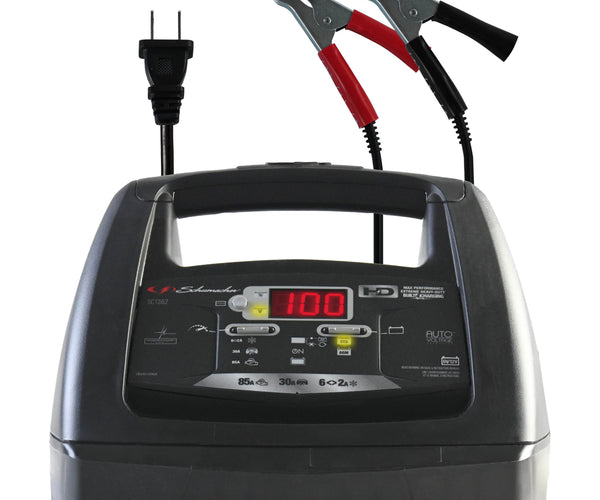
Your needs, this model
Does it fit your priorities?
Can the SC1362 handle a small 6 V AGM battery that needs ordinary charging?
The exact product page documents a 2 A 6 V charging and maintaining mode, and the linked manual includes an AGM selection for lead-acid batteries. That supports a one-output 6 V AGM match at a minimum-current request no higher than 2 A. Confirm the battery label and allowed current; the larger Boost and Engine Start numbers are separate modes, and no universal Ah ceiling is published.
Explore this need in the finder →Does its 85 A Engine Start label mean it charges a 12 V battery at 85 A?
No. Schumacher lists 6 A as the ordinary 12 V charging capability and keeps Boost (12–30 A) and 85 A Engine Start separate. The 85 A starting figure cannot satisfy a 7 A ordinary-charge minimum. The manual also requires a vehicle battery to be installed and specifies short cranking periods with a three-minute cool-down.
Explore this need in the finder →Could I leave the SC1362 maintaining a 12 V AGM battery in storage?
The maker describes automatic Charge/Maintain operation and the linked manual says completed charging changes to float maintenance. The manual calls for occasional monitoring and describes an automatic Boost/AGM start if no rate is selected within 30 seconds, so first confirm the actual battery type and mode and do not treat long-term maintenance as a no-monitoring guarantee.
Explore this need in the finder →The Schumacher SC1362 is a corded, single-output 6 V/12 V charger with separate charging, maintenance, battery/alternator checking and 85 A engine-start functions. It documents a 6 A ordinary-charge path for 12 V lead-acid batteries and a 2 A path for 6 V batteries. That can suit a garage needing one bench-style unit, not a cordless jump pack.
Separate ordinary charging from Boost and Engine Start
The exact U.S. page lists 2/6/30/85 A output modes and describes a 6 A-to-2 A 12 V Charge/Maintain path and 2 A 6 V charging. For matching, the ordinary charge ratings are 6 A at 12 V and 2 A at 6 V. The 12–30 A Boost range and 85 A Engine Start rating are separate functions, not routine charge current or safe-rate advice for a particular battery. A 6 V request above 2 A or 12 V request above 6 A cannot rely on those larger figures. Check the battery maker's allowed rate. The page does not document 24 V charging.
Lead-acid only, with an explicit AGM mode
The page names standard, AGM and deep-cycle compatibility, while its separate “Battery Compatibility Type” field says AGM. The linked manual identifies lead-acid STD and AGM modes, describes STD batteries as vent-capped and often labelled low-maintenance or maintenance-free, and warns that standard batteries should not be used for deep-cycle applications. I map only the explicit AGM subtype; “standard” is not converted into flooded, EFB, calcium or all maintenance-free batteries. Confirm the battery label and instructions.
No lithium charging profile or lithium BMS condition is documented. This is not the model to choose for a LiFePO₄ battery on the basis of its 6/12 V labels alone. The page-linked manual also says not to charge a frozen battery and directs marine batteries to be removed and charged ashore; do not infer that the word “marine” means onboard use.
Capacity examples are not a universal Ah limit
The manual's charge-time chart gives examples from 6 Ah to 105 Ah, based on a 50% discharged battery, and prints generic 2/6/8/10 A columns. It establishes neither a universal SC1362 Ah range nor 8 A/10 A SC1362 settings; the exact page lists 2/6/30/85 A. An example time is not a capacity limit.
Display and checks are useful, but not a shop diagnosis
The page lists a digital display, battery/alternator tester and desulfation function. The manual says the display can show voltage or an estimated charge percentage and warns that surface charge may mislead its battery-voltage reading. Its alternator procedure is a specified running-vehicle check, not a load test or diagnosis of every fault. Desulfation may take eight to ten hours and can abort; no recovery outcome is promised.
Know the power-up behavior: if Rate Selection is not pressed within 30 seconds, the manual says a connected battery can trigger automatic charging with Boost selected and AGM set. Check the actual battery type and chosen mode. Maintenance still calls for occasional monitoring. Engine Start uses an installed vehicle battery and grounded 120 V AC, limits cranking to seven seconds and requires a three-minute cool-down; it is not a cordless jump start.
Check bench fit, outlet and leads
The unit has no internal battery. Schumacher lists 120 V AC, 11.6 lb and a 10.27 by 7 by 10.9 inch footprint; these are maker-published values, not measurements from a sample. No IP rating is given. The manual says no rain/snow and requires grounded 120 V AC and ventilation, so plan for dry indoor use.
The page specifies a six-foot power cord and booster cables, then separately lists “Cable Reach: 6 ft” without clarifying whether that means DC clamp leads. Confirm actual lead length, outlet route, bench clearance, package and seller condition. Schumacher lists one charger, one manual and a one-year limited warranty; verify the offer's terms.
Bottom line
For a portable one-bank lead-acid setup, the SC1362's documented 12 V/6 A and 6 V/2 A charge plans, maintenance mode, display and separate starting assistance make it more versatile than a small maintainer. The tradeoffs are a 120 V corded setup, an 11.6 lb bench unit, a limited documented subtype match, no universal Ah ceiling, and a startup behavior that can begin Boost after a short delay. It is a poor fit if you need lithium support, wet-weather use, an onboard charger, multiple simultaneous battery outputs, an ordinary charging rate above its voltage-specific rating, or a standalone jump pack. This assessment is based on the exact manufacturer page and linked manual, not on hands-on testing.
Sources: Schumacher SC1362 product page; its linked owner’s manual 0099002227E-00; and the maker’s model summary.
Key specifications
Key details at a glance
| Output battery voltages | 6 / 12 V |
|---|---|
| Supported chemistries | lead_acid |
| Independent battery outputs | 1 |
| Arrangement | Portable plug-in charger |
Use the exact model’s instructions for operating limits, supplied equipment and version differences.
Sources for this review
Sources for this assessment
- Frozen Schumacher U.S. battery-charger collection record for SC1362
- Current U.S. Schumacher SC1362 product page
- Manual 0099002227E-00 directly linked from the exact SC1362 page; cover lists UL models 102-8 and 102-14
- Schumacher manufacturer model summary, SC1362 entry
- U.S. CPSC Schumacher manufacturer recall index, scoped check for SC1362
- Exact page-associated Schumacher SC1362 product image

Keep the next step evidence-led
Use the finder to combine voltage, battery chemistry, charging job and setup requirements; then check the exact model and its manual.