
Your needs, this model
Does it fit your priorities?
What does the SC1361's 50A label mean compared with its regular charging mode?
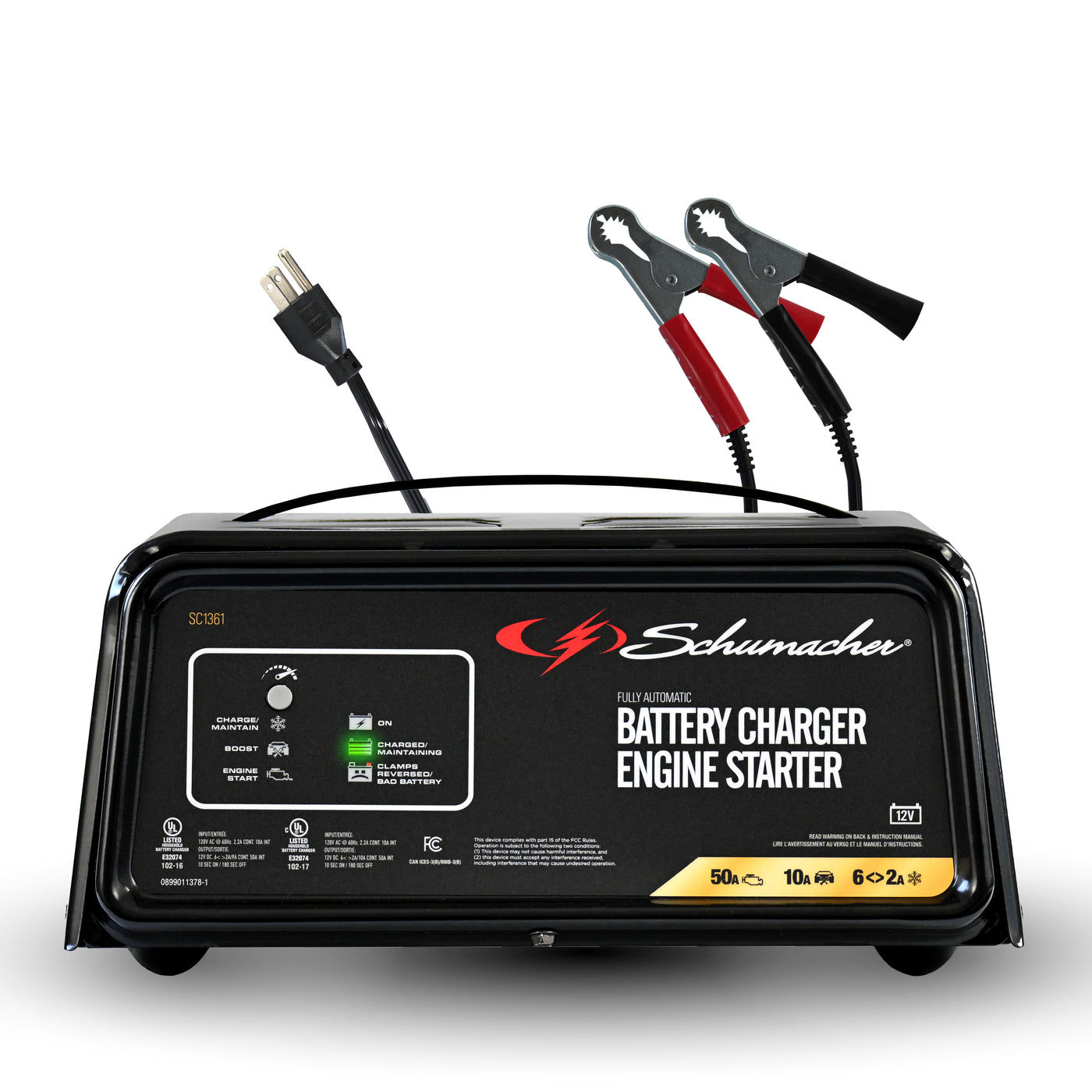
The exact image, page text and manual separate the functions: 6↔2A Charge/Maintain, 10A Boost before an engine-start attempt, and 50A Engine Start. Use 6A only as a maximum documented ordinary-charge capability, not a battery-specific safe-rate recommendation. The 50A setting is cranking assistance with a battery connected, not 50A routine charging or cordless jump-start power.
Explore this need in the finder →Which battery and voltage plan is established for the SC1361?
The directly linked instructions say 12V lead-acid Standard or AGM. The exact page title and charger face say 12V, while an extracted output icon says 6V/12V; the manual does not establish 6V. The Amazon retail copy claims LiFePO4, but no lithium profile or BMS condition appears in the page-linked manual. This assessment matches only AGM within the questionnaire's specific lead-acid subtypes and does not select the SC1361 for 6V or lithium.
Explore this need in the finder →Can the SC1361 be left on a charged AGM battery as a fixed-rate maintainer?
It automatically moves to Maintain when charging is complete and supplies a small current when needed, but the manual gives no fixed float-current value or universal Ah ceiling. If maximum maintain current is required continuously for 12 hours the charger aborts; the manual calls for occasional monitoring. Remove unintended battery loads, use a grounded outlet and follow the battery maker's instructions.
Explore this need in the finder →The SC1361's prominent numbers describe different jobs: a 6-to-2 A Charge/Maintain selector, separate 10 A Boost and 50 A Engine Start settings. The U.S. collection card emphasizes 6 A and 12 V while the product URL emphasizes 50 A; the page body, linked manual and image show one model with distinct modes, not a 50 A routine charger.
This is a desk-based assessment of the manufacturer page, its directly linked instructions, the exact page-associated image and a directly inspected single-unit retail listing. No unit was purchased, used, tested or measured. Page presence does not establish stock or the contents of an individual seller offer.
Read the three current ratings as three different functions
The product title, description, front-panel image and linked manual support a 12 V charger whose Charge/Maintain control is marked 6↔2 A. The manual says the current adjusts according to battery size. Six amperes is therefore the highest documented ordinary-charge capability used in this review's minimum-current filter; it is not a promise of continuous 6 A delivery, a battery-maker-approved charging rate, or a claim that all batteries should be charged at that level.
Boost adds energy before Engine Start; the 50 A setting is separate cranking help for a weak or run-down battery. The manual says to use it only with a battery installed, limits each crank attempt to three seconds and calls for a three-minute wait before another try. If a charged battery still will not start the vehicle, do not use Engine Start; have the battery checked. This corded charger needs AC power and has no internal battery, so it is not a self-contained jump pack.
One current-page specification field lists “2/10/50A,” which omits the 6 A charging figure stated in the title, product description, manual's 6↔2 A selector and the exact face label. The page also has a 6 V/12 V output icon despite a 12 V title, explicit 12 V output field and directly linked manual. Rather than treating the higher mode labels as ordinary charging or inferring an undocumented voltage configuration, this assessment follows the specific charge selector and manual: 12 V lead-acid only, with 6 A as its upper ordinary-charge capability.
What the manual supports—and leaves open
The page-linked owner manual tells the user to charge 12 V lead-acid Standard or AGM batteries. AGM is the subtype explicitly named in both the page and manual, so it is the only specific lead-acid subtype selected here. “Standard” is not enough to label the charger for flooded/wet, EFB, maintenance-free or calcium batteries. The Amazon listing's separate LiFePO₄ wording does not supply a lithium charging profile or BMS condition in Schumacher's linked instructions, so it is not used as a lithium match.
After automatic charging, the manual says the SC1361 switches to Maintain and supplies a small current when needed. It gives no fixed float-current figure or universal capacity ceiling. If maximum maintain current is needed continuously for 12 hours, the charger aborts; occasional monitoring is also required because drains or poor connections can cause excessive demand. This may suit a healthy storage battery whose setup can be checked, but it does not establish fit for every large battery or connected load. No usable universal Ah range is given.
Power, placement and footprint
This portable one-output unit is not an installed multi-bank charger. The exact product image shows one red-and-black clamp pair, AC plug and steel-colored housing. Schumacher lists 9.5 lb and dimensions of 11.13 by 10.66 by 5.19 inches. Its six-foot “cable reach” field does not say whether it refers to the AC cord or DC leads, so check the actual reach for your parking layout.
Power access is a real requirement. The manual calls for a properly grounded nominal 120 V circuit and says an extension cord is not recommended. It also says not to expose the unit to rain or snow, to set it on a dry, nonflammable surface in a ventilated area, and never to charge a frozen battery. A marine battery must be removed and charged ashore; a marine-use mention in marketing is not permission for a wet onboard installation. The product page says “No Rating” for IP, so there is no published ingress-protection rating to soften those restrictions.
Identity, package and buying checks
The SC1361 title/handle conflict is about emphasis, not a demonstrated second model: the collection identifies SC1361 as a 6 A, 12 V charger/maintainer; the page body and image identify the same SC1361 as also having 10 A Boost and 50 A Engine Start. The official page directly links manual 0099001890-02, which supports the mode split but prints family codes on its cover rather than the retail model. Its exact product photo visibly says SC1361 and makes the three functions easier to distinguish. That image is evidence of the pictured model and labels, not proof of every seller's package.
A directly inspected Amazon U.S. listing identifies a one-unit SC1361 by both model and manufacturer part number and lists a charger plus manual; the page also shows a pack-of-two option. No featured offer was displayed at inspection, so this review makes no availability or price claim. Before ordering, confirm the SC1361 label and manual, grounded 120 V access, an AGM battery maker-approved rate, actual clamp reach and seller return terms.
The SC1361's useful distinction is its combination of a documented 6 A 12 V charging path and separate boost/start assistance in one AC-powered case. Its tradeoffs are equally practical: only one battery channel, no confirmed six-volt or lithium plan, no universal Ah ceiling or fixed float-current specification, and dry, grounded, ventilated setup requirements. The 50 A figure is the engine-start rating, not the charging capability to compare against a battery's recommended charge current.
Key specifications
Key details at a glance
| Output battery voltages | 12 V |
|---|---|
| Supported chemistries | Lead-acid |
| Rated DC charging current | 6 A |
| Independent battery outputs | 1 |
| Arrangement | Portable plug-in charger |
| Included connection | The exact official image shows one red/black clamp pair and an AC plug. The manufacturer package line lists the unit and manual; confirm exact seller package and cable reach. |
Use the exact model’s instructions for operating limits, supplied equipment and version differences.
Sources for this review
Sources for this assessment
- Frozen Schumacher U.S. battery-charger collection observation for SC1361
- Current U.S. Schumacher SC1361 product page, browser-extracted text
- Owner manual 0099001890-02 directly linked from the SC1361 page
- Exact-page official image of the Schumacher SC1361
- CPSC Schumacher manufacturer index checked for SC1361

Keep the next step evidence-led
Use the finder to combine voltage, battery chemistry, charging job and setup requirements; then check the exact model and its manual.