
Your needs, this model
Does it fit your priorities?
Does the 200 A figure describe everyday charging?
No. The 200 A rating is the short Engine Start mode; 40 A is a separate Boost mode. The linked manual distinguishes both from 6↔2 A Charge/Maintain and sets short cranking and cooldown limits. Schumacher's technical output summary gives a continuous 2 A path at 6 V, but its aggregate 6 A/2 A listing does not make the 200 A or 40 A values ordinary charging current.
Explore this need in the finder →Is the SC1353 documented for a 6 V or 12 V AGM battery?
The detailed manufacturer description/specification and linked manual support 6 V and 12 V lead-acid use, including AGM. The current product page's short title says 12 V while its detailed description says 6/12 V; its automatic-voltage-detection claim also sits beside a manual instruction to set the correct voltage. Confirm the battery label, delivered manual and panel setting. Only the 6 V/2 A continuous path has a voltage-specific current value in this assessment.
Explore this need in the finder →Can the SC1353 stay installed or serve several batteries at once?
No. The SC1353 is a wheeled portable 120 V AC charger with one clamp pair, not a multi-bank or on-board charging system. The linked manual requires a grounded outlet and a dry, ventilated location and says marine batteries must be removed and charged ashore. Check the installed equipment instructions before attempting marine or on-board charging.
Explore this need in the finder →Is there a documented SC1353 LiFePO₄ mode?
No lithium charging plan is documented by the exact product page and linked manual. The manual's stated battery scope is 6 V/12 V lead-acid Standard or AGM. Do not infer a LiFePO₄ mode or BMS condition from the separate 40 A and 200 A labels.
Explore this need in the finder →This is a source-based assessment, not a hands-on test. I compared Schumacher’s current U.S. SC1353 page with the manual that page links and the exact page-associated product image. The manual’s cover is generic rather than model-labelled, so the manufacturer page is the bridge between it and this exact model.
Where the SC1353 makes sense
The SC1353 is a corded, wheeled charger for one battery at a time. Its appeal is the combination of routine charging and maintenance with a much larger, separate boost/start function. That makes it a different sort of tool from a small maintainer or a compact bench charger: the cabinet and wheels suit a garage location, while the ordinary charging job still depends on a grounded 120 V outlet and the battery’s own charging instructions.
Schumacher describes 6 V and 12 V use, a 6 A-to-2 A Charge/Maintain selection, a 40 A Boost mode and a 200 A Engine Start mode. Those numbers are not interchangeable. The 40 A mode is for adding charge to a deeply discharged battery before starting; Engine Start supplies brief cranking assistance with a battery installed. The linked manual limits cranking to short intervals and calls for a three-minute cooldown after three minutes in Engine Start. Neither 40 A nor 200 A should be read as the routine charge current.
Routine charging is the smaller number
For ordinary use, the manual separates its 6↔2 A Charge/Maintain setting from Boost and Engine Start. It says automatic charging changes to Maintain after the battery is full, then delivers a small current when needed. It does not give a fixed float-current value, a universal amp-hour ceiling, or a battery-specific safe charging rate. Its example charge times assume a half-discharged battery and vary with battery age and condition; they are not a promise that every battery of the listed size is a fit.
The manufacturer’s technical output summary identifies a continuous 2 A 6 V path, so that is the only voltage-specific routine-current figure used in the finder. The page also presents 6 A and 2 A in aggregate, but its current allocation is not sufficiently clear to encode a 12 V minimum-current value. If you require a documented 12 V current floor, the SC1353 will not be counted by that numeric filter. That conservative result reflects an unassigned rating in the available documentation, not proof the charger cannot charge a 12 V battery. The finder also leaves it out when an amp-hour limit is specified, because no universal SC1353 capacity ceiling is stated.
Battery and voltage checks matter
The page-linked manual says to use the charger only with rechargeable 6 V or 12 V lead-acid batteries in Standard (STD) or AGM mode. Standard and AGM are its battery-type selections; I do not treat those labels as evidence for gel, EFB, calcium, or a lithium profile. The product page mentions deep-cycle batteries, but the manual’s explicit supported modes are still STD and AGM; confirm the exact battery instructions rather than treating “deep-cycle” as a separate charger setting.
There is a meaningful documentation mismatch: the current page promotes automatic voltage detection and describes 6/12 V output, while the linked manual tells the user to determine the battery voltage and set the output selector. The same page’s short title calls the product a 12 V charger even though its detailed description and specification list 6/12 V. Use the current manual supplied with the actual unit and confirm the voltage and mode at the control panel before connecting it. No LiFePO₄/BMS plan is documented here, so this is not a supported lithium recommendation.
Garage setup, not an installed boat charger
The linked manual calls for a properly grounded nominal 120 V circuit, ventilation around the battery, and a dry location; it says not to expose the charger to rain or snow and not to charge a frozen battery. It also says a marine battery must be removed and charged ashore; charging one aboard requires equipment designed for that purpose. The product page’s mention of marine batteries is not permission to install this wheeled AC unit on a boat.
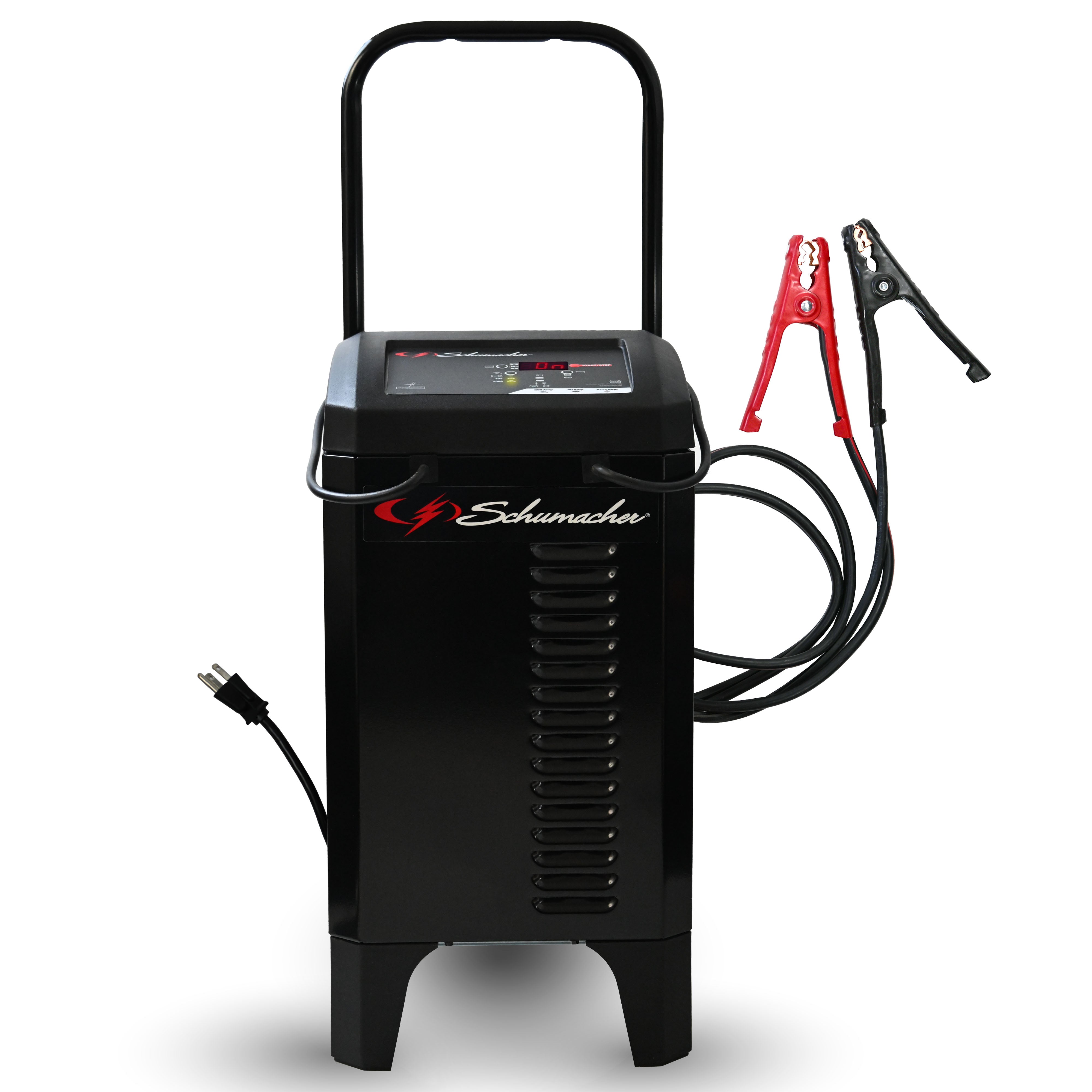
The pictured unit has one clamp pair, and neither page nor manual documents independent banks or an on-board installation. Think of it as one charger-to-battery connection, not several outputs because it has several operating modes. The manufacturer’s page versions also disagree on the cabinet’s weight and dimensions, so I would not plan a shelf, vehicle compartment, or tight parking space from those inconsistent figures. Check the delivered unit’s actual footprint and keep enough room for the manual’s ventilation instructions.
What to compare before choosing
For a confirmed 6 V AGM lead-acid battery and a one-output portable setup, the documented 2 A Charge/Maintain path is the clearest finder fit. A 12 V owner may still find the SC1353 worth examining if the wheeled format, tester and separate boost/start functions matter, but should verify the exact ordinary-charge rate and battery compatibility in the supplied manual instead of selecting by the 200 A headline. A compact portable charger may be easier to store; a dedicated multi-bank or installed charger is more appropriate when multiple batteries must remain connected or marine charging happens on board.
The image is useful for identifying the cabinet and its clamp arrangement, not for reading the model number or measuring reach. The page lists a one-year limited warranty and a charger-plus-manual package, but a third-party seller’s condition and included accessories still need checking. Confirm the exact SC1353 nameplate, the manual version, the battery maker’s permitted charge rate, the grounded outlet and the space available. If those conditions are unresolved, pause and verify rather than treating a feature headline as a compatibility guarantee.
Key specifications
Key details at a glance
| Output battery voltages | 6 / 12 V |
|---|---|
| Supported chemistries | Lead-acid |
| Independent battery outputs | 1 |
| Arrangement | Portable plug-in charger |
Use the exact model’s instructions for operating limits, supplied equipment and version differences.
Sources for this review
Sources for this assessment
- Schumacher U.S. Automotive Battery Chargers collection card for SC1353
- Current Schumacher Electric SC1353 U.S. product page; exact product-card link from the official collection
- Schumacher Electric SC1353 6/2/40/200 A 6/12 V product specifications and directly linked manual
- Manual 0099001927E-02 linked directly from the exact SC1353 page; generic Automatic Battery Charger booklet
- Exact official product image associated with the current SC1353 product page

Keep the next step evidence-led
Use the finder to combine voltage, battery chemistry, charging job and setup requirements; then check the exact model and its manual.