
Your needs, this model
Does it fit your priorities?
Does the SC1352 document a regular 12 V AGM charge/maintain plan?
Yes. Its exact page and page-linked manual document the 12 V 6<>2 A Charge/Maintain setting, and the manual explicitly identifies AGM. The 24 V selections are Boost and Engine Start, not ordinary charging; follow the battery maker's permitted charge rate and monitor the process.
Explore this need in the finder →Can its separate 24 V boost/start modes count as a 24 V charger plan?
No for routine battery charging or maintenance. The page-linked manual limits Charge/Maintain to 12 V; 24 V is offered for Boost and Engine Start, which are separate momentary functions and are not used as a 24 V charging match.
Explore this need in the finder →Does the manual set an Ah maximum for an automotive battery?
No universal ceiling is stated. The manual includes example charging times, including a 105 Ah marine battery, and warns that a battery that is too large may abort; neither detail defines a maximum Ah rating for this exact model. The capacity filter therefore does not treat the SC1352 as a known-capacity match.
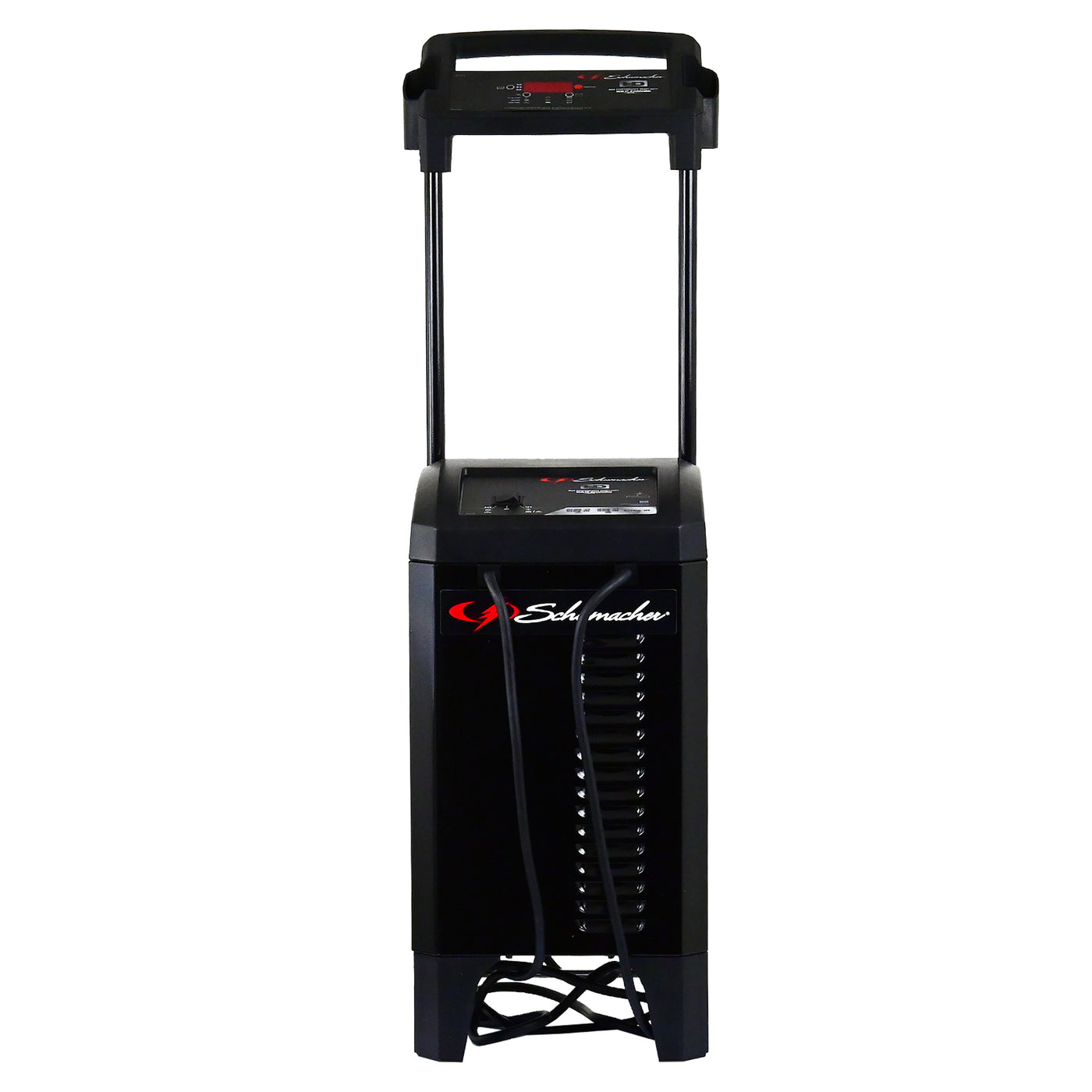
Explore this need in the finder →The current U.S. Schumacher page identifies SC1352 as a wheeled, 120 V AC charger and engine starter. Its ordinary charge/maintain path is for a 12 V lead-acid battery; the 24 V numbers belong to separate Boost and Engine Start selections. This is a source-based assessment of the maker's exact product page, the manual linked from that page and its associated image—not a hands-on test or a claim about a particular seller's box.
Keep the 12 V charge setting separate from Boost and Engine Start
Schumacher describes several jobs in one cabinet: a 12 V 6-to-2 A Charge/Maintain mode, 12 V 40 A and 24 V 20 A Boost modes, plus separate 12 V 250 A and 24 V 125 A Engine Start modes. The owner's manual calls the ordinary setting “6<>2A CHARGE/MAINTAIN (12V only)” and describes Boost as a pre-start energy addition. The high Boost and starter ratings are not charge-current alternatives and should not be added to the 6 A charge figure.
That distinction matters if “24 V” appears on the marketing title or product page. The manual's base switch offers 24 V Boost and Engine Start, but it does not document 24 V routine charging or maintenance. The finder therefore records only a 12 V charge/maintain plan. A request for a 24 V battery charger is not answered by the SC1352, even though it has separate 24 V assistance modes. The page also describes battery and alternator tests and a desulfation function; those are supplementary features, not additional battery banks or a DC device-supply mode.
Read the unusual power-up instructions before leaving it connected
For a 12 V automatic charge, the linked manual says the unit changes to maintenance after charging is complete. It also calls for occasional monitoring, rather than promising that every battery and vehicle can be left unattended. If the charger must provide its maximum maintenance current continuously for 12 hours, it can abort; the manual points to a battery problem or a continuing electrical load as possible causes.
There is a less obvious instruction worth checking before use: after power-up, if no button is pressed for ten minutes and a battery is connected, the manual says the unit can change from tester to charger with Boost rate and Gel type selected. This is not the same thing as a deliberately selected, completed 12 V charge followed by maintenance. Read the supplied procedure, choose the intended battery type and mode, and stay with the setup; do not assume that the word “automatic” means an unattended, already-correct default. The manual is directly linked by the exact model page and identifies UL Model 106-4, also listed on that page, but its cover does not print the retail name SC1352.
Lead-acid profiles are documented; an Ah ceiling is not
The linked manual restricts charging to lead-acid batteries and discusses STD, AGM, GEL and deep-cycle use. AGM and GEL are explicit questionnaire subtypes. The manual describes its STD batteries as having vent caps and says they may be marked low-maintenance or maintenance-free, but it does not call them “flooded/wet” or establish every battery sold as maintenance-free. This assessment therefore does not silently translate STD into the flooded, EFB, calcium or maintenance-free filters. Lithium is not listed as supported. The 6 A equipment rating is a capability screen, not a recommendation that a particular car battery should be charged at 6 A; follow the battery maker's rate and profile instructions.
The manual's table gives charge-time examples, including a 105 Ah marine battery, and says a battery that is too large may cause an abort. It does not state 105 Ah—or any other example—as a universal SC1352 charge limit. The numeric capacity filter leaves this model out when a visitor enters an Ah requirement because the maximum is unknown, not because the source proves a particular size incompatible. Its marine guidance is also specific: remove a boat battery and charge it ashore unless using equipment designed for on-board marine charging.
A wheeled garage station, not a compact maintainer
The current product page lists 37.6 lb and a body 12.94 inches wide, 39.59 inches high and 15.09 inches deep. Those are Schumacher's published figures, not measurements taken here. The tall wheeled format can be moved around a work area, but it takes storage space and is a different proposition from a small charger tucked beside a vehicle. The same page lists a 120 V AC input, a 7.5-foot power cord and six-foot booster cables. Check the outlet location and actual route to the battery before relying on those lengths.
The page's package summary names the charger and owner's manual; the linked manual's assembly instructions list a handle and screws and say the Phillips screwdriver is not included. Confirm that the exact offer includes the handle, hardware and clamp leads and that the delivered model label is SC1352. A page says the unit has a one-year limited warranty and “No Rating” for ingress protection. Do not interpret that as weatherproofing or as the seller's return policy.
Plan for a grounded, dry and ventilated location
The linked manual calls for a properly grounded nominal 120 V receptacle, a dry nonflammable surface and clear ventilation. It says not to expose the charger to rain or snow. Its lead-acid safety instructions warn about explosive gases and require the user to observe the vehicle and battery makers' connection procedures; keep leads clear of moving belts and fans. The page's “wheeled” convenience does not make the charger suitable for wet outdoor use or for permanent boat installation.
Who should compare the SC1352
It is worth comparing when the task is a 12 V lead-acid charge/maintain job, a wheeled workshop format is useful, and the user wants separate Boost, starter and testing functions in the same AC-powered unit. It is a poor match for an ordinary 24 V charger, a lithium charger, a two-battery independent-bank setup, an outdoor installation, or a buyer who needs a verified maximum Ah value before screening. Before ordering, confirm the exact SC1352 label, the manual revision and assembly pieces, the intended battery profile and charge rate, outlet grounding, dry placement and the seller's package and return terms. The manufacturer's mode list is useful for comparing capabilities; it does not establish charging speed, a safe rate for your battery or performance on a real vehicle.
Schumacher SC1352 product page · Page-linked owner's manual 0099001959E-02.
Key specifications
Key details at a glance
| Output battery voltages | 12 V |
|---|---|
| Supported chemistries | Lead-acid |
| Rated DC charging current | 6 A |
| Independent battery outputs | 1 |
| Arrangement | Portable plug-in charger |
| Included connection | The product page describes six-foot booster cables and heavy-duty clamps; its package line lists the unit and owner's manual. The linked manual lists the handle and screws for assembly and says a Phillips screwdriver is not included. Confirm that the exact seller package contains the handle/hardware and clamp leads. |
Use the exact model’s instructions for operating limits, supplied equipment and version differences.
Sources for this review
Sources for this assessment

Keep the next step evidence-led
Use the finder to combine voltage, battery chemistry, charging job and setup requirements; then check the exact model and its manual.