
Your needs, this model
Does it fit your priorities?
Does the SC1341 charge a 12 V AGM battery at 6 A?
The current SC1341 product title and image show a 6 A 12 V charge path. Its 20 A Boost and 100 A Engine Start figures are separate modes, so they do not count as routine charge current. A single portable 120 V output can meet a one-bank AGM request at a 6 A minimum if the battery maker permits that rate. No universal amp-hour ceiling is documented.
Explore this need in the finder →Can the SC1341 maintain a 12 V Gel battery after charging?
The manual directly linked from the current SC1341 page describes automatic charging followed by float maintenance and includes a Gel selection; the exact product image also shows a Gel mode label. It says float maintenance supplies a small current as needed and recommends occasional monitoring, but gives no fixed float-current value or no-checks guarantee. Use grounded 120 V AC, a dry and ventilated location, and the battery maker's instructions.
Explore this need in the finder →Can I use the SC1341 on a LiFePO4 battery or a 24 V battery?
There is no confirmed match for either request. The current product page's prose claims LiFePO4 support but conflicts with its directly linked manual's lead-acid-only instruction, while the title and exact model image identify a 12 V SC1341. The page's SC1341L wording is also inconsistent with the product form/SKU. Do not infer a lithium profile, BMS condition or 24 V capability; ask Schumacher to clarify the exact model and manual before use.
Explore this need in the finder →The Schumacher SC1341 is a corded, single-output 12 V charger with a separate 20 A Boost setting, 100 A Engine Start mode and automatic maintenance after charging. Its ordinary charging path is the important number for battery selection: the current model page and panel identify 6 A charging and a 2 A maintenance stage. The higher Boost and starting figures are different jobs, not a way to treat it as a 20 A or 100 A routine charger.
Read the mode labels as separate functions
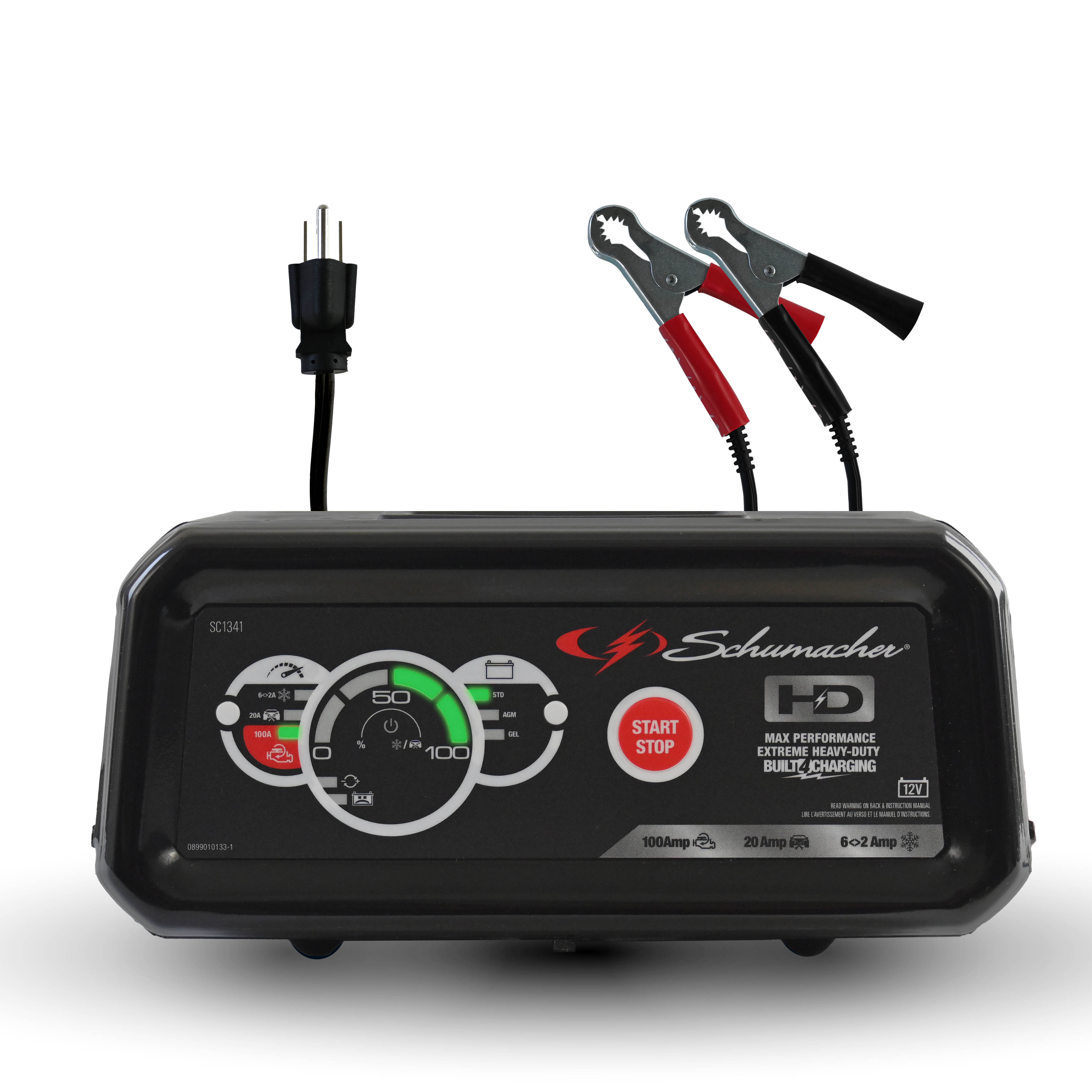
The exact U.S. SC1341 page lists a 6 A charger, 20 A Boost and 100 A Engine Starter; its pictured panel shows 12 V and those separate mode labels. The linked manual calls ordinary charging “6<>2A Charge,” separates Boost from Engine Start, and says automatic charging changes to maintenance when complete. Together, these sources support 6 A ordinary charging for a 12 V battery and a lower maintenance stage. The 20 A and 100 A figures are not routine charging rates. Follow the battery maker’s permitted current.
Boost is separate from regular charging and Engine Start is corded. The manual requires a battery installed in the vehicle, a Start/Stop press, a short crank and a three-minute cooling interval. It warns against using this feature without a connected battery. The SC1341 is not a cordless jump pack or power supply, and it cannot diagnose every no-start condition.
Conservative chemistry and voltage fit
For matching, SC1341 is treated as a 12 V lead-acid charger. Its title and image say 12 V; the linked manual describes lead-acid use and Standard, AGM and Gel modes. The exact page names AGM compatibility; the manual and model face also indicate Gel. Only AGM and Gel are mapped. “Standard” is not converted into every flooded, EFB, calcium or maintenance-free subtype, and “deep-cycle” is an application, not another chemistry.
Several page paragraphs call the item “SC1341L” and claim LiFePO₄ support, although the title, form/SKU, barcode and image identify SC1341. The linked manual says to use it only with lead-acid batteries and provides no lithium profile or BMS condition. Lithium is excluded from confirmed matches rather than inferred from conflicting copy. Verify the exact model label and manual with Schumacher before using it on LiFePO₄.
One portable outlet; plan the setup
This bench-style unit needs grounded 120 V AC. Its exact image shows one red/black clamp pair and a mains plug. The page specifies a six-foot AC cord, but a separate “Cable Reach” field also says six feet without identifying which cable; DC clamp-lead length is unverified. The manual calls for dry, ventilated use, prohibits rain/snow exposure and says to remove marine batteries and charge ashore. “Marine” does not mean on-board rated.
Follow the battery and vehicle manufacturers’ connection procedures, wear eye protection and avoid sparks near lead-acid batteries. The manual forbids charging a frozen battery and describes float maintenance as a small current when needed, with occasional monitoring. It gives no fixed float-current value or no-checks guarantee. Check the delivered manual and label: package copy alternates between SC1341 and SC1341L.
Capacity, size and what the sources do not settle
The manual’s sample charge-time table assumes batteries at 50% discharge and uses generic 2/6/8/10 A columns. It is not a universal SC1341 Ah range; the finder therefore does not claim a fit for a user-entered capacity. Whether 6 A is suitable depends on battery condition, chemistry and the battery maker’s instructions.
The maker page advertises reverse-polarity protection, multi-stage charging and a one-year limited warranty; these are not test results. The manual’s desulfation section is no guarantee that a damaged or end-of-life battery can be restored. Check the exact SC1341 label, manual revision, lead reach, package and seller warranty.
Who should consider it
Consider the SC1341 if you need a portable, mains-fed 12 V charger for one lead-acid battery, an ordinary 6 A charge path suits that battery, and you value having separate maintenance, Boost and vehicle-connected starting modes in one chassis. It is a poor match if you need a documented 6 V or 24 V plan, more than 6 A of ordinary charging, a second bank, an on-board installation, a defined high-Ah limit, wet-weather operation, or confirmed lithium support. The maker’s conflicting SC1341/SC1341L wording should be resolved against the delivered label and manual before using any disputed capability. This review is based on current manufacturer sources and an exact-model image, not hands-on use or performance testing.
Sources: Schumacher’s SC1341 product page, its directly linked owner’s manual 0099001947E-03, and the maker’s model summary. Where the page and manual disagree, the uncertainty is retained rather than resolved by inference.
Key specifications
Key details at a glance
| Output battery voltages | 12 V |
|---|---|
| Supported chemistries | lead_acid |
| Independent battery outputs | 1 |
| Arrangement | Portable plug-in charger |
Use the exact model’s instructions for operating limits, supplied equipment and version differences.
Sources for this review
Sources for this assessment
- Frozen Schumacher U.S. battery-chargers collection record for SC1341
- Current U.S. Schumacher SC1341 product-page observation
- Official Shopify product JSON for the current Schumacher SC1341 page
- Manual 0099001947E-03 directly linked from the exact SC1341 product page
- Schumacher manufacturer model-summary entry for SC1341
- Exact current-page Schumacher SC1341 product image
- Official Schumacher SC1341 mode infographic
- Dated U.S. CPSC Schumacher manufacturer recall index


Keep the next step evidence-led
Use the finder to combine voltage, battery chemistry, charging job and setup requirements; then check the exact model and its manual.