
Your needs, this model
Does it fit your priorities?
Can the SC1340L charge and maintain a 6 V AGM battery with a maker-listed 6 A charge setting?
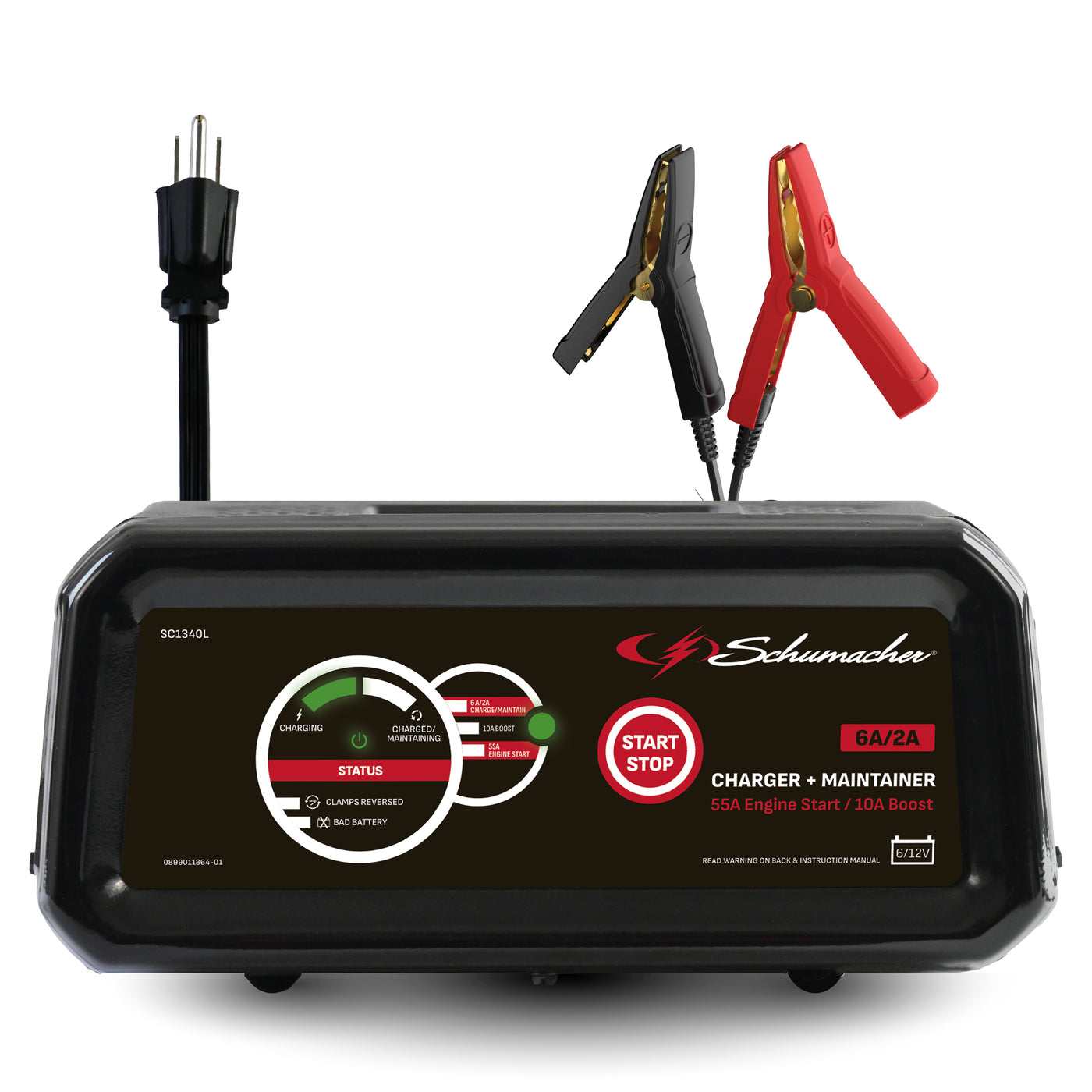
The exact U.S. product page and its image are titled/labeled SC1340L, and the page-linked manual covers 6 V lead-acid AGM use with a 6A<>2A Charge/Maintain selector. The 6 A value is a selectable capability, not guaranteed continuous output or a safe-rate recommendation for every battery. The manual cover does not print the product code, so verify the delivered SC1340L label and instructions.
Explore this need in the finder →Does the 55 A Engine Start figure mean it charges a battery at 55 A?
No. The exact product page and labeled face image separate 55 A Engine Start from 10 A Boost and 6 A/2 A Charge/Maintain. The linked manual describes Engine Start as a cranking mode that must be used with a battery in the vehicle. The 55 A figure is not ordinary charge current; the matcher will not include this model for a 7 A minimum ordinary-charge request.
Explore this need in the finder →Can I rely on this SC1340L page to select it for a LiFePO₄ battery, and what BMS condition does it require?
Not on the evidence available here. The product page says 12 V lithium/LiFePO₄ is compatible, but its directly linked owners manual instructs charging only 6 V or 12 V lead-acid batteries and gives no lithium profile or BMS condition. Until Schumacher reconciles the page and manual, this assessment treats lithium suitability and BMS requirements as unresolved and does not match the charger to a lithium battery.
Explore this need in the finder →The Schumacher SC1340L is a compact, corded charger/maintainer with separate engine-start and Boost functions. The current U.S. product page and its page-associated image identify it as SC1340L, but the embedded Shopify SKU, a source-reported product identifier and one package line use SC1340. This assessment follows the exact page's public SC1340L name while keeping that conflict visible; check the label, SKU and instructions on the exact offer rather than assuming a retailer's package from the page title.
Keep its four amperage labels in separate jobs
The page body and the labeled face image describe 6 A/2 A Charge/Maintain, 10 A Boost and 55 A Engine Start. The directly linked manual calls the ordinary charging selection 6A<>2A Charge, then treats Boost and Engine Start as separate functions. One structured output-current line on the same product page instead lists 2/10/55 A and omits the ordinary 6 A selection. The labels therefore need context: this review uses 6 A as the maker-listed ordinary-charge capability for a minimum-current comparison, but not as guaranteed continuous output or advice that 6 A is safe for every battery. Follow the battery maker's permitted rate and the instructions for the delivered charger.
The larger figures do not raise that charge-current threshold. Boost adds energy before an engine-start attempt; Engine Start supplies cranking amps and the linked manual says to use it with a battery installed in the vehicle. The 55 A label does not make this a batteryless jump pack or a 55 A routine charger. At a 7 A minimum ordinary-charge request, the SC1340L falls below the documented Charge setting. Its automatic transition from charging to maintenance is a separate use after charging; the manual describes a small current when needed, not a fixed 2 A float current.
Lead-acid use is supported; lithium use remains unresolved
The manual linked directly by the SC1340L page specifies 6 V and 12 V lead-acid batteries and names Standard, AGM, GEL and deep-cycle applications. AGM and Gel are the subtypes explicitly represented in the finder plans. The manual's broader Standard and deep-cycle wording is not silently translated into the separate flooded/wet, EFB, maintenance-free or calcium choices. For a 6 V or 12 V AGM or Gel battery, the manual's ordinary-charge and maintenance instructions are useful fit evidence, subject to the battery maker's own limits.
There is a material conflict on lithium: the product-page promotional copy says 12 V LiFePO4 is compatible, while the directly linked owners manual instructs users to charge 6 V and 12 V lead-acid batteries only. That manual does not supply a LiFePO4 charging profile or state whether a built-in BMS is required. Until Schumacher reconciles the page and operating instructions for the exact labeled unit, this assessment does not recommend the SC1340L for lithium under either BMS answer. A matching voltage by itself is not enough to establish chemistry support.
Capacity and maintenance limits are not stated as one number
The manual provides example charging times, including entries up to 105 Ah under a 50% discharge assumption, but it does not set a universal Ah ceiling. Those examples are not a promise about charge time or proof that 105 Ah is the maximum compatible battery. The numeric-capacity field therefore stays unknown: the finder will not claim that this model meets a requested Ah limit, while also not declaring a larger battery physically incompatible.
After automatic charging, the manual says the charger moves to maintain mode and provides a small current when necessary. It calls for occasional monitoring and does not identify a fixed continuous maintenance current. A maintainer cannot correct an abnormal vehicle drain or a failing battery, and the mode labels do not remove the need to follow battery-specific instructions.
Plan for an outlet, one battery and a dry location
This is a portable plug-in charger, not an on-board installation. The page specifies 120 V AC and says the unit must remain plugged in during use; its linked manual requires a properly grounded nominal 120 V circuit. The face image shows one red/black clamp pair, so Boost and Engine Start are not extra battery outputs: the reviewed arrangement is one bank at a time. The maker lists the unit at 10.5 lb and 10.89 by 10.89 by 5.09 inches; these are page specifications, not independent measurements or clearance requirements. The page's generic six-foot cable-reach line does not clarify DC clamp-lead length, so check the exact cord and lead arrangement before planning where the charger can sit.
The manual says not to expose the charger to rain or snow, to provide ventilation, and never to charge a frozen battery. A marine battery must be removed and charged ashore; the product page's marine application language does not make this an on-board marine charger. The product page lists no IP rating. These limitations make a dry, ventilated garage setup with grounded power a more defensible use than an outdoor, unattended, on-board or weather-exposed installation.
Compare by the charging task, not the start rating
The SC1340L is a plausible shortlisting choice on paper when a single 6 V or 12 V lead-acid AGM/Gel battery, a 6 A/2 A charge-and-maintain selector, and separate plug-in Boost/Engine Start functions fit the intended job. It is not the right way to shop for multiple independent batteries, documented lithium support, a higher ordinary charge-current threshold, a stated Ah ceiling or marine on-board use. A reviewed Schumacher SC1326 offers a different wheeled form with its own 6 A/2 A Charge/Maintain path and larger separate Boost/Start labels; compare those two exact reviews by form factor and documented setup, not by the biggest printed amp number.
The current product page links a 17-page owners manual whose cover lists certification-family codes 102-18 and 102-19, not SC1340 or SC1340L. The manual is valuable page-linked operating evidence, but verify that the delivered unit's manual matches its label. The same page's identity details also need care: the title/body and visible face say SC1340L, the embedded SKU is SC1340, and package wording alternates between the two. The page describes a one-charger/one-manual package and a two-year limited warranty, but it does not establish a seller's live stock, delivered condition, return terms or warranty eligibility. Before ordering, confirm the exact model label, current instructions, battery chemistry and permitted charge rate, grounded outlet, dry ventilated position, usable cable reach and seller terms.
This is a source-based desk assessment, not a hands-on test. No physical unit was purchased, operated, measured or load-tested.
Key specifications
Key details at a glance
| Output battery voltages | 6 / 12 V |
|---|---|
| Supported chemistries | Lead-acid |
| Independent battery outputs | 1 |
| Arrangement | Portable plug-in charger |
Use the exact model’s instructions for operating limits, supplied equipment and version differences.
Sources for this review
Sources for this assessment

Keep the next step evidence-led
Use the finder to combine voltage, battery chemistry, charging job and setup requirements; then check the exact model and its manual.