
Your needs, this model
Does it fit your priorities?
Can the SC1339L-titled offer charge a 12 V AGM lead-acid battery at a documented 10 A capability?
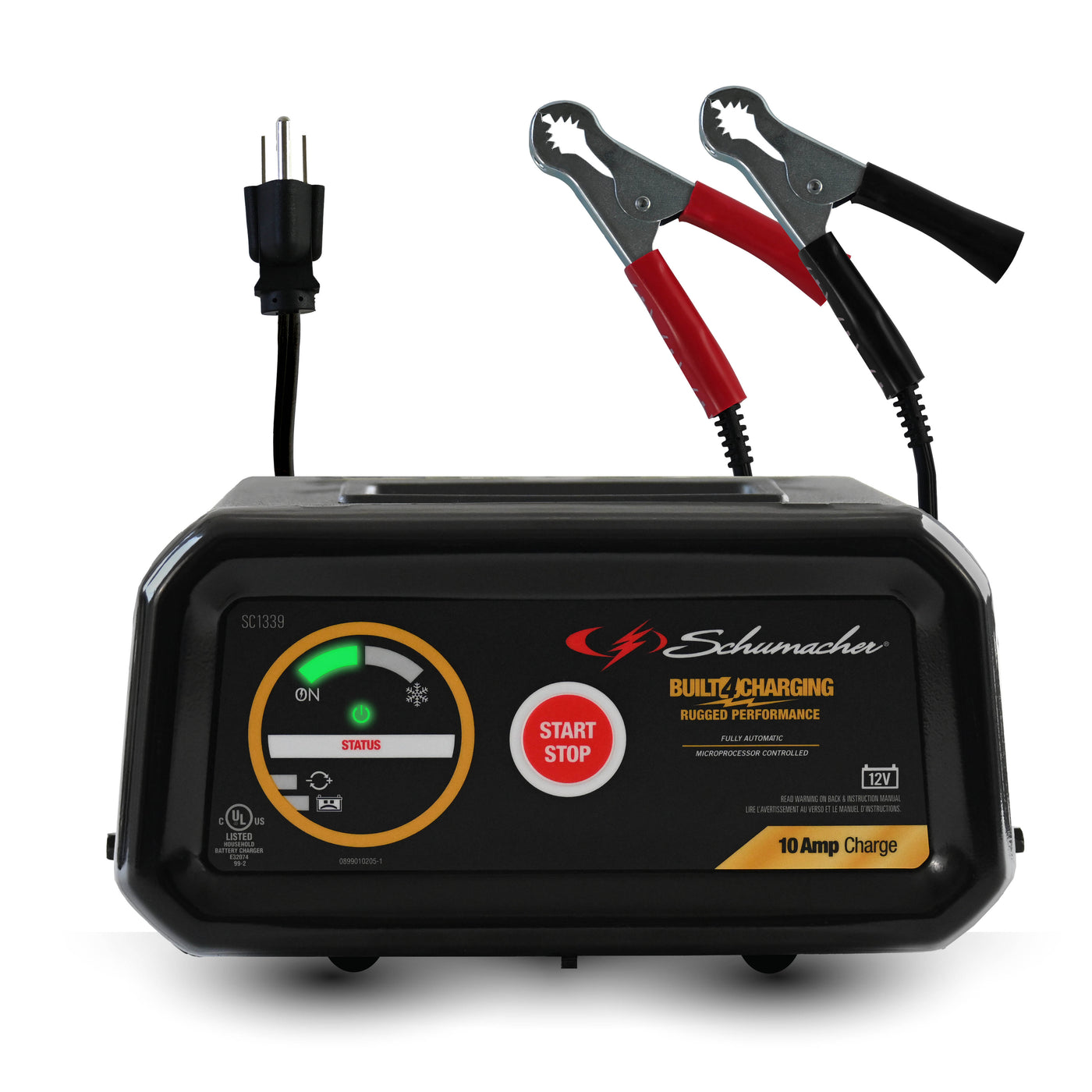
The current page title and output-current specification say 10 A, the associated face image labels 12 V and 10 Amp Charge, and the page-linked instructions name 12 V lead-acid and AGM. The manual says current adjusts with battery size, so this is a maximum capability screen, not a continuous guarantee or battery-safe-rate recommendation. Verify the delivered SC1339/SC1339L label and instructions.
Explore this need in the finder →Can this offer maintain a charged 12 V AGM battery after charging?
The page-linked manual says automatic charging switches to Maintain after charge completion and describes supplying a small current when needed. It does not state a fixed float current, a universal Ah ceiling, or approval for every battery size; the page's 2 A line is not a maintenance-rate specification. Follow the battery maker's instructions and monitor the setup as directed.
Explore this need in the finder →Should the SC1339L-titled page's LiFePO4 copy be used to select it for lithium?
Not from the evidence available. Promotional page copy says LiFePO4, but the directly linked manual says to use the charger for 12 V lead-acid batteries and gives no lithium profile or BMS condition. The assessment therefore excludes lithium and leaves the BMS requirement unknown until the manufacturer reconciles the exact offer.
Explore this need in the finder →Who this charger may suit
The observed Schumacher offer is presented on the U.S. manufacturer page as the SC1339L: a portable, corded 10 A charger and maintainer for a single 12 V battery. Its useful documented path is routine charging followed by automatic maintenance, not a high-current engine-start function or a fixed multi-bank installation. The distinction matters because a bright amperage label does not say whether that rate is appropriate for a particular battery. Check the battery maker’s voltage, chemistry, and permitted charging current before connecting it.
This is a desk-based reading of the manufacturer page, its linked instructions, and the page-associated image. No unit was bought, operated, tested, or measured. The maker’s current reference page is not a promise that a seller has stock or will supply a particular package.
What the charging path supports
The exact page title and pictured front panel identify a 10 A, 12 V charger; the page’s specification block also lists 10 A output. The page-linked manual describes an automatic charger whose current adjusts to battery size and whose completion stage switches to maintenance. Its charging-time table includes several rate columns, including 10 A, but does not establish that the charger holds 10 A continuously in every condition. This assessment therefore uses 10 A as a documented maximum ordinary-charge capability for a minimum-current screen, not as a guaranteed output or a recommendation for every 12 V battery.
The linked instructions say to use the charger only on 12 V lead-acid batteries, naming Standard and AGM. Because “Standard” does not identify a more specific subtype in the questionnaire, only the explicit AGM type is matched. The product page’s promotional copy also claims LiFePO₄ compatibility, and its specification block says 6/12 V; those statements conflict with the linked manual’s 12 V lead-acid-only instruction. This review does not treat the offer as a lithium charger, infer a lithium BMS condition, or match it to a 6 V battery.
After an automatic charge, the manual describes a maintain mode that supplies a small current when needed. It does not publish a fixed float-current rating or a universal battery-capacity ceiling. Its example charging times, including a 105 Ah marine example, are not an Ah limit. A numeric capacity request therefore cannot be answered by assuming that example is a maximum. The maintenance stage also does not establish compatibility with every battery size or an unattended guarantee if the battery or vehicle has a drain.
Identity and specification conflicts to check
The current collection row, page title, description, and package wording use SC1339L, while the page’s product-form code and the visible face of its associated image say SC1339. The image is genuinely associated with that page, but it does not settle which suffix a seller will deliver. A 14-digit identifier appears in a field labelled “gtin8”; that label/value combination is retained as reported, not normalized into a verified standard identifier. Confirm the physical label, manual, and seller’s exact model designation rather than treating SC1339 and SC1339L as interchangeable.
Other page fields deserve the same caution. A feature line says the unit delivers 2 A for charging and maintaining, while the product title, output-current specification, and pictured panel identify a 10 A charger. The same specification block says 6/12 V even though the page title, charger face, and linked manual support a 12 V-only interpretation. The manufacturer page and its linked manual also disagree about lithium support. For matching, the conservative reading follows the 10 A/12 V identity corroborated by the face label and manual’s 10 A table, includes only explicit AGM lead-acid support, and leaves the 2 A statement, 6 V claim, lithium claim, and any model suffix equivalence unresolved.
Setup and limits
This is a portable mains unit, not an on-board charger: its manual requires a grounded nominal 120 V AC circuit. The page says the package includes the charger and manual and lists a six-foot cable reach, but the product page contains other inconsistent package details; verify which cable and clamps are actually supplied. The photographed assembly shows one red-and-black clamp pair and an AC plug, which supports a one-output visual description but does not prove a seller’s box contents.
Placement is a real constraint. The manual says not to expose the charger to rain or snow, to use a ventilated area, and never to charge a frozen battery. It also requires marine batteries to be removed and charged ashore; a marine mention in product copy is not permission for an on-board installation. Follow the vehicle and battery instructions for connection order and ventilation, keep leads away from moving parts, and stop if the charger reports a fault rather than repeatedly attempting an aborted charge.
Buying checks
Before ordering, compare the offered label and manual against the SC1339L-titled page, since both the pictured unit and product-form code show SC1339. Check that the actual unit is for 12 V lead-acid, that AGM support is documented for the delivered version, that the included clamp and AC leads reach the intended location, and that grounded power is available. Do not rely on the page’s LiFePO₄ or 6 V text without a model-specific correction from Schumacher. For long-term maintenance, confirm that the battery and vehicle have no incompatible loads and plan for the occasional monitoring called for by the instructions.
The appeal is a relatively direct 10 A, single-output 12 V charging path with automatic post-charge maintenance. The tradeoffs are the unresolved suffix and page-copy conflicts, the absence of a published capacity ceiling or fixed float current, and the dry, grounded-AC installation limits. Verify the exact offer rather than buying by amperage headline alone.
Key specifications
Key details at a glance
| Output battery voltages | 12 V |
|---|---|
| Supported chemistries | Lead-acid |
| Rated DC charging current | 10 A |
| Independent battery outputs | 1 |
| Arrangement | Portable plug-in charger |
| Included connection | One red/black clamp pair and AC plug are visible in the official page-associated image. The page says the charger and manual are included; verify exact seller package and DC lead reach because the product form and image face use SC1339 while the page title/package use SC1339L. |
Use the exact model’s instructions for operating limits, supplied equipment and version differences.
Sources for this review
Sources for this assessment
- Dated Schumacher U.S. Battery Chargers collection row titled SC1339L
- Current U.S. Schumacher product page titled SC1339L with product-form identity conflicts
- Owner manual 0099001953-03 linked from the SC1339L-titled page
- Official image linked from the current SC1339L-titled Schumacher page
- CPSC Schumacher manufacturer recall index checked for this model review

Keep the next step evidence-led
Use the finder to combine voltage, battery chemistry, charging job and setup requirements; then check the exact model and its manual.