
Your needs, this model
Does it fit your priorities?
Can the SC1326 serve a 6 V AGM battery when I want at least a listed 6 A charging setting?
The exact U.S. page identifies SC1326 and documents 6/12 V output with a 6 A/2 A Charge/Maintain choice; its page-linked manual names lead-acid AGM and 6 V use. The 6 A figure is a listed selectable capability, not a continuous-output guarantee or a recommended safe rate for every battery. Use the battery maker's instructions and confirm the delivered label, controls and manual, whose cover uses family designators rather than SC1326.
Explore this need in the finder →Can the SC1326 maintain a 12 V Gel battery after automatic charging?
The current page describes automatic charge-to-maintain and the directly linked manual names Gel lead-acid use and says the unit maintains 6 V and 12 V batteries after charge completion. It calls for occasional monitoring and does not publish a fixed continuous float current; do not interpret the 2 A selector as a measured float rate. The manual also says not to charge a frozen battery or expose the charger to rain or snow.
Explore this need in the finder →Does the SC1326's 275 A Engine Start label mean it charges a 12 V battery at 275 A?
No. Schumacher lists the ordinary 6 A/2 A Charge/Maintain selector separately from 40 A Boost and 12 V Engine Start; the 275 A figure is a short-duration start-mode rating, not ordinary charge current. The manual requires a battery installed in the vehicle for Engine Start. It also describes voltage-based battery/alternator checks, not a load test or a substitute for a qualified diagnosis.
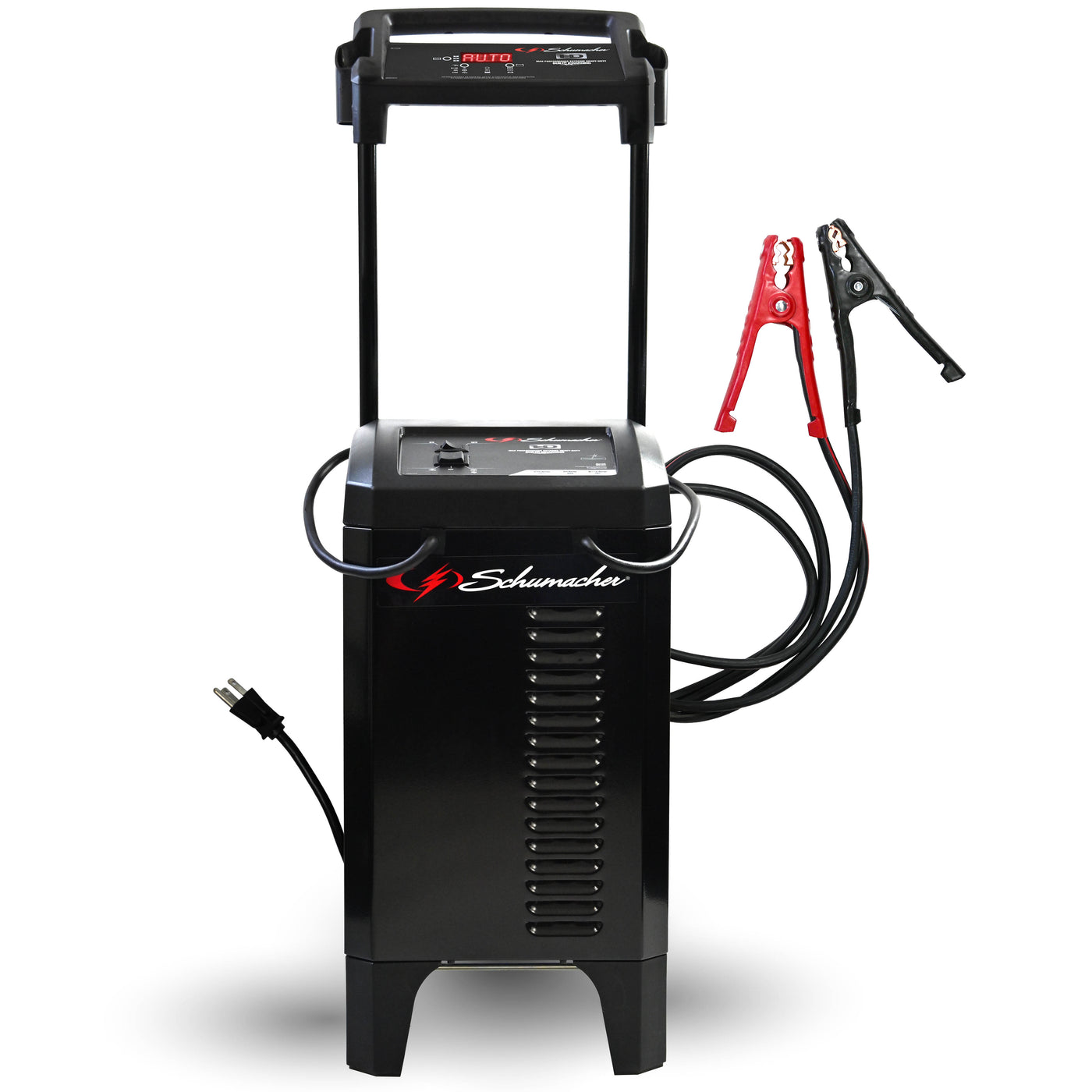
Explore this need in the finder →The Schumacher SC1326 is a corded 6/12 V lead-acid charger in a tall, wheeled case, with a few jobs beyond ordinary charging. Its current U.S. product page identifies SKU SC1326 and GTIN-8 00026666813266, while the page-linked owner's manual supplies the operating instructions. This is a source-based assessment, not a hands-on test; the maker's page describes a 6 A/2 A Charge/Maintain selector, a separate 40 A Boost setting and separate Engine Start ratings of 125 A at 6 V and 275 A at 12 V.
Keep the rate modes separate
For normal charging, the SC1326 offers a 6 A or 2 A Charge/Maintain choice. The manufacturer's linked manual presents that selector separately from Boost and Engine Start, then describes an automatic move into maintenance after charging. I count 6 A as the largest listed ordinary-charge capability for a minimum-current screen; it is not a promise of continuous output or a recommendation for a particular battery. The battery maker's allowed rate still controls. The separate 40 A Boost setting is for adding energy before an Engine Start attempt, while the 125 A/275 A ratings describe cranking output. Neither figure should be added to the ordinary charging rate.
The manual says to use Engine Start only with a battery installed in the vehicle. That makes this a plug-in charger/starter, not a batteryless jump pack. It also means the large start rating is useful only in a compatible setup with power available; it does not make the SC1326 a portable roadside energy source.
What the battery support does—and does not—establish
The linked instructions cover 6 V and 12 V lead-acid batteries and name Standard, AGM, GEL and deep-cycle applications. AGM and GEL are explicit subtype matches here. The manual's broad Standard label is not silently converted into the finder's distinct flooded/wet, EFB, maintenance-free or calcium choices. No lithium profile or BMS condition is documented, so an apparently compatible voltage is not enough to use this unit with a lithium battery.
The manual's charging-time chart gives examples for a few battery sizes and starting conditions, including a 50% discharge assumption. It is guidance about example charging times, not a universal Ah ceiling for the SC1326. Accordingly, the capacity field remains unknown; the finder will not claim an Ah-specific match merely because a number appears in the chart, without asserting that a larger battery is physically incompatible. Under a fixed portable 12 V AGM Charge task with the 6 A floor and one bank, compare the 100 Ah and 101 Ah results; this model is unconfirmed at both numeric capacity answers. Check the battery manufacturer's permitted charging current and the exact charger instructions, especially when battery capacity or condition is unusual.
Maintenance and built-in checks are convenience features, not a diagnosis
After an automatic charge, the manual says the unit changes to maintain mode and describes keeping 6 V and 12 V batteries charged. It also calls for occasional monitoring. The maker does not publish a fixed float-current value for this mode, so the selector's 2 A label should not be mistaken for a measured, continuous maintenance current. If a healthy battery or vehicle has an unexpected drain, a maintainer cannot make that underlying problem disappear.
The SC1326 also has a battery-voltage display and an alternator-performance procedure. The manual cautions that a voltage reading alone can be misleading, and its alternator procedure requires a running engine and directs users with out-of-range readings to a qualified technician and the vehicle manual. Treat these as basic checks, not a load test, a full battery-health report or a substitute for diagnosis. The page and manual describe desulfation as an automatic response to a potentially sulfated battery, but the manual notes it may take hours and can abort. It is not a promise to revive a damaged battery.
Plan around a heavy, mains-powered unit
Schumacher lists the SC1326 at 39.15 lb and 14.13 by 13.5 by 24.13 inches. Its handle and wheels are useful if the intended storage and work area can accommodate a cart-style charger; those dimensions are not independently measured here. The product page lists a 7.5 ft AC cord and 6 ft output leads, so check the actual parking position and reach before purchase rather than assuming the charger can sit wherever convenient. One clamp pair is one output: 6 V and 12 V are alternative voltage settings, not extra independent banks.
The unit requires nominal grounded 120 V AC. The manual advises against extension cords unless necessary and gives cord-size instructions if one is used. It also calls for ventilation and a dry surface, says not to expose the charger to rain or snow or charge a frozen battery, and requires a boat battery to be removed and charged ashore. It is therefore not an on-board marine charger or an outdoor-weatherproof choice. The manufacturer's page currently describes a one-charger/one-manual package and a one-year limited warranty, but a current reference page does not establish seller stock, delivered condition or the terms a particular seller will honor.
Who should compare it with another model?
The SC1326 is most compelling on paper when the buyer has compatible lead-acid batteries, a grounded outlet and space for a wheeled machine, and values the built-in voltage checks, Boost and Engine Start functions alongside ordinary charging. It is a poor match if the primary need is a compact low-current maintainer, a fixed on-board installation, several independent battery outputs, lithium charging, an outdoor-rated case or a published Ah ceiling. In this reviewed library, the SC1280 is a different two-voltage rapid charger with a higher page-listed 12 V ordinary-charge figure but a much lower 6 V figure; the SC1364 is a different, 12 V-only wheeled option. Compare those exact profiles rather than selecting by their starting-amp labels.
Before buying, confirm the physical model label, the current manual for that unit, the battery chemistry and voltage, permitted charging rate, usable lead reach, outlet/grounding, dry ventilated location, and package, warranty and return terms. The latest manual linked by the SC1326 page lists family designators 106-2/106-3 on its cover rather than the retail SKU. That page-to-manual association is useful operating evidence, but the printed-code difference is a reason to check the delivered documentation, not to transfer specifications from a sibling charger.
Key specifications
Key details at a glance
| Output battery voltages | 6 / 12 V |
|---|---|
| Supported chemistries | lead_acid |
| Independent battery outputs | 1 |
| Arrangement | Portable plug-in charger |
Use the exact model’s instructions for operating limits, supplied equipment and version differences.
Sources for this review
Sources for this assessment
- Current Schumacher U.S. automotive charger collection card for SC1326
- Current exact Schumacher SC1326 U.S. product page and embedded variant record
- Automatic Battery Charger manual directly linked from the exact SC1326 page, document 0099001958-02
- Official image associated with the exact Schumacher SC1326 product page
- CPSC Schumacher manufacturer page, limited model-name observation

Keep the next step evidence-led
Use the finder to combine voltage, battery chemistry, charging job and setup requirements; then check the exact model and its manual.