
Your needs, this model
Does it fit your priorities?
Can the SC1325 maintain a 6 V AGM battery in storage?
The exact SC1325 page names 6/12 V lead-acid compatibility and a 6 A<>2 A charge/maintain path with float monitoring; it also names AGM. Its directly linked automatic-charger manual describes float maintenance and says to monitor during extended use, but the cover lists UL 101-11/cUL 101-12 while the product page lists 102-11/102-12. The matcher therefore records the exact-page 6 V AGM maintenance capability, but verify that the delivered manual matches the SC1325 label before leaving a battery connected for storage.
Explore this need in the finder →Is the SC1325 a 40 A or 250 A everyday charger?
No. Schumacher's exact page and model summary distinguish 6 A<>2 A charge/maintain, 40 A Boost and a separate Engine Start rating (125 A at 6 V and 250 A at 12 V). The 6 A charging plan, not the Boost or crank figure, is the documented ordinary charge-current ceiling used for matching. Choose a rate only if it fits the battery maker's instructions; the 250 A rating is not proof of a battery-free jump pack.
Explore this need in the finder →Can I use the PDF linked from the SC1325 page as an exact-model manual?
The current product page links manual 0099002429, but the manual cover says UL 101-11 and cUL 101-12 while the exact page's certification fields say UL 102-11 and cUL 102-12; the cover does not print SC1325. That is an unresolved document-to-configuration bridge, not a basis for substituting a related charger. Confirm the manual and label for the delivered SC1325 before relying on mode-specific operating steps, environmental instructions or claimed protective behavior.
Explore this need in the finder →The Schumacher SC1325 is a rolling, outlet-powered shop charger with more than one job: it documents 6 V and 12 V charging and maintenance, then offers separate Boost and Engine Start modes. That makes it a plausible fit for a garage that wants one wheeled unit for ordinary lead-acid charging and occasional supervised starting assistance. It is not a battery-powered jump pack, and its headline 40 A Boost and 250 A Engine Start numbers do not make it a 40 A or 250 A everyday charger. For routine charging, the current exact model page describes a 6 A / 2 A charge-and-maintain path.
Keep the ratings in their lanes
Schumacher's exact U.S. SC1325 page identifies a 6/12 V automatic charger and names a 6 A to 2 A Charge/Maintain mode. Its 40 A Boost is a separate function for adding energy before an Engine Start attempt; the page assigns the 250 A starting figure to 12 V and 125 A to 6 V. Those are not interchangeable outputs. If your everyday requirement is more than 6 A of ordinary battery charging, the SC1325 does not meet it simply because one of its other modes is rated at 40 A or 250 A. Conversely, a request for a documented 6 A maximum charge path should not be mistaken for advice that every battery should be charged at 6 A. Check the battery maker's accepted rate and the actual battery condition first.
The manufacturer page says the charger handles 6 V and 12 V standard, AGM, gel and deep-cycle batteries. Its linked manual also describes only lead-acid charging and names STD, AGM and GEL. For this comparison, AGM and gel are the narrowly tagged subtypes. A general Standard or deep-cycle phrase is not enough to label every battery as flooded, EFB, maintenance-free or calcium. The page does not document lithium or a lithium BMS condition, so do not treat the SC1325 as a LiFePO₄ charger.
A material manual-identity caveat
The exact product page directly links Schumacher manual 0099002429, but its identification is not cleanly reconciled to the page. The manual cover lists UL model 101-11 and cUL model 101-12; the product page's certification field lists UL model 102-11 and cUL model 102-12. The cover does not print the retail string SC1325. That direct page association is useful evidence, but the model-code mismatch means I do not treat every manual-only detail as a fully confirmed SC1325 specification. Before operating a delivered unit, compare its own label and included manual and obtain the correct instructions from Schumacher if the codes differ. Do not resolve this conflict by borrowing a manual from a visually similar wheeled charger.
The current page independently supports the 120 V AC input, 6/12 V lead-acid use, 6 A / 2 A charge-and-maintain path, 40 A Boost and separate Engine Start ratings. The linked manual gives an example charge-time chart, but examples are not a universal amp-hour ceiling; no SC1325 charging-capacity maximum is established in the reviewed exact-page evidence. Its maintenance function is described as float monitoring rather than a fixed current claim. The 6-in-1 and 4-in-1 labels both appear on the same current page, so a marketing count is not a useful way to compare it with another model.
Think about the physical setup, not just the voltage
This is a wheeled, single-output charger that must be plugged in during use. The exact page lists 120 V AC and no IP rating. The linked manual says not to expose its charger to rain or snow, but the model-code conflict means the delivered SC1325 instructions need to be confirmed before relying on detailed use restrictions. The safe shopping assumption is a dry, ventilated garage location unless Schumacher supplies current instructions for the exact labeled unit. A boat-compatible battery list is not permission to charge a battery aboard a vessel: the linked manual says marine batteries should be removed and charged ashore, and you should confirm the same rule in the exact SC1325 manual.
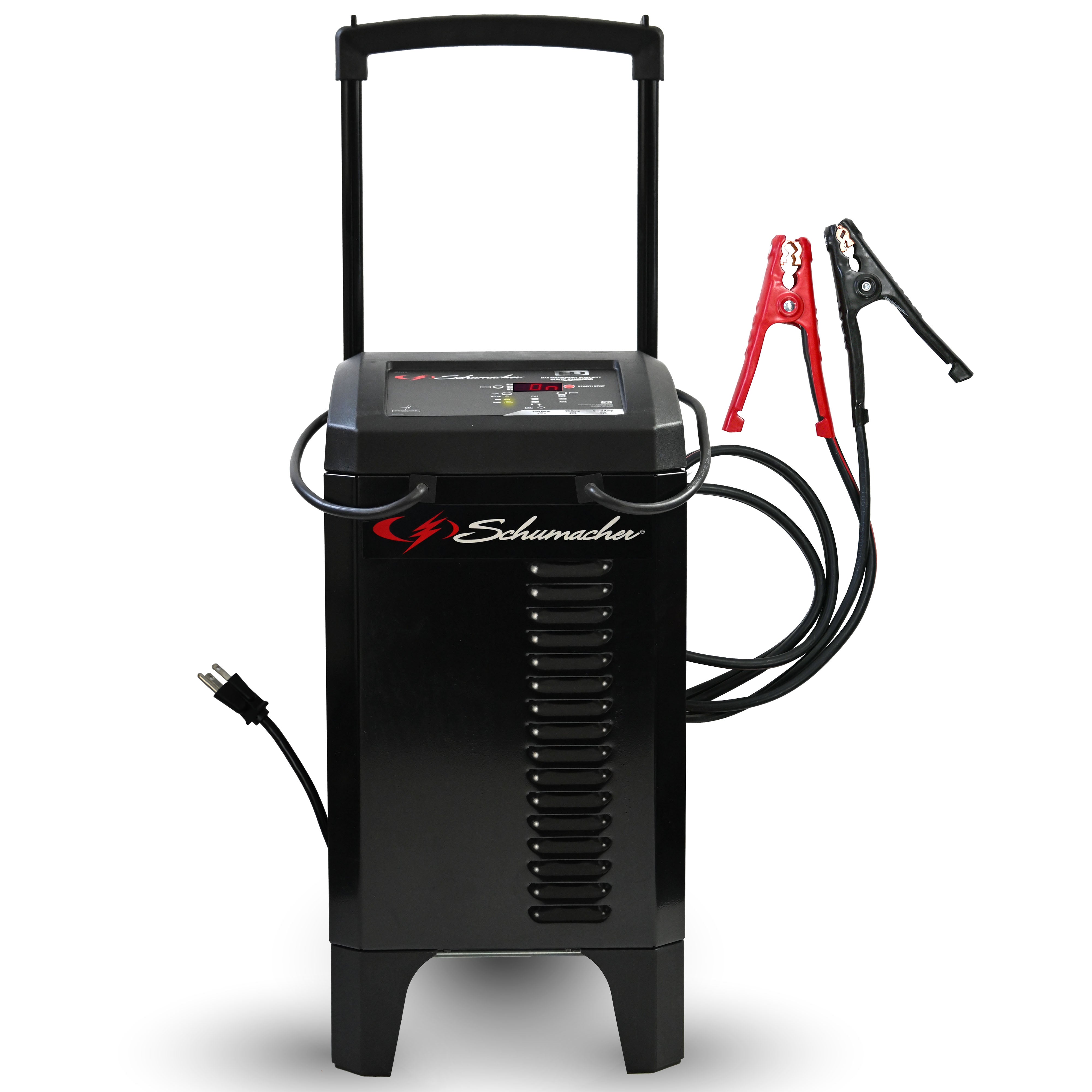
Do not buy it based only on the image or its “wheeled” label. The official image is associated with the exact SC1325 page and shows a tall cabinet, front control head, handle, one clamp pair and AC lead, but the straight-on artwork does not show wheel hardware clearly or prove how far the clamps reach. The specification field says “Cable Reach: 6 ft,” while nearby page copy calls out a six-foot power cord without separately defining clamp-lead length. Treat that as an ambiguity to check with the seller, especially if a vehicle's battery is far from an outlet. The same page lists 28.4 lb and a 34.74 by 11.76 by 10.82 inch envelope; those are manufacturer-published fields, not measurements made for this review, so confirm floor and storage clearance against the exact offer.
Where it differs from neighboring Schumacher models
Compared with the SC1324, the SC1325's clearest documented distinction is 6 V as well as 12 V output; the SC1324's current page is 12 V only. Both are wheeled, plug-in products, but this review does not transfer the SC1324's details to the SC1325. The SC1445 is another 6/12 V wheeled option, but it is a manual charger whose timed session ends when the timer expires; the SC1325 page describes automatic Charge/Maintain operation instead. The SC1400 also documents automatic maintenance and a wheeled format, while its separate Boost and starting labels differ. These are comparisons of published model configurations, not performance tests or recommendations based on hands-on use.
What to verify before choosing it
Confirm the maker label says SC1325, the exact battery is 6 V or 12 V lead-acid, and AGM or gel is the subtype you actually need. Check whether 6 A ordinary charging and a maintenance function suit the battery and how you plan to supervise it. Do not count Boost or Engine Start as routine charge current or assume a model-specific amp-hour ceiling that the sources do not publish. Ask for the manual that matches the physical unit, because the PDF linked from the current page carries UL/cUL model codes that differ from the page's codes. Finally, check outlet grounding, actual charger footprint, AC and clamp-lead reach, carton contents, condition and return terms with the seller. The page's limited warranty is one year; confirm that the offer and seller carry the terms you expect.
Key specifications
Key details at a glance
| Output battery voltages | 6 / 12 V |
|---|---|
| Supported chemistries | Lead-acid |
| Rated DC charging current | 6 A |
Use the exact model’s instructions for operating limits, supplied equipment and version differences.
Sources for this review
Sources for this assessment
- Schumacher current Battery Chargers collection product record, frozen page-one enumeration
- Schumacher Electric current U.S. SC1325 product-page capture
- Manual 0099002429 directly linked from the exact SC1325 maker page; cover models 101-11 and 101-12
- Schumacher Electric SC1325 model-summary listing on the manufacturer patents page
- U.S. CPSC Schumacher manufacturer recall index checked for the observed SC1325
- Official exact-page Schumacher SC1325 product image

Keep the next step evidence-led
Use the finder to combine voltage, battery chemistry, charging job and setup requirements; then check the exact model and its manual.