
Your needs, this model
Does it fit your priorities?
Can the SC1308L charge both 6 V and 12 V batteries?
The exact Schumacher page and its directly linked manual support 6 V and 12 V lead-acid use. Schumacher describes a 2 A 6 V Charge/Maintain path and a 6↔2 A Charge/Maintain selector; the 6 A capability applies to the 12 V routine plan, not every voltage or battery. The manual names Standard (STD) and AGM, but only the explicit AGM type is mapped by the finder. Do not extend that to lithium: current page copy and the LI photo label conflict with the narrower manual.
Explore this need in the finder →Does the SC1308L's 100 A rating mean it charges a battery at 100 A?
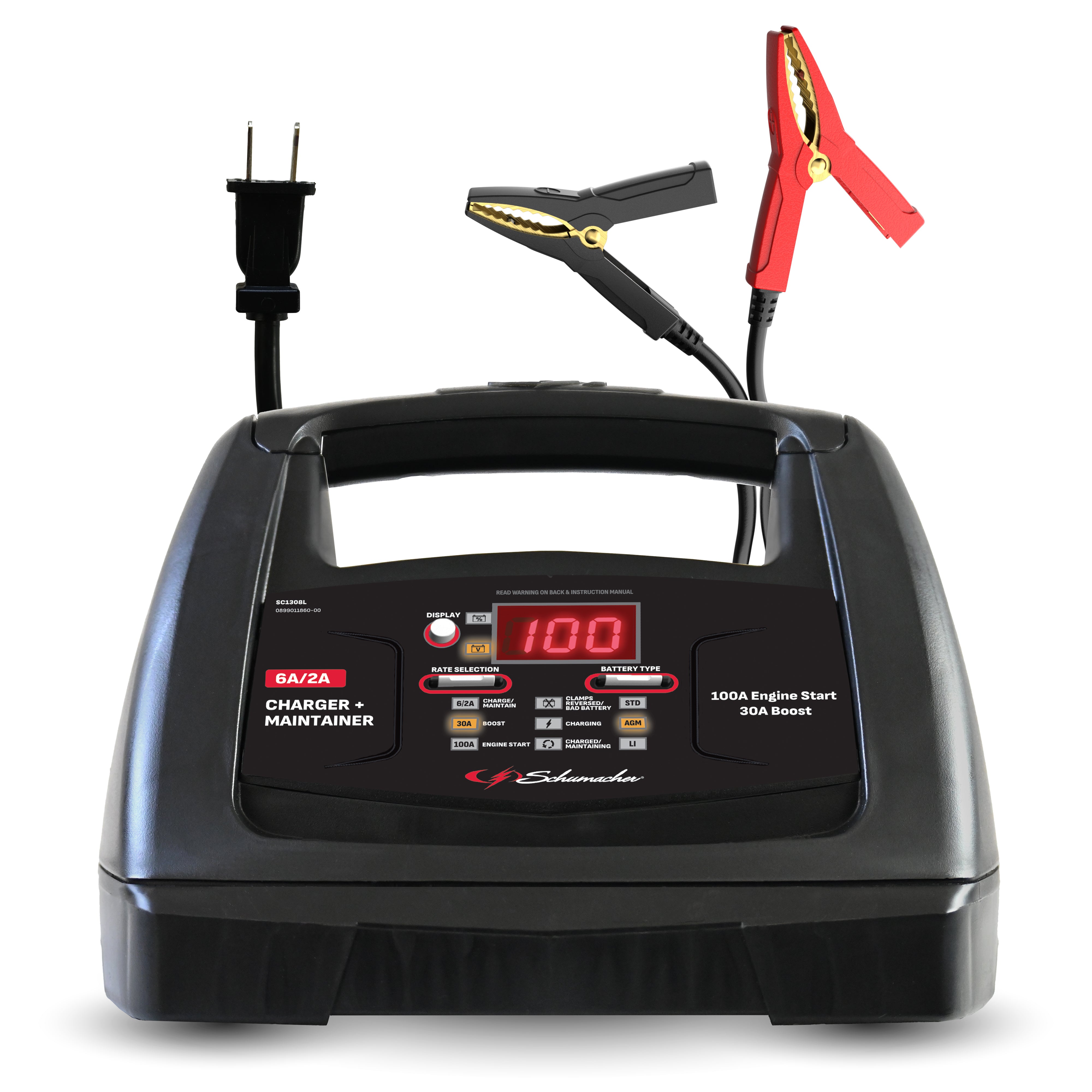
No. The exact product page and front panel separate the 6↔2 A routine Charge/Maintain selector from 30 A Boost and 100 A Engine Start. At 12 V, 6 A is the listed upper ordinary-charge capability; at 6 V the page describes a 2 A routine path. Neither number tells you the correct rate for an individual battery—follow its maker's instructions.
Explore this need in the finder →Can I leave it connected as a maintenance charger?
The page-linked manual says routine charging automatically changes to Maintain and supplies a small current as needed, but it states no fixed float-current value and requires occasional monitoring. If excessive maintenance current is needed for 12 continuous hours, the charger can abort. Treat it as a supervised maintenance tool, not a way to hide a failing battery or vehicle drain.
Explore this need in the finder →What the current Schumacher record establishes
The current U.S. Schumacher product page is titled SC1308L, and the official front-panel image also prints SC1308L. That makes this a model-specific assessment, not a generic SC1308 profile. There is still a naming conflict inside the same manufacturer record: the product form and one contents-in-the-box line say SC1308, and the directly linked 22-page manual, 0099002330-01, does not print the L suffix on its cover. The manual is directly linked from the SC1308L page, so its instructions are relevant evidence, but that page-level version ambiguity should not be hidden. Check the delivered label and its included manual rather than assuming a historical SC1308 listing is interchangeable.
Charge settings are not the starting ratings
For ordinary charging, Schumacher describes a 2 A 6 V Charge/Maintain path and a 6↔2 A Charge/Maintain selection. The manual calls this selector suitable for small and large batteries; the product page says the microprocessor adjusts amperage as needed. The useful comparison is therefore a maximum listed 6 A routine capability at 12 V, not a promise to supply 6 A continuously or a recommendation for every battery. The page also shows 30 A Boost and 100 A Engine Start; those are separate modes, not ordinary charger current. A high engine-start number says nothing by itself about how quickly a depleted battery will charge.
The page's specifications field lists output current as 2/6/30/100 A without allocating every figure to a particular voltage or mode. Its description and face labels are clearer about the distinction between Charge/Maintain, Boost and Engine Start, so this assessment uses only those separated roles. The maker's manual is the place to follow the sequence; the battery manufacturer remains the authority for the battery's appropriate charging rate.
Where the chemistry evidence disagrees
The page and pictured face say/show 12 V lithium (LiFePO₄) and an LI label. But the page-linked manual says to charge 6 V and 12 V lead-acid batteries and describes Standard (STD) and AGM profiles only; it does not explain an LI setting or state a lithium BMS condition. I cannot reconcile that difference from the supplied official instructions. The finder therefore treats only lead-acid, including the explicitly named AGM subtype, as supported. Do not buy or use it for a lithium pack based on the product copy or photo alone; obtain current instructions that explicitly identify this exact model and chemistry first. “Standard” is not stretched to mean every flooded, EFB, calcium or maintenance-free battery subtype.
Maintenance is automatic, not a fixed float-rate promise
After the ordinary charge completes, the manual says the charger switches to Maintain and supplies a small current when needed. It does not state a fixed float-current value. If excessive maintenance current is required for 12 continuous hours, the charger can abort; the manual calls for occasional monitoring because a battery fault, vehicle drain, poor connection or other condition can keep drawing power. This is useful for a compatible healthy battery that needs maintenance, but it is not a remedy for a battery that will not hold charge or a vehicle with an unresolved electrical problem. The manual also describes desulfation behavior; that is not a promise to restore a damaged battery.
Physical and setup tradeoffs
The official image shows one clamp pair, an AC plug and the SC1308L-labeled unit. That is a portable, one-output arrangement rather than an on-board or multi-bank charger. The page calls for a nominal 120 V AC connection, while the linked manual requires a properly grounded outlet, a dry and ventilated work area, and distance from battery gases. It says not to expose the charger to rain or snow, never to charge a frozen battery, and to remove marine batteries for shore-side charging. “Portable” is not the same as weatherproof, battery-powered, or suitable for permanent installation.
Schumacher lists a six-foot cable-reach figure but does not distinguish the AC cord from DC clamp reach in that field. The photograph cannot measure lead length or confirm what a retailer will put in a box. The product page also provides conflicting SC1308/SC1308L package wording, so verify the exact suffix, manual, cord and clamps with the seller before relying on fit or included parts. The published weight and dimensions are page specifications, not independent measurements, and this assessment is not a hands-on test.
Who should consider it
It is worth comparing for someone who needs a portable charger for a 6 V or 12 V lead-acid battery, wants an automatic Charge/Maintain path, and values separate boost, engine-start and tester features in one bench unit. A shopper whose primary need is 12 V AGM charging can compare the listed 6 A routine capability with lower-current maintainers while checking the battery maker's rate limit. For 6 V AGM charging, use the page's 2 A routine path rather than inferring a 6 A setting from its 12 V capability. If you need verified LiFePO₄ support, a BMS condition, an exact fixed float current, a universal Ah ceiling, multiple independent banks or an on-board installation, this evidence does not establish that fit.
There is no price or stock claim here. Schumacher's current manufacturer page is a reference for the named model, not proof that a particular seller has it or will deliver the same package. Compare the model suffix and manual on any offer; do not substitute a similar Schumacher charger just because the 100 A starting number looks familiar.
Key specifications
Key details at a glance
| Output battery voltages | 6 / 12 V |
|---|---|
| Supported chemistries | Lead-acid |
| Rated DC charging current | 6 A |
| Independent battery outputs | 1 |
| Arrangement | Portable plug-in charger |
Use the exact model’s instructions for operating limits, supplied equipment and version differences.
Sources for this review
Sources for this assessment

Keep the next step evidence-led
Use the finder to combine voltage, battery chemistry, charging job and setup requirements; then check the exact model and its manual.