
Your needs, this model
Does it fit your priorities?
Does the SC1307 charge at 85 A during ordinary use?
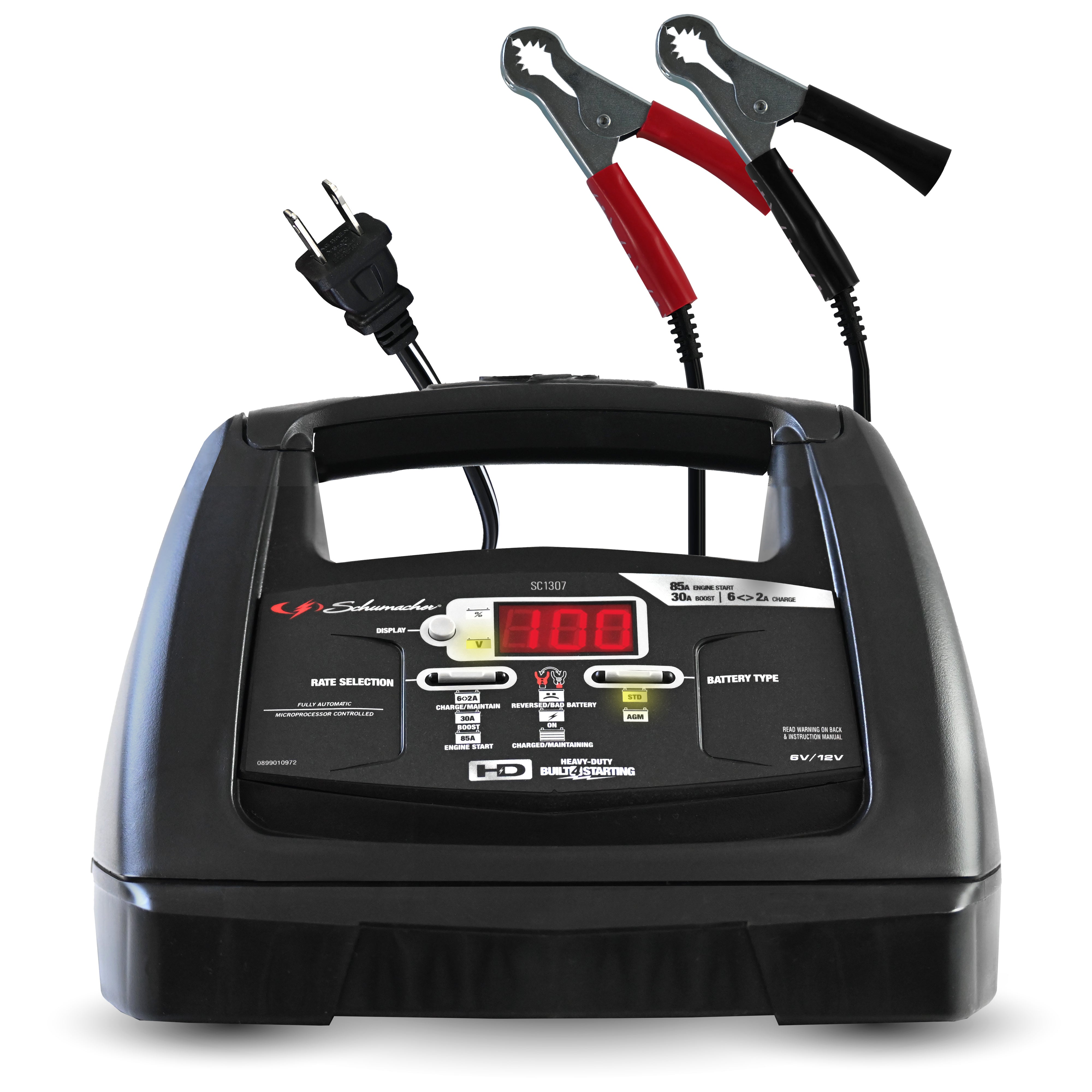
No. The exact SC1307 page and official face image separate 6/2 A Charge/Maintain from 30 A Boost and 85 A Engine Start. The assessment treats the two routine settings as 2 A at 6 V and 6 A at 12 V; 6 A is a listed capability, not a safe-rate prescription. Follow the battery maker's charging limit and verify the current SC1307 face/manual.
Explore this need in the finder →Which batteries and voltage profiles are documented?
The exact page and directly linked 0099002204-00 manual cover 6 V and 12 V lead-acid Standard (STD) and AGM. The manual also lists a 12 V LiFePO4 profile, but only with a BMS and all necessary protection integral to the battery pack. The face photo visibly labels STD and AGM without showing a lithium selector; check the current manual for the unit. Only AGM and the documented BMS-required LiFePO4 plan are subtype-mapped here; Standard does not mean every flooded, EFB, Gel or maintenance-free subtype.
Explore this need in the finder →Can the SC1307 maintain a battery after charging?
For its lead-acid Charge/Maintain setting, the linked manual says the charger switches to Maintain when charge is complete and supplies a small current as needed. It does not state a fixed float-current value, requires occasional monitoring and can abort after excessive maintain current for 12 continuous hours. The 30 A Boost and 85 A Engine Start labels are not maintenance or continuous-charge ratings.
Explore this need in the finder →The Schumacher SC1307 is a corded 6 V/12 V charger with engine-start features, not an 85 A routine charger. Its exact product page and front-panel photo separate the 6/2 A Charge/Maintain setting from 30 A Boost and 85 A Engine Start. The linked instructions document 6 V and 12 V lead-acid use and a 12 V LiFePO4 profile only for a battery pack with its own battery-management system and all necessary protection. This assessment is based on those manufacturer materials, not hands-on testing.
What the ratings do—and do not—tell you
The headline 85 A figure belongs to Engine Start; it is a brief aid for cranking with the vehicle battery still connected. The 30 A Boost is a separate pre-start mode. Neither rating is the ordinary charging current. The panel and manual distinguish the regular 6/2 A Charge/Maintain selection. The product page calls SC1307 a 6 A charger and lists 6/12 V output; this review treats the ordinary settings as 2 A for the 6 V plan and 6 A for the 12 V plan. That is a maximum capability screen, not a recommendation to charge every battery at either rate. Check the battery maker’s charging limits before choosing a rate.Battery fit and the lithium condition
The current U.S. product page identifies the exact model as SC1307 and links owner’s manual 0099002204-00. Its cover names both SC1307 and SC1308L; it is a shared manual, not a reason to merge the models. The instructions explicitly cover 6 V and 12 V lead-acid batteries with Standard (STD) or AGM selection, and 12 V LiFePO4 only when the battery has an integral BMS and all required protection. The product page also describes 12 V lithium support. The finder therefore includes the documented 12 V LiFePO4/BMS-required plan, but not 6 V lithium or lithium without a BMS requirement. There is a visual qualification: the exact official SC1307 photo shows the front panel’s STD and AGM labels, but does not visibly show a LiFePO4 selector. The photo establishes what is visible on that pictured unit; it cannot settle every nonvisible setting. The page-linked manual names SC1307 and explains the lithium/BMS condition. Check that the current manual supplied with the unit matches the exact SC1307 before charging lithium. The finder also maps only explicitly labelled AGM to a lead-acid subtype; “Standard” is not enough to certify Flooded/Wet, EFB, Gel, Calcium or maintenance-free batteries.One portable output and a mains outlet
The image shows a single red/black clamp pair and an AC plug, while the manual gives one battery connection procedure. This is a portable, one-output setup, not a multi-bank charger. The page lists a 120 V AC input and the manual requires a properly grounded nominal 120 V outlet. It is not an on-board charger. The manual also calls for a dry, ventilated location, forbids rain or snow exposure and says to remove marine batteries and charge them ashore. A six-foot power cord is listed; the page’s generic “Cable Reach” field does not tell you the DC clamp-lead length, so check actual placement and delivered lead reach.Maintenance, capacity and the limits of an assessment
After an ordinary Charge/Maintain cycle finishes, the manual says the unit switches to Maintain and supplies a small current when needed. It does not give a fixed float-current figure. It calls for occasional monitoring and says excess maintenance demand over 12 continuous hours can cause an abort—useful warnings if a battery or vehicle is drawing current. This is not a repair for a failing battery or parasitic drain. The manual’s charge-time chart uses examples and says times vary with battery age and condition. It does not establish a universal SC1307 amp-hour ceiling, so the numeric capacity filter does not treat an example size as proof of fit. The manufacturer page lists 11.6 lb and body dimensions of 10.27 × 7 × 10.27 in; these are page specifications, not independent measurements. The page lists one year of limited warranty coverage. Check the current exact-model manual, seller package, return terms, physical clearance and battery-specific rate before buying.Who should compare it
SC1307 is relevant if one grounded-outlet, portable charger needs to handle a 6 V or 12 V AGM battery at the documented routine setting, or a 12 V LiFePO4 pack with its own BMS and protections. It adds separate Boost and Engine Start modes, but those should not make you choose it as a faster everyday charger. If you need two independent battery channels, fixed on-board wiring, wet-weather operation, a guaranteed Ah ceiling or a no-BMS lithium profile, this record does not establish that fit.Schumacher SC1307 product page · SC1307/SC1308L owner’s manual 0099002204-00, linked from the SC1307 page.
Key specifications
Key details at a glance
| Output battery voltages | 6 / 12 V |
|---|---|
| Supported chemistries | Lead-acid / Lithium-ion |
| Rated DC charging current | 6 A |
| Independent battery outputs | 1 |
| Arrangement | Portable plug-in charger |
Use the exact model’s instructions for operating limits, supplied equipment and version differences.
Sources for this review
Sources for this assessment
- Frozen U.S. Schumacher battery-chargers collection snapshot containing SC1307
- Current exact U.S. Schumacher SC1307 product page, individually inspected in rendered form
- Owner's manual 0099002204-00 directly linked from the exact SC1307 page
- Exact official SC1307 image associated with its U.S. collection card

Keep the next step evidence-led
Use the finder to combine voltage, battery chemistry, charging job and setup requirements; then check the exact model and its manual.