
Your needs, this model
Does it fit your priorities?
Does the SC1306 charge an AGM battery at 6 A, or is its 80 A figure the charging rate?
The exact page and face image show a 6↔2 A Charge/Maintain setting for 12 V; 20 A Boost and 80 A Engine Start are separate modes. The page's Output Current field omits the 6 A claim and lists 2/20/80 A, so the figures must not be treated as one charging rate. A 6 A minimum is a capability screen only; use the AGM battery maker's allowed rate and monitor the process.
Explore this need in the finder →Can the SC1306 maintain a charged 12 V Gel battery?
The current exact page and its directly linked family manual name Gel and describe automatic post-charge Maintain/float monitoring. The manual calls for occasional monitoring and says the charger aborts if it must provide maximum maintain current continuously for 12 hours. It gives no fixed float current or universal Ah ceiling; check the actual battery and keep its load and condition in view.
Explore this need in the finder →What is established when a battery is labeled 12 V Standard/STD lead-acid?
The exact product page and linked family manual name a Standard/STD 12 V lead-acid selection, alongside AGM and Gel. The sources do not define Standard as the questionnaire's Flooded/Wet, EFB, maintenance-free or calcium subtype. Confirm the battery label and its own charge-rate guidance; the broad lead-acid finder result is not a specific subtype certification.
Explore this need in the finder →Does the example charge-time chart confirm that the SC1306 supports a 100 Ah AGM battery?
No universal SC1306 capacity limit is stated. The page-linked family manual gives approximate examples based on a 50% discharge and warns that time changes with battery age and condition; those examples are not a maximum-capacity rating. The finder therefore does not treat an entered 100 Ah value as a confirmed fit. Check the battery maker's instructions and the exact delivered charger manual rather than extrapolating from the chart.
Explore this need in the finder →This source-based assessment uses Schumacher Electric’s current U.S. SC1306 page, the owner’s manual linked there, and a model-labelled manufacturer image; it is not a hands-on test. The SC1306 is a 120 V AC, single-output 12 V charger with automatic post-charge maintenance and separate Boost and Engine Start modes. Its most defensible charging claim is a 6 A ordinary-charge capability, not an 80 A charge rate.
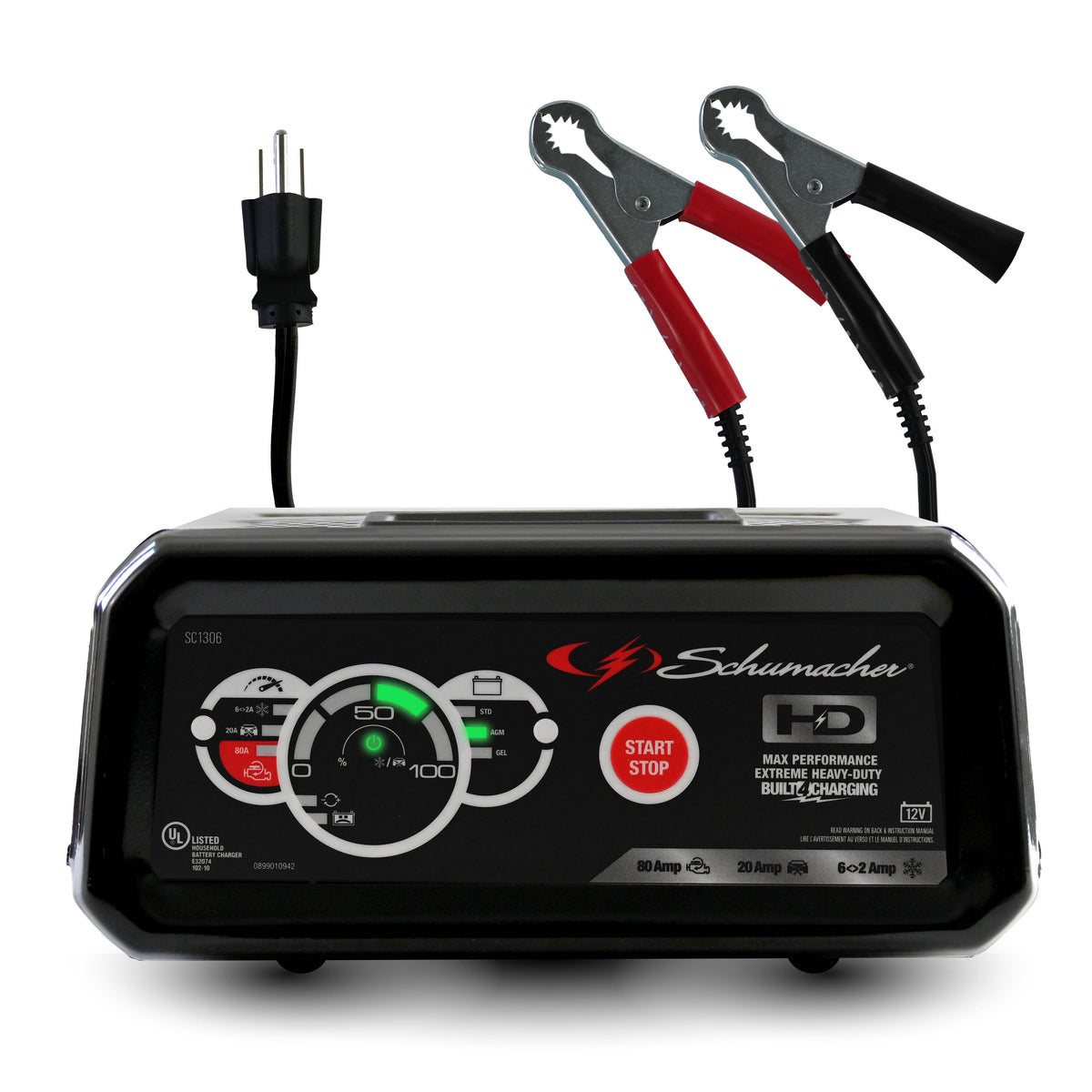
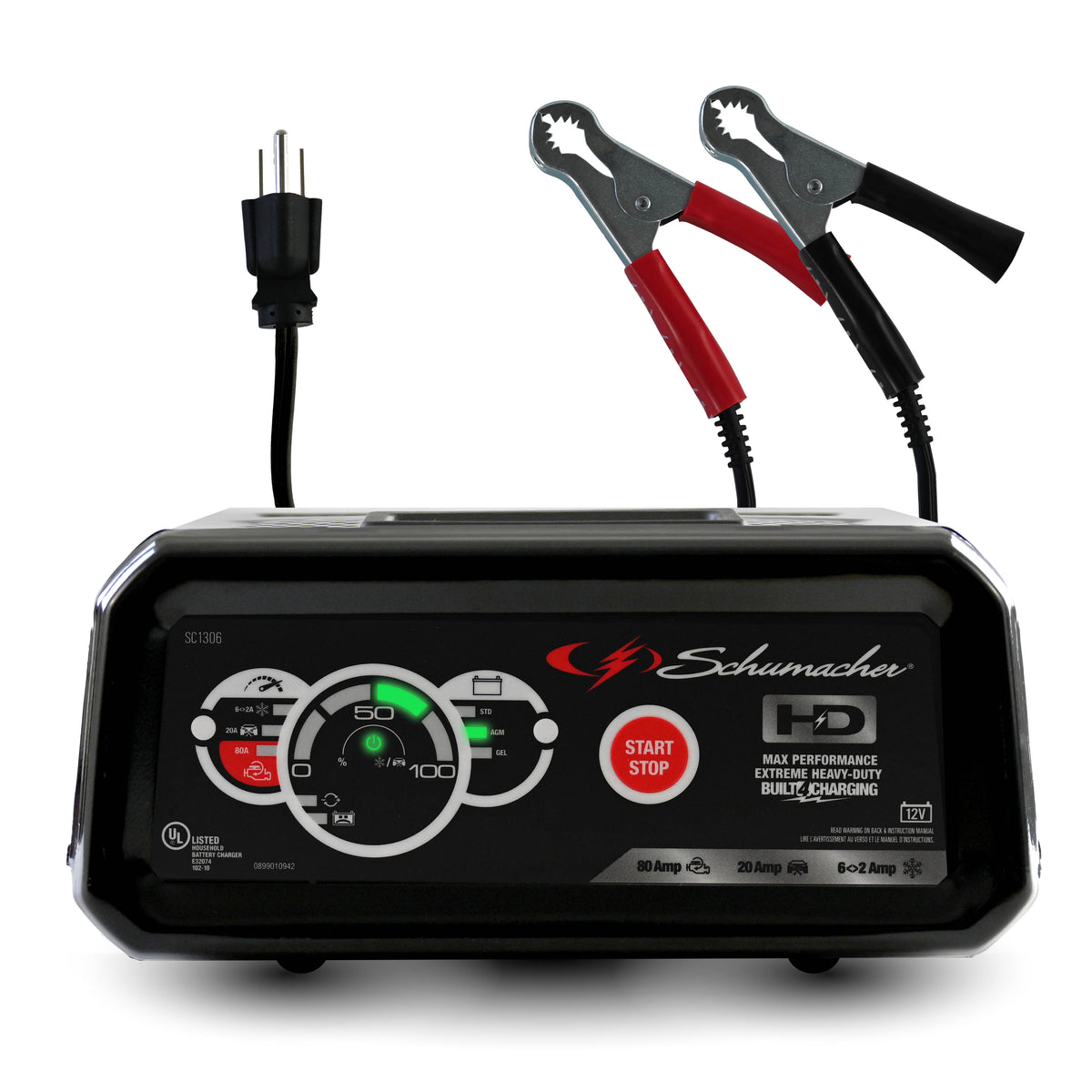
The exact page and charger face identify SC1306
The frozen U.S. collection card names SC1306 and links the 80 A 12 V charger/starter page. Its current product form identifies SC1306, and the associated gallery photo visibly carries the same code. This resolves the observed offer as a charger, not seller stock or delivered package.
The exact page links owner manual 0099001930E-04, whose cover prints family identifiers 102-3, 102-4 and 102-10 rather than SC1306. I use it for family safety/control guidance, not as independent model-code proof. The page body and face show a 6↔2 A Charge/Maintain selector, but its Output Current field lists 2/20/80 A without 6 A and its Boost copy varies between 10 and 20 A. Those fields remain separate.
Ordinary charging, Boost and Engine Start are different modes
The exact title, description and face point to 6 A ordinary charging, with 2 A at the lower side of Charge/Maintain. That is a listed capability, not guaranteed continuous output or a safe rate for a particular battery; follow the battery maker’s permitted rate. The separate 20 A Boost and 80 A Engine Start labels do not mean faster routine charging.
Boost adds energy before starting; the linked family manual says the charger returns to 6↔2 A Charge afterward. Because the page’s Boost wording varies and its summary field mixes modes, the face’s 20 A marking is described only as a separate Boost label. Engine Start is brief cranking assistance with a vehicle battery connected. The manual says to wait two minutes, crank no more than three seconds at a time, then allow a three-minute cooldown; stop if the engine turns but will not start. The 80 A figure is not ordinary charge current or a battery-capacity rating.
A 12 V lead-acid match, not a lithium or 6 V model
The exact page says 12 V and names Standard, AGM, Gel and deep-cycle. The linked manual limits charging to 12 V lead-acid and names STD, AGM and GEL. Only AGM and Gel map to the questionnaire’s specific subtypes; “Standard” does not establish Flooded/Wet, EFB, maintenance-free or calcium, and deep-cycle is a use class. No lithium/BMS, 6 V or 24 V ordinary-charge plan is documented.
Maintenance is documented, but capacity limits are not
The page describes automatic charging/float monitoring, and the linked manual says charging transitions to Maintain when full. It supplies a small current as needed and requires occasional monitoring; a continuous 12-hour need for maximum maintain current triggers abort. This is not a fixed float-current rating or permission to ignore battery condition and vehicle loads.
The manual’s example charge times assume a 50% discharge and vary with battery age and condition; they are not a universal SC1306 Ah ceiling. A requested 100 Ah battery is not confirmed merely because the chart includes examples. Check the exact battery instructions. The manual also says not to charge frozen batteries, requires dry ventilation and grounded nominal 120 V AC, and directs that marine batteries be removed from the boat and charged ashore.
One portable output and an AC outlet are part of the fit
The product is mains-powered and its model-labelled photo shows one red/black clamp pair: portable, one bank, not an on-board or multi-battery charger. The page mentions a six-foot power cord, but does not assign that length to the DC clamps. Check outlet access, actual lead reach, model label, instructions and seller package.
Where it sits beside the SC1361
Compared with the SC1361, the SC1306 lists 20 A Boost and 80 A Engine Start versus the SC1361’s 10 A Boost and 50 A Engine Start. These auxiliary labels do not raise either unit’s 6 A routine-charge capability.
The SC1306 suits one portable 12 V lead-acid task when a 6 A maximum ordinary-charge capability is appropriate and a grounded outlet and occasional monitoring are available. It is not supported here for lithium, 6 V, 24 V, multi-bank or on-board use, and no universal Ah ceiling is published. Check the delivered label/manual and battery-maker rate guidance.
Key specifications
Key details at a glance
| Output battery voltages | 12 V |
|---|---|
| Supported chemistries | Lead-acid |
| Rated DC charging current | 6 A |
| Independent battery outputs | 1 |
| Arrangement | Portable plug-in charger |
Use the exact model’s instructions for operating limits, supplied equipment and version differences.
Sources for this review
Sources for this assessment
Keep the next step evidence-led
Use the finder to combine voltage, battery chemistry, charging job and setup requirements; then check the exact model and its manual.