
Your needs, this model
Does it fit your priorities?
Is the SC1305's 50 A label its normal battery-charging rate?
No. The manual and face label separate 6↔2 A Charge/Maintain from 10 A Boost and 50 A Engine Start. The 6 A figure is the listed upper routine-charge capability, and Schumacher says current adjusts with battery size. Check the battery maker's allowed rate; do not use the larger starting/boost numbers as a charging-rate recommendation.
Explore this need in the finder →Can I use the SC1305 for a battery that needs 6 V or LiFePO4 charging?
The linked owner's manual establishes a 12 V lead-acid plan and names Standard (STD) and AGM. It does not document a 6 V output or lithium charging profile/BMS condition. Although current page marketing mentions LiFePO4, that copy conflicts with the narrower operating instructions, so this assessment does not recommend lithium use. Confirm the exact label and instructions for any battery outside the documented 12 V lead-acid scope.
Explore this need in the finder →Is its Maintain mode suitable for a storage battery?
After an automatic charge, the manual says the SC1305 changes to Maintain and supplies a small current as needed. It gives no fixed float-current number; if maximum maintenance current is needed continuously for 12 hours, the charger aborts. Occasional monitoring is required, so it is not an unattended fix for a bad battery or vehicle drain.
Explore this need in the finder →This is a desk-based assessment of Schumacher Electric’s current U.S. SC1305 page, the owner’s manual linked there, and the exact-model product image. No unit was purchased, used, tested or measured. The SC1305 is a portable, 120 V AC, single-output 12 V charger with automatic maintenance and separate Boost and Engine Start settings. The central distinction is that 50 A is the cranking setting—not the ordinary battery-charge rate.
The manual and face label clarify the model’s mixed descriptions
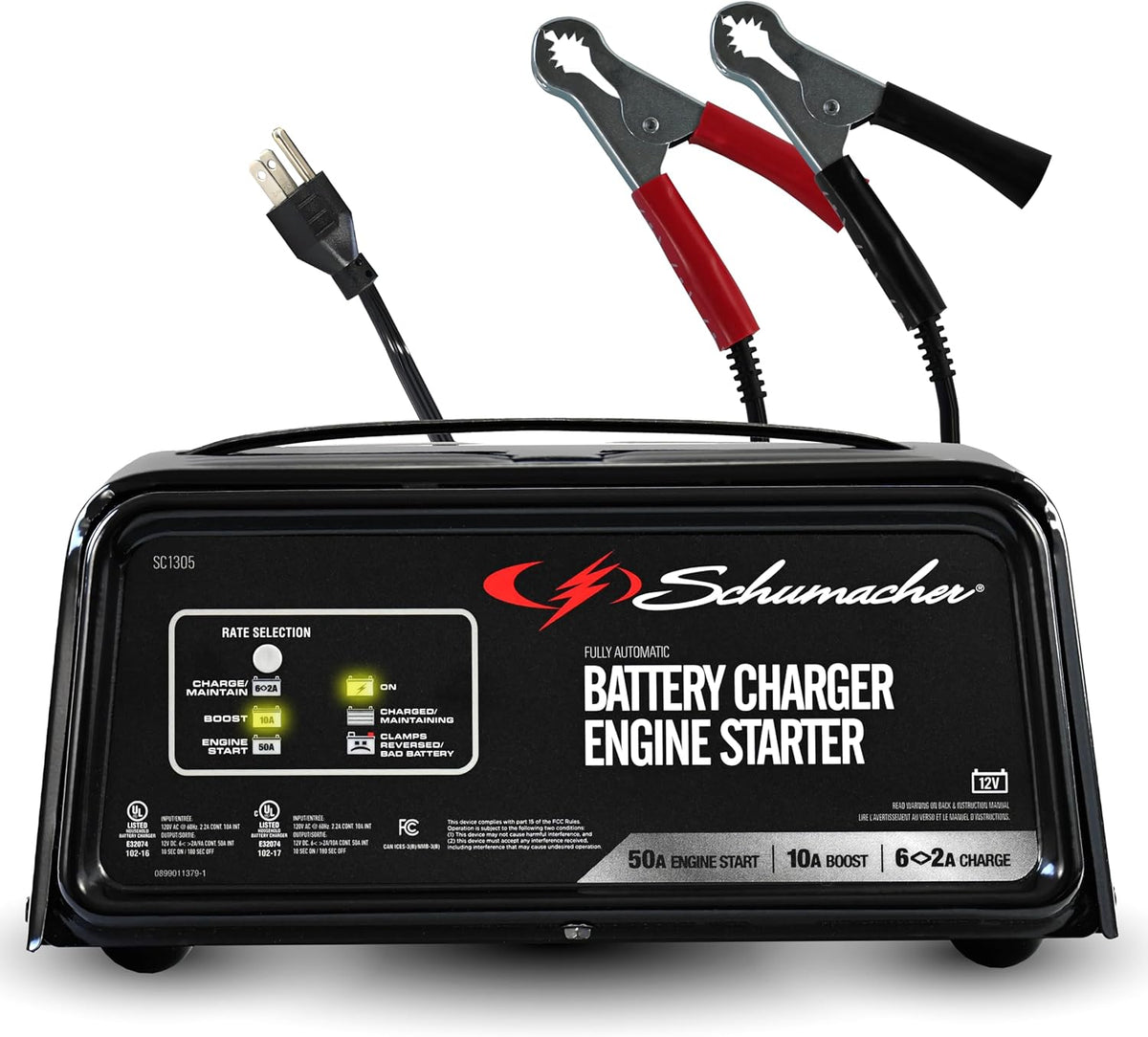
Schumacher’s U.S. charger collection and the exact product-page form both identify SC1305. The image associated with that page visibly prints “SC1305” and labels the front-panel settings 6↔2 A Charge, 10 A Boost and 50 A Engine Start. The page’s product title calls it a 3-in-1 device, while its description calls it 4-in-1 and separately mentions desulfation. Rather than rely on either marketing count, it is more useful to distinguish what each selector does.
The page’s specification field lists output current as 2/10/50 A, leaving out the 6 A ordinary-charge capability named in the title and description and shown on the face. The directly linked manual is a strong model bridge: its cover identifies UL models 102-16 and 102-17, which the exact product page lists as the SC1305’s cUL and UL model numbers. Its rate selector expressly calls the routine position 6↔2 A Charge/Maintain. I therefore treat 6 A as the listed upper ordinary-charge capability and keep 10 A Boost and 50 A Engine Start separate. The manual says charging current automatically adjusts with battery size, so 6 A is not a promise of continuous output or a safe-rate recommendation for every battery.
Charge, Boost and Engine Start answer different needs
For ordinary recharging, the face and manual support a 6↔2 A Charge/Maintain selection. Schumacher describes the lower rate as a fit for smaller batteries, with the unit adjusting current to battery size. If your battery maker specifies a maximum charge rate below 6 A, follow that limit; this charger’s nameplate capability does not override the battery instructions.
Boost is a separate 10 A pre-start function for adding energy before a starting attempt, not a 10 A substitute for the routine charging selection. Engine Start is a separate, brief 50 A cranking aid for a vehicle battery that remains connected. The manual limits each crank attempt to three seconds and calls for a three-minute wait before trying again. It warns not to use Engine Start without the battery installed in the vehicle, and says not to keep cranking when the engine turns but will not start. This is a mains-powered charger, not a cordless jump pack with an internal battery.
A narrow, documented 12 V lead-acid fit
The current page describes a 12 V unit. Its linked manual says to use it for rechargeable 12 V lead-acid batteries and specifically names Standard (STD) or AGM. The page’s current web copy also mentions LiFePO₄, but the directly linked operating instructions do not provide a lithium mode or a battery-management-system condition. That conflict is not enough to recommend lithium charging. No 6 V or 24 V plan is documented either. In the finder, AGM is the only specific lead-acid subtype selected; “Standard” does not resolve whether a particular flooded/wet, EFB, maintenance-free or calcium battery is suitable.
For the manual’s desulfation function, the instructions describe a process that can take eight to ten hours and may abort if it does not succeed. That is a charger mode, not a promise to restore a damaged or worn-out battery. Battery age, condition, initial state and connected vehicle loads can all affect the result; have a battery checked rather than repeatedly trying to charge one that the charger flags as bad.
Automatic maintenance still needs occasional attention
After an automatic charge, the manual says the charger changes to Maintain and supplies a small current when needed. It does not publish a fixed float-current value or a universal capacity ceiling. If the charger has to provide its maximum maintenance current continuously for twelve hours, it aborts; the manual says a load or a failing battery may be responsible and calls for occasional monitoring. That can suit a healthy 12 V storage battery whose condition and connections can be checked, but it is not a reason to ignore a parasitic drain or leave an unknown battery unattended indefinitely.
Charge-time examples in the manual assume a battery at 50% discharge and vary with battery age and condition. They are not a general SC1305 Ah rating. A numeric battery-capacity requirement therefore cannot be certified from those examples alone; verify the battery maker’s permitted rate and ask Schumacher about an unusual size or application.
Plan around grounded AC and a dry, ventilated location
The exact page describes a 120 V AC input, while the manual requires a properly grounded nominal 120 V circuit and says an extension cord is not recommended. The image shows one clamp pair, which supports a portable, one-output setup—not simultaneous multi-bank charging or an installed onboard system. The manual also says not to expose the charger to rain or snow, to use it on a dry surface with ventilation, and never to charge a frozen battery. A marine battery must be removed from the boat and charged ashore; the page’s marine-vehicle language is not permission for wet onboard use.
Who should consider the SC1305?
The SC1305 is a reasonable reference point when the task is one 12 V Standard or AGM battery, a portable plug-in charger, a documented 6 A maximum routine-charge capability, and occasional maintenance monitoring. Its Boost and Engine Start settings add convenience for a vehicle already at hand, but do not turn it into a faster ordinary charger. The SC1306 shares a 6 A Charge/Maintain path but has separately labelled 20 A Boost and 80 A Engine Start settings; those larger auxiliary numbers likewise do not raise its routine-charge capability.
Look elsewhere or verify directly if you need 6 V, 24 V, lithium charging, a published Ah ceiling, multiple independent outputs, onboard installation or weather exposure. Before buying, confirm the SC1305 model label and manual, the battery’s chemistry and voltage, the maker-approved charge rate, grounded-outlet access, actual lead reach and the seller’s exact package. See the Schumacher SC1305 product page and its linked owner’s manual for the operating instructions.
Key specifications
Key details at a glance
| Output battery voltages | 12 V |
|---|---|
| Supported chemistries | Lead-acid |
| Rated DC charging current | 6 A |
| Independent battery outputs | 1 |
| Arrangement | Portable plug-in charger |
Use the exact model’s instructions for operating limits, supplied equipment and version differences.
Sources for this review
Sources for this assessment
- Frozen U.S. Schumacher battery-chargers collection card for SC1305
- Current exact U.S. Schumacher SC1305 product page
- Owner manual 0099002274 linked from the exact SC1305 product page
- Official SC1305 image associated with the exact manufacturer page and collection card
- Limited current CPSC Schumacher manufacturer-index check for SC1305

Keep the next step evidence-led
Use the finder to combine voltage, battery chemistry, charging job and setup requirements; then check the exact model and its manual.