
Your needs, this model
Does it fit your priorities?
Does the current SC1282L-titled offer document 12 V AGM charging at a 10 A minimum?
Yes as a documented capability screen: its current page calls it a 10 A 12 V charger and the linked manual covers 12 V lead-acid AGM charging. That is not a safe-rate recommendation. The current page's variant SKU and one package line say SC1282, so confirm the suffix on the unit/manual and follow the battery maker's permitted rate.
Explore this need in the finder →Can it maintain a 12 V LiFePO4 battery after charging?
The linked manual supports 12 V LiFePO4 and describes automatic post-charge maintenance, but it requires the battery pack's own BMS and protection and says the process should be monitored occasionally. The manual gives no fixed maintenance-current rating or universal Ah ceiling; check the battery maker's instructions.
Explore this need in the finder →Does the current model documentation confirm gel charging despite the page copy?
No matching gel capability is assigned. The product-page marketing paragraph lists gel, but the exact page-linked manual names 12 V lead-acid Standard/AGM and LiFePO4 and does not list gel; the page specification block also says AGM. Because the documents disagree, this review does not recommend the SC1282L-titled offer for gel until Schumacher confirms the exact delivered configuration and manual.
Explore this need in the finder →Does its manual establish a maximum size for a 105 Ah charging request?
No. The manual has a marine 105 Ah example with an estimated charge time at each listed rate, but it never identifies that row as a maximum. Since the finder capacity question asks for a documented upper limit, the model does not match a numeric Ah request; check the battery maker and do not infer a ceiling from an example row.
Explore this need in the finder →At a glance: Schumacher’s current U.S. Battery Chargers collection lists a 10 A, 12 V automatic charger/maintainer as the SC1282L. The matching product page uses that name in its heading, but its product form’s variant SKU and GTIN record say SC1282, and one package line also calls the unit SC1282. The page-linked owner manual is headed SC1282L / SC1339L. This is one distinct SC1282L-titled offer in the observed collection, but the suffix and package identifiers do not agree. Treat that as a real purchase check, not a reason to collapse it into a different SC1282 listing or to assume every model sharing the manual is identical.
What the current page and manual establish
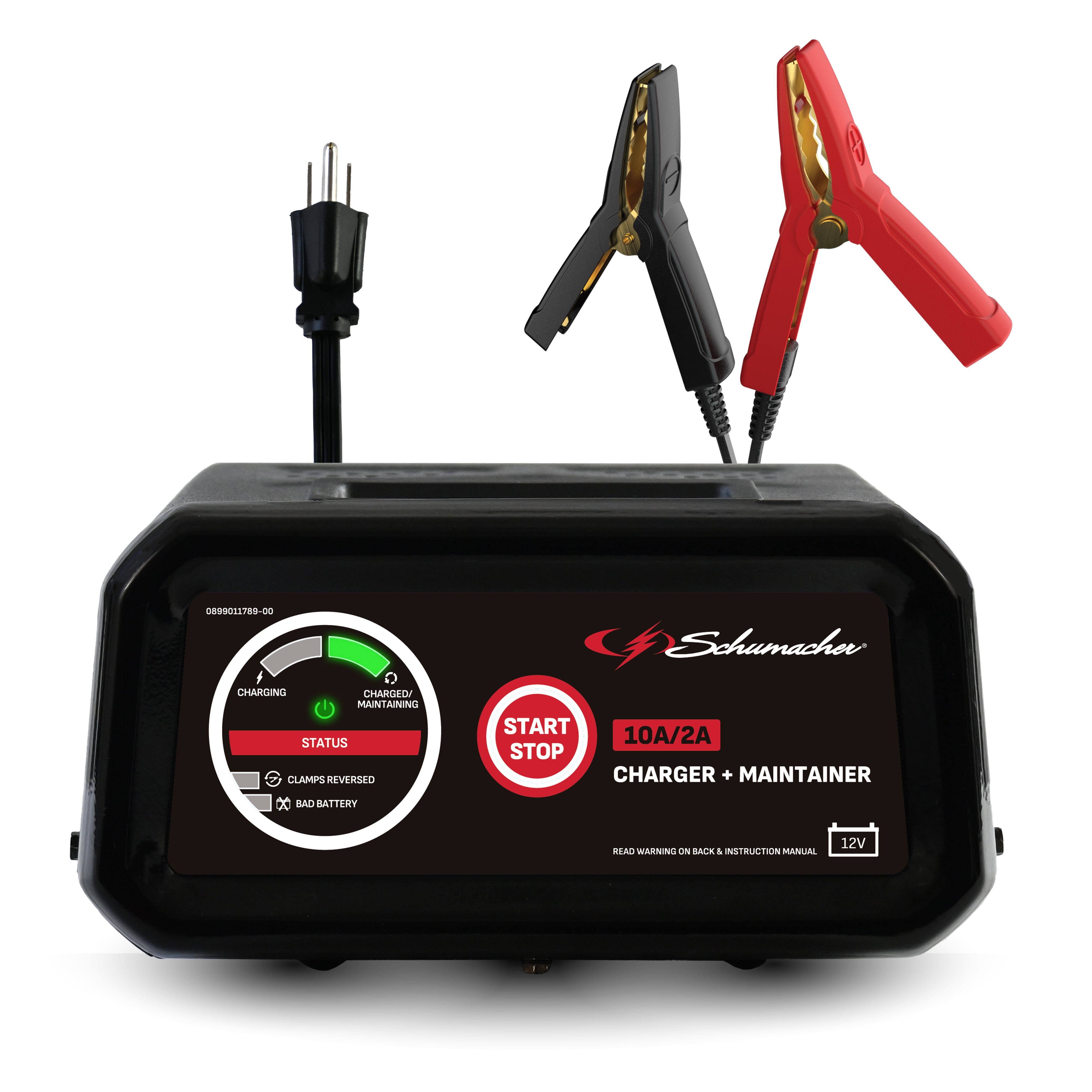
The exact manufacturer page describes a plug-in, single-output charger that can charge and maintain 12 V batteries. Its copy calls the charge rate 10 A and the maintenance mode 2 A; the associated panel image is marked 10A/2A and 12V. The page-linked manual says the charger adjusts its charging current to battery size, begins automatically after a correctly connected battery is detected, and shifts to maintain mode after charging. In maintenance, the manual describes a small current when needed rather than a fixed continuous output, and it asks owners to monitor the charging process occasionally. That distinction matters: a 10 A charging capability is not the same thing as an everyday maintenance current or a safe rate for every battery.
The manual cover names both SC1282L and SC1339L. A shared instruction document can support the stated operating rules, but it does not prove those two collection offers are identical, interchangeable or packaged alike. The SC1282L page itself repeats SC1282 in its internal SKU and package text. The current listing and the page-associated image are the strongest evidence for this offer’s label and physical reference; verify the actual suffix on the box, unit and included manual if the exact generation matters.
Battery compatibility needs a conservative read
The exact linked manual allows 12 V lead-acid batteries in Standard or AGM form, and 12 V LiFePO4 packs that include their own battery-management system and pack protection. It does not map “Standard” to a specific flooded, EFB, maintenance-free or calcium subtype, so this review only uses the separately named AGM subtype in the subtype finder. It also does not list gel. That is important because the product-page marketing paragraph does advertise gel, while the exact page specification block lists AGM and the linked manual omits gel. Until Schumacher resolves that conflict for the delivered SC1282L configuration, this review does not treat the model as a documented gel choice.
The lithium guidance is more explicit: the manual requires the battery pack to carry its own BMS and all necessary protection. That is a battery condition, not a claim that the charger supplies a battery-management system. The manual names only 12 V for both its lithium and lead-acid instructions, so the SC1282L-titled listing is not a 6 V or 24 V option in this library.
Charging current and capacity are separate questions
The manual’s charge-time table has 2 A, 6 A, 8 A and 10 A columns and gives examples for several battery sizes. For example, it estimates eight hours at 10 A for a 105 Ah marine battery that is 50% discharged, with time varying by battery age and condition. That is an illustrative time, not a statement that 105 Ah is the model’s maximum. The table also includes smaller capacities and CCA examples; none is labeled as a universal upper boundary. The finder therefore leaves the model out when a shopper enters any Ah size as a required documented charge ceiling. Check the battery manufacturer’s approved rate and any charger limit rather than using the example table as a blanket compatibility guarantee.
The page and image describe 10 A charging and a 2 A maintain claim, but the manual says the controller adapts current to the battery. The 10 A rating is useful for comparing charger capability; it is not a recommendation to push 10 A into a small or sensitive battery. The manual’s occasional-monitoring advice also means “maintainer” should not be read as proof that no checks are ever needed. If the unit remains in maintain mode at its maximum current for 12 hours, the manual says it will abort; that can signal a battery drain or fault that needs attention.
Installation, reach and weather limits
This is a portable AC-powered charger, not an on-board unit. The page lists 120 V AC input, six-foot power and booster leads, 3.7 pounds and a body of 8.75 by 4.6 by 8.79 inches. Those are manufacturer-listed figures, not measurements from hands-on inspection. The page says there is no IP rating, and the manual says not to expose the unit to rain or snow; neither the product label nor its marine-battery examples establish that it may be installed or operated aboard a boat. The manual directs users to remove a marine battery and charge it on shore.
The exact page package descriptions say the charger and owner manual are included, but one line names SC1282L and another says SC1282. The official page-associated photograph shows a single red/black clamp pair, 12 V marking, grounded AC plug and 10A/2A panel; the photo itself does not print the SC1282L suffix or prove package contents. Confirm that the unit, clamps, manual revision and return terms match the intended offer before purchasing.
Who should shortlist it—and what to verify
The evidence supports a narrow, useful case: a portable 120 V charger/maintainer for one 12 V AGM battery, or a 12 V LiFePO4 pack with its own BMS, where a 10 A charging capability fits the battery maker’s instructions. Its automatic transition to maintenance is more useful for storage than a charger that only stops, but the manual’s monitoring warning still applies. It is not the documented pick for a 6 V battery, gel subtype, fixed on-board installation, DC accessory supply, or a shopper who needs a published Ah ceiling.
There is no hands-on testing or ownership claim here. This assessment follows the current exact Schumacher product page and the owner manual linked from that page. For an exact purchase, check whether the seller’s carton and delivered case say SC1282L or SC1282, which manual is included, and whether the stated battery chemistry, voltage and current match the battery maker’s requirements.
Key specifications
Key details at a glance
| Output battery voltages | 12 V |
|---|---|
| Supported chemistries | Lead-acid / Lithium-ion (LiFePO4) |
| Rated DC charging current | 10 A |
| Independent battery outputs | 1 |
| Arrangement | Portable plug-in charger |
| Included connection | One red/black clamp pair appears in the exact page-associated image. The current page says charger and manual are included but conflicts between SC1282L and SC1282 in separate package lines; confirm exact suffix and contents before purchase. |
Use the exact model’s instructions for operating limits, supplied equipment and version differences.
Sources for this review
Sources for this assessment
- Schumacher current U.S. Battery Chargers collection products JSON, page 1
- Schumacher Electric current U.S. SC1282L-titled product page
- Exact current page-linked Schumacher owner manual 0099002522-00, headed SC1282L / SC1339L
- Official image associated with Schumacher's current SC1282L-titled product page

Keep the next step evidence-led
Use the finder to combine voltage, battery chemistry, charging job and setup requirements; then check the exact model and its manual.