
Your needs, this model
Does it fit your priorities?
Does the SC1281L-titled offer document an ordinary 6 V or 12 V AGM charge plan?
Yes. Manual 0099002293-00 names 6/2 A Charge, supports 6 V and 12 V lead-acid, and explicitly lists AGM. Its ordinary charge path is not the separate 30 A Boost or 100 A Engine Start mode; the 6 A capability screen is not a safe-rate recommendation. Follow the battery maker's permitted charging profile and verify the delivered SC1281L/SC1281 label.
Explore this need in the finder →Can this model charge 12 V LiFePO4, and what BMS condition applies?
The exact page-linked manual permits 12 V LiFePO4 only when the battery pack includes its own integrated BMS and all necessary protection. It does not establish 6 V lithium or other lithium chemistries. The charger is a single portable output; confirm the battery manufacturer's current/rate guidance.
Explore this need in the finder →Does the manual establish a maximum Ah battery size?
No universal Ah ceiling is stated. Its charge-time table gives examples, including 6 Ah, 32 Ah and 105 Ah applications, while separate notes say the charging current changes with battery size and an excessive battery may abort. None of those examples is a rated capacity maximum, so the model is excluded when a numeric capacity requirement is entered; check the battery manufacturer and do not infer a limit.
Explore this need in the finder →Is the SC1281L/SC1281 suffix discrepancy just a second charger?
The evidence documents one current manufacturer offer, not two distinct units: its title/manual say SC1281L, while the exact page's embedded SKU, GTIN and another package line say SC1281. The current source page links the manual and exact image; confirm the model and manual on the delivered unit before treating another listing as identical.
Explore this need in the finder →This is a source-based assessment of one current Schumacher U.S. product-page offer and the manual linked from that exact page—not a hands-on test or a claim about a particular seller’s box. The page title and manual cover say SC1281L, but the page’s embedded part number, GTIN and a separate package line say SC1281. That discrepancy stays visible throughout this review.
Treat SC1281L and SC1281 as a documented page conflict
Schumacher’s Battery Chargers collection record leads to a current product page whose descriptive heading and product copy call the 6 A 6 V/12 V charger SC1281L. Its embedded product data instead lists variant SKU SC1281 and GTIN-8 00026666812818; the exact page also contains one package line for an SC1281 charger. The page links manual 0099002293-00, whose cover names SC1281L alongside SC1564L. That is a direct page association for the manual, but the shared cover does not make SC1564L a cosmetic or box variant of this product. The most careful reading is one current SC1281L-titled offer with an unresolved suffix/package-label mismatch—not two models, and not proof that every SC1281 retail listing has the same contents. Verify the label and manual supplied with the offer you are considering.
Keep the 6/2 A Charge setting separate from Boost and Engine Start
The linked manual labels an ordinary 6/2 A Charge setting and describes automatic voltage detection for 6 V and 12 V batteries. It does not assign those two current figures to individual voltages in the reviewed instructions, so this assessment does not treat either setting as a verified per-voltage minimum-current figure in the finder. The manual says the charger adjusts current based on battery size and that a completed automatic charge changes to maintenance. The page’s 6 A headline is an upper product-level charging figure, not a battery-safe-rate recommendation or a promise that the unit will deliver a constant 6 A to every battery. Check the battery maker’s profile and permitted rate before connecting it.
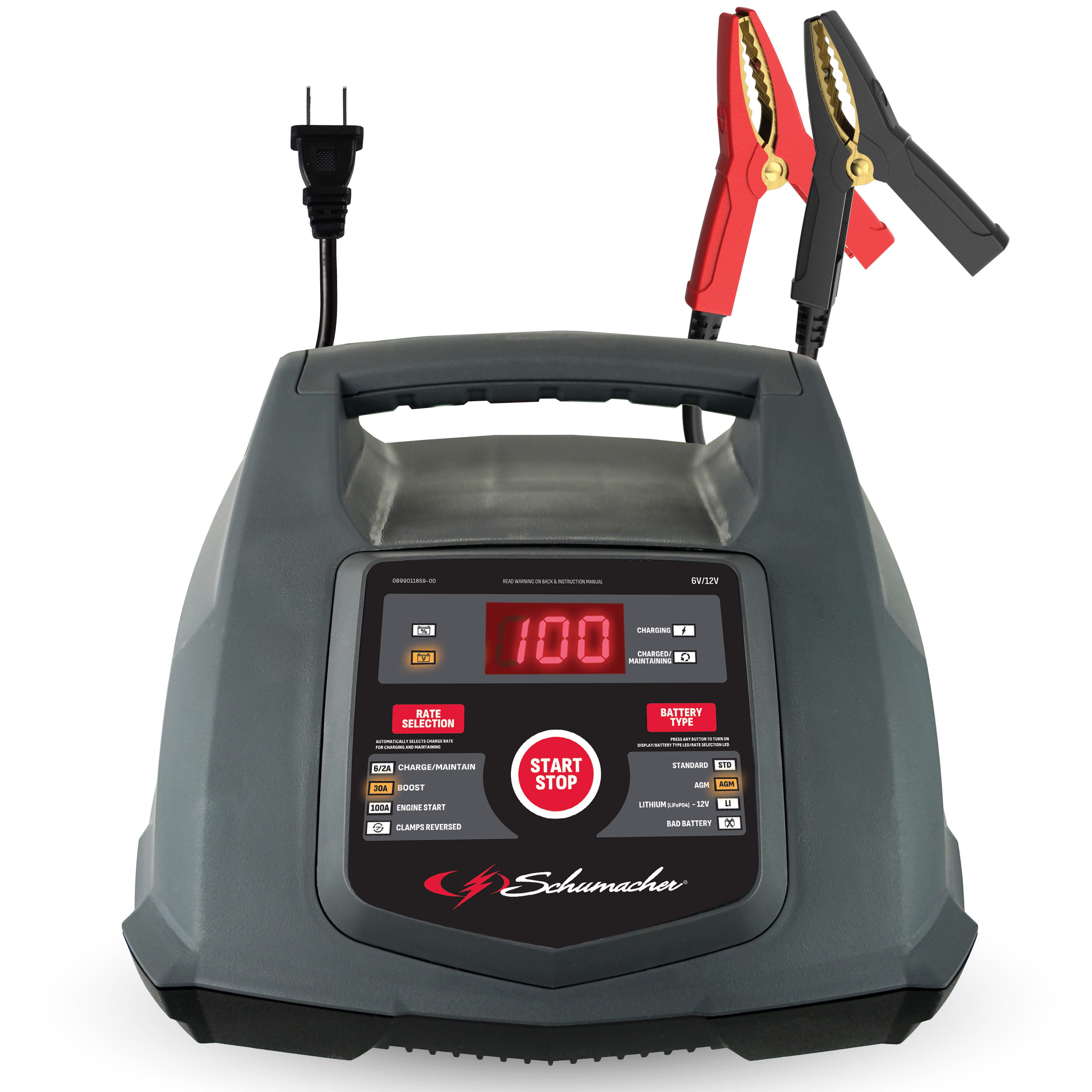
The manufacturer’s title and feature line advertise separate 30 A Boost and 100 A Engine Start functions, and the exact-page photograph labels those controls separately from Charge/Maintain. The product description also says “12-amp to 30-amp boost charging,” while the page’s output-current summary bundles the numbers rather than defining each mode. The manual treats Boost as a separate pre-start selection and Engine Start as a cranking aid used with a battery. These larger figures are not alternate routine charging rates. During charge mode, the manual also says Boost may be used briefly during the first ten minutes if needed before the selected charge rate takes over; follow that procedure rather than assuming the start/boost features establish another battery-charge plan.
Use the chemistry named in the exact manual
Manual 0099002293-00 identifies 6 V and 12 V lead-acid batteries, including Standard, AGM and deep-cycle applications. AGM is explicit and is included in the specific subtype filter. The manual’s Standard profile refers to vent-capped starter batteries that may be called low-maintenance or maintenance-free; it does not say “flooded/wet” or establish every battery sold as maintenance-free. Gel appears on other Schumacher products, but this exact shared manual does not list it, so this review does not recommend the SC1281L-titled offer for gel on that basis.
The manual separately permits 12 V LiFePO₄, but only for a battery pack containing its own integrated battery-management system and all required protection. That is not permission for 6 V lithium, another lithium chemistry, or a lithium pack without protection. It also says not to use the charger as a general low-voltage supply except in a starter-motor application. A chemistry label alone is not enough: match the battery’s exact voltage, profile and BMS requirements.
The manual gives examples, not a maximum Ah rating
The manual’s time table covers several battery sizes and its charging section says current adjusts with battery size. It also warns that an excessively large or problematic battery may trigger an abort. Those statements do not establish a universal maximum capacity for this model: an example such as 105 Ah is not a ceiling, and no numeric Ah limit is published in the reviewed material. The finder therefore treats its charge-capacity limit as unknown and will not match it to a numeric capacity request. A blank limit is not evidence that every size is suitable.
On a completed automatic charge, the manual says the charger enters maintain mode and delivers a small current as needed; it asks users to monitor occasionally. It gives no fixed float-current number or universal maintenance-size limit. If the maximum maintenance current continues for 12 hours, the charger aborts, often because a load remains on the battery or the battery needs attention. Treat maintenance as a separate operating job, not an unlimited unattended guarantee.
A portable unit still needs a grounded, dry work area
The exact page lists 120 V AC input, a six-foot cord/cable reach, a 10 lb weight and dimensions of 10.57 by 7.12 by 10.57 inches. These are manufacturer specifications, not measurements made here. The product-page contents line lists the charger and manual, but its own package wording alternates between SC1281L and SC1281; confirm the unit label, lead set and included paperwork before ordering. The page lists a one-year warranty and no ingress rating.
The linked manual requires a properly grounded nominal 120 V outlet, ventilation and a dry, nonflammable surface; it says not to expose the charger to rain or snow and never to charge a frozen battery. For a boat battery it specifies shore charging after removal, unless equipment designed for onboard marine charging is used. Keep cords clear of belts and fans and follow the battery and vehicle makers’ connection instructions. This compact portable charger is not an installed onboard unit or an outdoor-weatherproof product.
When this offer is worth comparing
It is a candidate for someone who needs one portable AC-powered output for a 6 V or 12 V lead-acid battery, or a documented 12 V LiFePO₄ pack with a built-in BMS, and whose battery maker permits the charger’s ordinary output. The useful tradeoffs are the low-profile 6/2 A charge/maintain mode, separate pre-start Boost and Engine Start features, and the built-in battery/alternator test and desulfation functions. It is not a fit for 24 V routine charging, 6 V lithium, unprotected lithium, a multi-bank installation, wet outdoor use, or a buyer who requires a published Ah ceiling before screening. Before purchase, resolve the exact SC1281L/SC1281 label and verify the current manual, included clamp leads, seller condition and return terms. No product-page rating proves charge time, a battery-safe rate or real-vehicle performance.
Schumacher SC1281L-titled product page · Page-linked manual 0099002293-00.
Key specifications
Key details at a glance
| Output battery voltages | 6 / 12 V |
|---|---|
| Supported chemistries | Lead-acid / Lithium-ion LiFePO4 |
| Rated DC charging current | 6 A |
| Independent battery outputs | 1 |
| Arrangement | Portable plug-in charger |
| Included connection | The page describes a six-foot AC power cord and booster cables and its contents line lists charger and owner manual; another page line names the unit SC1281. Confirm the exact delivered label, manual, clamp leads and package rather than inferring contents from the title. |
Use the exact model’s instructions for operating limits, supplied equipment and version differences.
Sources for this review
Sources for this assessment

Keep the next step evidence-led
Use the finder to combine voltage, battery chemistry, charging job and setup requirements; then check the exact model and its manual.