
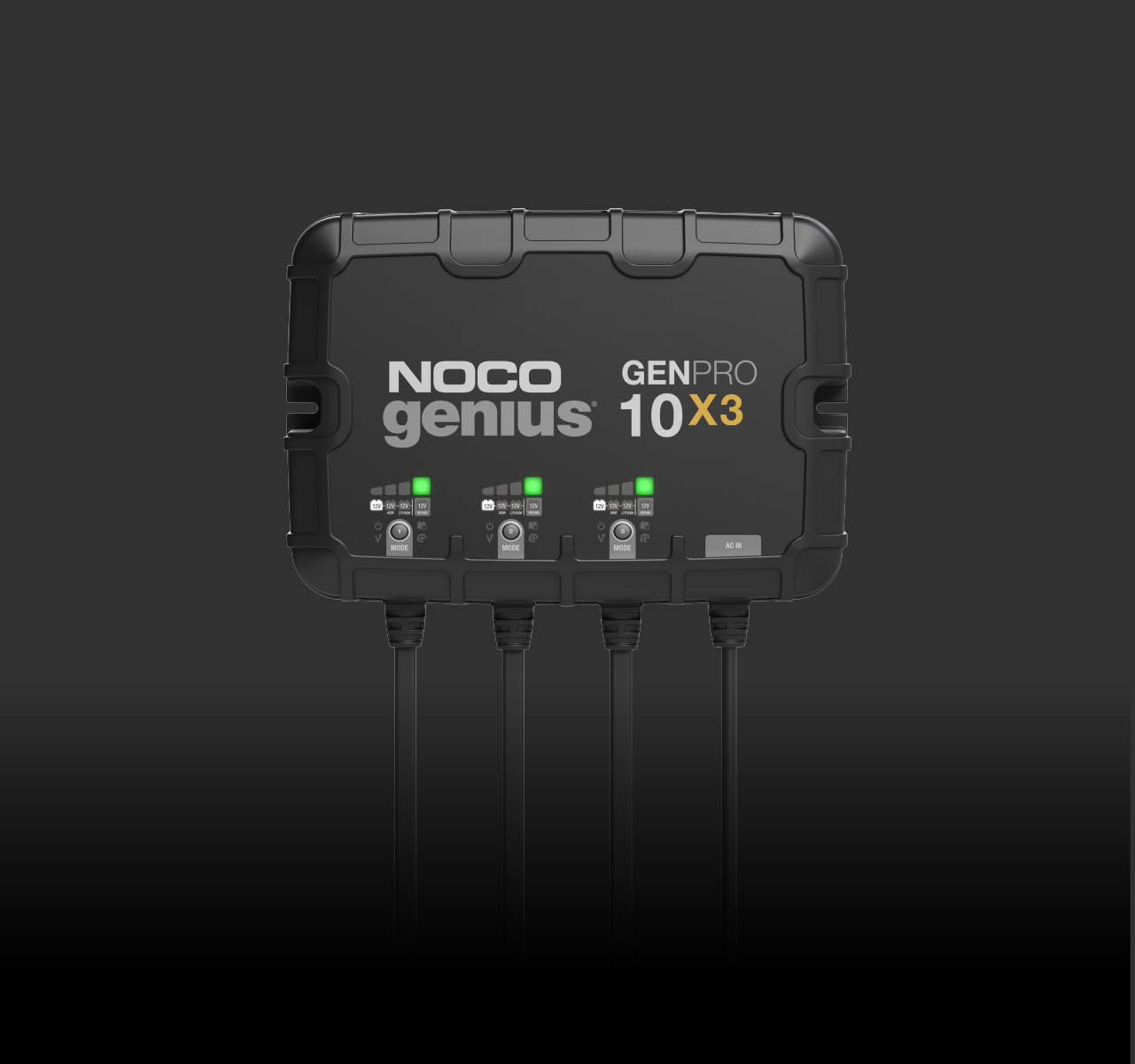
Your needs, this model
Does it fit your priorities?
Does GENPRO10X3 provide 30 A to one car battery?
No. It has three isolated 10 A banks; the manufacturer states 30 A combined across those outputs. Its published capacity limit is up to 230 Ah per battery, and the independent channels do not turn into a single 30 A output. For one battery needing more than 10 A, compare a one-bank charger with an appropriately rated documented output and confirm the battery maker's allowed rate.
Explore this need in the finder →How does GENPRO10X3 differ from GENPRO10X2?
The GENPRO10X3 adds one independently isolated bank: it is 30 A total at 10 A per output, compared with two outputs and 20 A total for the X2. The X3 is also larger and heavier in the published records. A third bank is useful only if the installation genuinely needs a separately managed third battery; otherwise it adds wiring and mounting burden without raising any one bank's 10 A rating.
Explore this need in the finder →Can the GENPRO10X3 charge AGM and lithium batteries?
The official guide lists a 12 V AGM profile and a separate 12 V lithium-ion mode, including LiFePO4; the lithium mode is limited to batteries with a built-in BMS. Each of the three banks is rated 10 A. Match the chemistry profile separately for each battery and check its maker's rate and voltage instructions; this model does not document 6 V or 24 V modes.
Explore this need in the finder →The NOCO GENPRO10X3 brings three isolated 10 A charging channels into one fixed 12 V on-board unit. Its 30 A headline is the sum of those banks, not a 30 A output for a single car battery. The X3 can be a relevant comparison when three separate batteries need independent control in an installation, but that use case—not the aggregate current—should justify its size and wiring. This is a document-based assessment, not a hands-on test.
Three independently managed banks
The current overview identifies three 12 V banks at 10 A each; the manual explicitly says the GENPRO banks are isolated and work independently. The total is therefore 30 A over three battery connections. If only one or two batteries need charging, the GENPRO10X1 or GENPRO10X2 would avoid paying the installation burden of unused channels. The three-bank GEN5X3 has the same bank count at 5 A per bank and a 120 Ah charging ceiling; it is a distinct lower-current installed alternative. A single battery that must receive more than 10 A needs a single-output product rated for that battery, not a three-bank sum.
Each bank can charge a 12 V battery under the documented mode families. The shared guide lists standard 12 V lead-acid for wet/flooded, gel, enhanced flooded, maintenance-free and calcium batteries; AGM has a named profile. The lithium mode is for 12 V lithium-ion batteries including LiFePO₄, only where a built-in BMS is present. An application with unlike batteries needs profile selection per bank and the exact battery makers' rate limits—not simply a claim that the charger supports all chemistries.
Capacity and maintenance are separate jobs
NOCO states ordinary charging up to 230 Ah per battery and maintenance for batteries of all sizes. Do not add the three channel ratings into an unsupported 690 Ah capacity figure, and do not read “all sizes” as a promise to charge an oversized depleted battery. It describes maintaining batteries after they have reached charge. The stated 230 Ah limit applies to the battery on an individual bank; a larger depleted battery is outside the documented range reviewed here. A 10 A channel also does not override the battery maker's permitted charging current.
The current spec page lists 72-inch AC and DC leads, the DC leads with eyelet terminals, and two mounting screws in the listed box contents. Check the listing for the exact X3 package and any additional connector parts. The X3's three cable paths should be routed to the right battery terminals with the guide's slack and vehicle-clearance instructions followed; protect the wires from hoods, doors, belts, fans and hot or moving parts. A planned permanent location is part of the product choice, not a minor accessory decision.
Size, mass and source conflicts
The current technical page reports a body of 8.11 × 10.51 × 2.83 inches and weight of 13.43 lb, with the weight also shown as 6.2 kg. The 2024 manual and sell sheet give 10.5 × 7.4 × 2.8 inches and 12.8 lb (5.81 kg). Both the dimensions and weight conflict; the current page's metric weight does not convert exactly to its own pound figure. These are manufacturer data, not independent measurements. Check the actual enclosure, mounting clearance, support surface and instructions before making holes.
Current X3 specifications list 120–240 V AC, while the family manual and sell sheet state 100–240 V AC. Those sources agree on use at a US 120 V outlet, but the disagreement prevents a broader low-voltage claim. The charger is rated IP68 in its product materials. Its manual describes a defined fresh-water immersion test but also says not to submerge or wet the charger and to avoid leaving it wet. Treat the rating cautiously rather than planning routine underwater or long-term wet use; keep it dry and within its stated operating temperature range.
Recovery modes are not a reason to skip diagnosis
GENPRO10X3 has a 12 V Repair profile for certain lead-acid recovery situations. The shared guide specifies 16.5 V and 1.5 A, describes possible water loss in flooded cells and warns about sensitive vehicle electronics; it says disconnecting the battery can reduce that electronics risk. Force mode is for a battery too low to trigger ordinary detection, below 1 V. It disables safety features and exposes live power at the output terminals, then times out after five minutes. Use these only when the mode, battery condition and instructions make sense; they do not revive every damaged battery or make an unsafe charging location safe.
NOCO's safety text also says not to use the unit unattended, not to charge a frozen battery, and to work in a ventilated area around lead-acid batteries. Continuous maintenance language should not be taken to cancel that warning. The distinct selectable modes and fault indicators help identify an operating state; they are not a substitute for checking battery voltage, chemistry, fuse condition, polarity and wiring.
Who should compare the GENPRO10X3
It is a candidate for three compatible 12 V batteries with separate charging paths where 10 A per bank, the 230 Ah charge limit per battery and a permanent on-board installation fit. It is not appropriate solely because “30 A” sounds faster, and it does not document portable clamps, a DC device-supply mode or 6/24 V charging. Compare the X2 if two banks suffice or the X4 if a documented fourth channel is genuinely needed. Verify current dimensions, package, wiring plan, chemistry and each battery's accepted rate before purchase.
Primary sources checked: NOCO's GEN/GENPRO collection, GENPRO10X3 overview, current specifications, mode/support guide, the North American user guide and sell sheet. No test results, measurements, seller stock or personal-use claim is implied.
Key specifications
Key details at a glance
| Output battery voltages | 12 V |
|---|---|
| Supported chemistries | lead-acid / lithium-ion |
| Rated DC charging current | 30 A |
| Published charge capacity limit | 230 Ah |
| Maintenance claim | Yes |
| Independent battery outputs | 3 |
| Arrangement | On-board charger |
| Ingress rating | IP68 |
| Minimum operating temperature | -20 °C |
| Maximum operating temperature | 40 °C |
| Included connection | Fixed on-board AC cord and three DC battery-bank leads; current specs identify 72-inch DC leads with eyelet terminals and a 72-inch AC cable. Current box listing names the charger, two self-tapping screws, guide and warranty; verify the exact seller package and connections. |
Use the exact model’s instructions for operating limits, supplied equipment and version differences.
Sources for this review
Sources for this assessment

Keep the next step evidence-led
Use the finder to combine voltage, battery chemistry, charging job and setup requirements; then check the exact model and its manual.