
Your needs, this model
Does it fit your priorities?
Can the GENIUS2 maintain a 12 V car battery during storage?
NOCO states maintenance for all battery sizes and its North American guide says the charger may remain connected after the battery is full. The same guide warns not to leave the product unattended while in use, so that connection claim is not blanket approval for an unsupervised setup. Confirm the battery maker's storage directions and follow the exact charger's current safety instructions.
Explore this need in the finder →Can GENIUS2 charge a 12 V AGM battery rated up to 40 Ah?
NOCO documents a separate 12 V AGM mode, a 2 A output and a charging capacity up to 40 Ah. It is a low-current option rather than a fast charger. Check that your battery maker allows this charging profile, and use the AGM setting rather than assuming the ordinary 12 V lead-acid mode is interchangeable.
Explore this need in the finder →Will GENIUS2 charge a 12 V LiFePO4 battery?
NOCO's manual includes 12 V lithium-ion, including LiFePO4, but restricts that mode to batteries with a built-in battery management system. The published charging range is up to 40 Ah and the output is 2 A. Confirm voltage, BMS and permitted charging current with the battery maker before selecting the lithium mode.
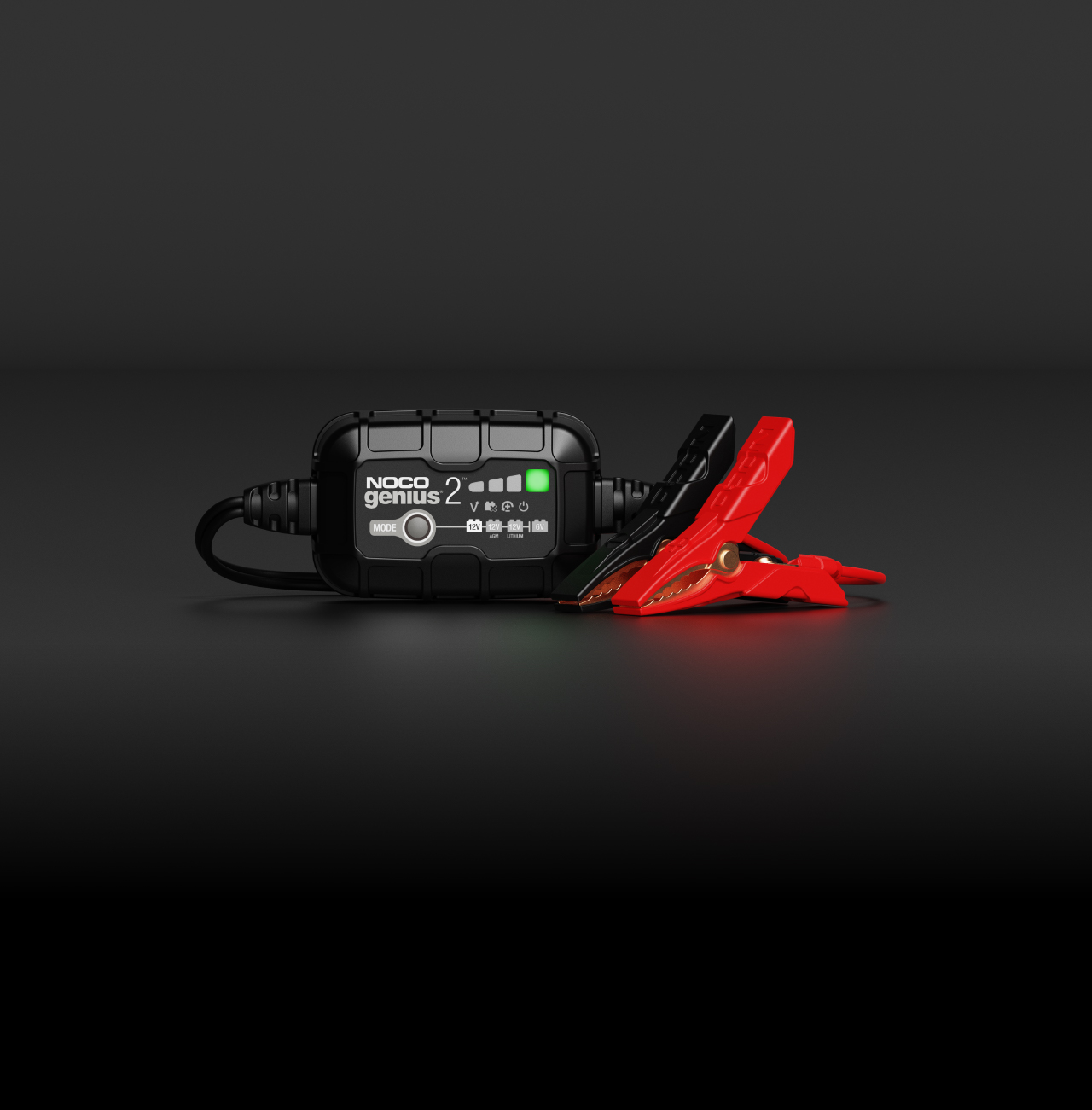
Explore this need in the finder →The NOCO GENIUS2 is a compact, plug-in 2 A charger for one battery at a time. It offers more current than the GENIUS1, but it is not a fast charger: NOCO limits its stated charging range to 40 amp-hours. Its appeal is the mix of 6 V and 12 V lead-acid modes, a 12 V lithium setting and maintenance function. This source-based assessment is not a hands-on test.
One output with several distinct battery modes
The GENIUS2 provides 2 A DC from one output. NOCO documents a 6 V mode for wet/flooded, gel, enhanced flooded, maintenance-free and calcium lead-acid batteries. For 12 V lead-acid batteries, the regular mode is separate from the 12 V AGM setting. Do not infer a 6 V AGM mode from the broad chemistry list: the exact instructions describe 6 V lead-acid types, then identify AGM as its own 12 V mode.
There is also a 12 V lithium-ion mode for batteries such as LiFePO4, but NOCO restricts it to packs with a built-in battery-management system (BMS). The battery maker's voltage and current directions still matter. GENIUS2 is not documented here as a 6 V lithium charger. These are selectable ways to charge one compatible battery, not simultaneous outputs or a substitute for checking the battery label and its instructions.
What the 40 Ah charging limit means
NOCO's exact-model specifications and North American guide state charging capacity up to 40 Ah. At 2 A, that can suit a smaller battery or a slow, planned charge when the battery maker allows the rate. It is not the right profile for someone who needs a rapid recovery of a depleted full-size starting battery, nor should the rating be read as a promise that any battery up to 40 Ah will recover successfully. Battery condition, depth of discharge, temperature and its permitted charge rate all affect the outcome.
There is a documentation wrinkle worth keeping visible. NOCO's support FAQ gives approximate charge-time examples for 80 Ah and 100 Ah batteries, while its exact-model specifications state a 40 Ah maximum charging capacity. The English manual and current specification page also support the 40 Ah limit. The sources do not explain how the larger-battery estimates fit that limit, so this assessment uses the explicit 40 Ah figure for charging suitability rather than treating the time chart as permission to go beyond it. Ask NOCO and the battery maker if a larger depleted battery is your intended use.
Against the GENIUS1, the GENIUS2 doubles the stated current from 1 A to 2 A and raises the stated charge ceiling from 30 Ah to 40 Ah. That is a meaningful distinction for small batteries, but it does not turn this model into the faster GENIUS5 or a multi-bank GENIUS2X2/GENIUS2X4. NOCO lists those as separate machines. A one-output GENIUS2 should be matched to one battery at a time.
Maintenance is a different job from recovery charging
The specifications say the GENIUS2 can maintain all battery sizes, and the manual describes leaving a fully charged compatible battery connected for ongoing maintenance. That is not the same operation as bringing a large, deeply discharged battery back to full: the charging-capacity ceiling remains a separate stated limit. For a vehicle in storage, assess the battery's condition, the available AC outlet and a safe lead route before considering a maintainer.
The manual's safety language deserves attention here. It says not to leave the product unattended while in use, yet also explains that a full battery can remain connected indefinitely for maintenance. Rather than treating the second statement as blanket approval for unsupervised charging, follow the current manual's safety instructions and the vehicle and battery makers' storage guidance. NOCO also says not to charge a frozen battery, to keep the charger dry, and to stop if the battery becomes excessively warm.
Force Mode is a careful-use feature, not a shortcut
The unit normally detects batteries down to 1 V; NOCO describes Force Mode for a battery below that threshold. The manual warns that it disables safety features and leaves live power at the connectors; connections must be made first and must not touch. A zero-volt recovery claim does not diagnose an unsafe battery, and NOCO says not to run a load while charging. Do not use this mode to bypass uncertainty about battery condition, voltage or chemistry.
Check reach, environment and package before choosing
NOCO lists a 1.1 lb body measuring about 2.4 by 3.7 by 1.69 inches, IP65 housing protection and an operating range of -20 to 40 °C. The rated DC cable-plus-clamp length is 77 inches, with a 71.7-inch AC lead. Those numbers help judge whether a nearby outlet and battery can be connected while keeping the cables clear of moving parts. IP65 is not an instruction to wet or submerge the product: the guide says to operate it dry.
The published box contents include the charger with an interchangeable connector, clamps with integrated M6 eyelets, a mounting bracket and strap, and two self-tapping screws. A seller's opened, older or bundled listing may not include every piece. Confirm that the exact listing says GENIUS2, not GENIUS1, GENIUS2D or a two-/four-bank model, and check the connectors you need. The data sheet carries UPC 0-46221-19003-8; no separate retail SKU was shown on the reviewed specifications page.
Who should consider it
The GENIUS2 is plausible when 2 A is acceptable, the battery mode matches NOCO's instructions and charging is within the documented 40 Ah range, or a compatible charged battery needs maintenance. Its separate lead-acid/lithium settings require correct battery identification. Higher current, multiple banks, fixed mounting or a charging range above 40 Ah point toward another exact model. This review cannot establish battery health, real-world performance, seller stock or package contents.
Manufacturer references: GENIUS2 technical specifications, GENIUS2 support and charging FAQ, the North American user guide, and the manufacturer data sheet.
Key specifications
Key details at a glance
| Output battery voltages | 6 / 12 V |
|---|---|
| Supported chemistries | Lead-acid / Lithium-ion |
| Rated DC charging current | 2 A |
| Published charge capacity limit | 40 Ah |
| Maintenance claim | Yes |
| Independent battery outputs | 1 |
| Arrangement | Portable plug-in charger |
| Ingress rating | IP65 |
| Minimum operating temperature | -20 °C |
| Maximum operating temperature | 40 °C |
| Included connection | Clamps with integrated M6 eyelets and interchangeable charger connector |
Use the exact model’s instructions for operating limits, supplied equipment and version differences.
Sources for this review
Sources for this assessment
Keep the next step evidence-led
Use the finder to combine voltage, battery chemistry, charging job and setup requirements; then check the exact model and its manual.