
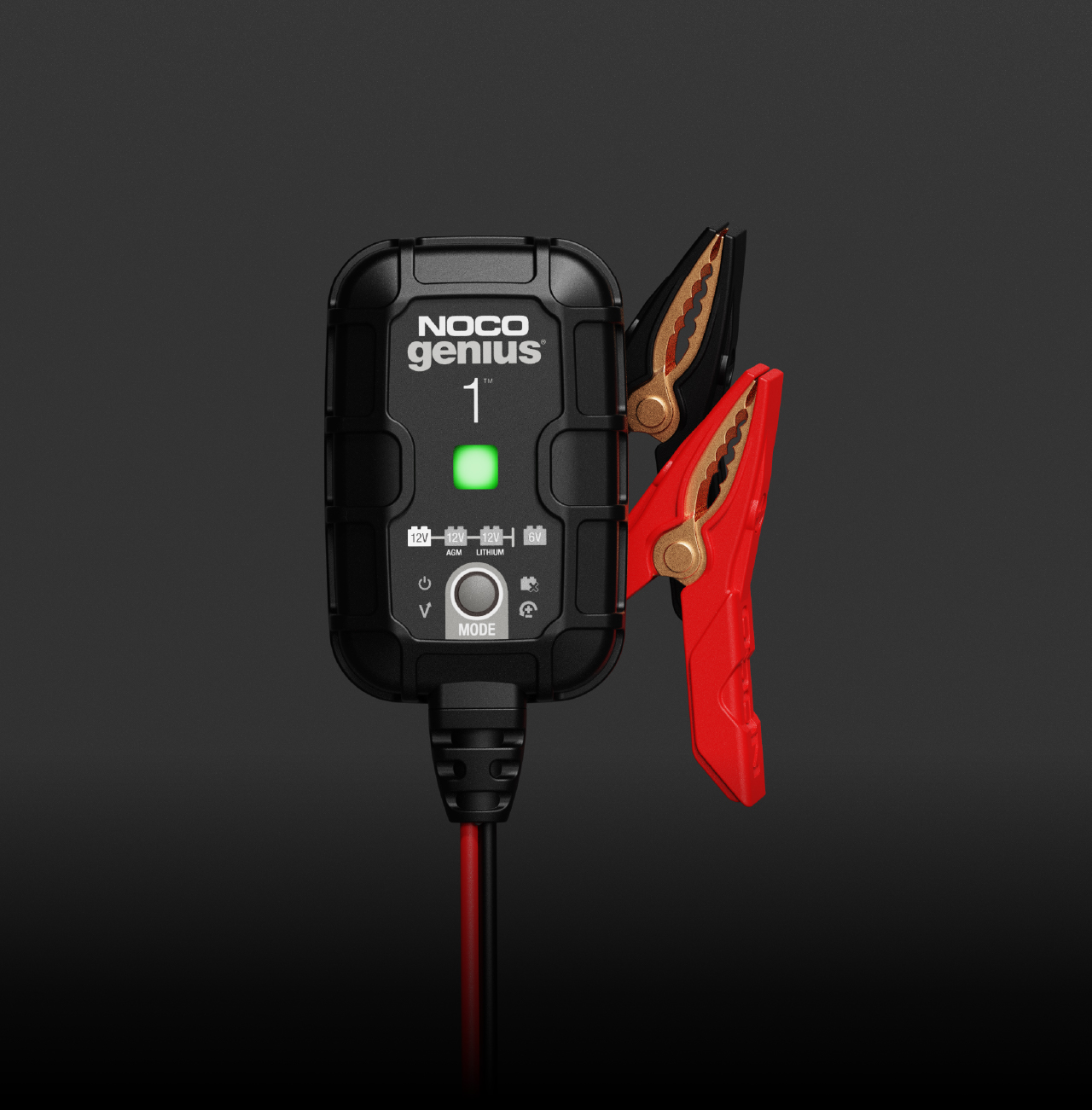
Your needs, this model
Does it fit your priorities?
Can the GENIUS1 maintain a 12 V lead-acid car battery while it is stored?
Its published specifications say it maintains all battery sizes, so the 1 A output is relevant to a battery that is already charged and is being kept up. That is different from using the stated up-to-30-Ah charging range to recover a deeply discharged larger battery. NOCO's manual says not to leave the product unattended while in use, so any storage setup must follow its supervision instructions as well as the battery maker's directions.
Explore this need in the finder →Does the GENIUS1 support a small 12 V AGM battery?
NOCO lists 12 V AGM support and the exact-model specifications list a 30-Ah upper charging capacity. The maker describes a dedicated 12 V AGM setting. Confirm that your battery's rated capacity and manufacturer's charge directions fit the intended use; the charger supplies only 1 A.
Explore this need in the finder →Can it charge a 12 V LiFePO4 battery?
NOCO documents a 12 V lithium mode, including lithium iron phosphate, but restricts that mode to batteries with a built-in battery management system (BMS). Select the lithium setting only after checking the battery maker's voltage and current instructions; the GENIUS1 remains a 1 A charger.
Explore this need in the finder →The GENIUS1 sits at the low-current end of NOCO’s plug-in Genius range. Its job is a narrow one: offer a selected charging mode for one compatible battery, then act as a maintainer when the battery is full. The important buying question is not whether its feature list is long, but whether its modest output and operating limits match the battery you intend to connect. This is a source-based assessment, not a hands-on test.
What the model is—and what it is not
NOCO specifies a 1 A DC output, one set of battery leads and 6 V or 12 V operation. Lead-acid modes cover wet/flooded, gel, EFB, maintenance-free and calcium types; 12 V AGM has a separate setting. Its 12 V lithium mode includes LiFePO4, but requires a built-in battery management system (BMS). It is not a 6 V lithium charger, a multi-bank unit or a jump starter. Select the correct mode; “automatic” charging does not identify the battery for you.
The manufacturer’s own limit needs careful attention: the exact-model specifications and North American guide state charging capacity up to 30 amp-hours, while maintenance is listed for all battery sizes. Those are different jobs. A low-current maintainer can be appropriate for keeping a charged battery up during storage without being the right recovery charger for a large, deeply discharged car battery. This does not make an unattended setup appropriate: NOCO's manual says not to leave the product unattended while in use.
How its low output changes the decision
At one amp, charging is gradual. It may suit a small battery, a patient top-up or maintenance of a charged battery; it is a poor fit when a full-size car battery must be restored promptly. NOCO’s support FAQ estimates 60 hours for an 80-Ah battery starting at 50% depth of discharge, yet that material also lists GENIUS1 charging up to 30 Ah. Because it does not reconcile the discrepancy with the exact-model rating, this assessment does not use the chart to expand the stated limit. Ask NOCO and the battery maker before relying on it to recover a larger discharged battery.
That conservatism also explains why the GENIUS1 should not be chosen by its “all battery sizes” maintenance line alone. A large battery that is already fully charged and connected for maintenance is not equivalent to a large battery that needs substantial energy restored. If your routine often involves the latter, compare a higher-output charger whose exact model documentation supports the battery’s amp-hour rating and required chemistry.
Battery chemistry and mode are essential checks
The manual and support page restrict 12 V lithium, including LiFePO4, to batteries with a built-in BMS. Confirm the battery chemistry, BMS and charge settings before connection; the mode is not permission to use any lithium pack. For lead-acid, choose the matching voltage setting; 12 V AGM has its own mode. Force Mode is for batteries below the normal detection threshold, not an everyday shortcut. NOCO warns it disables safety features and presents live output at the connectors. Follow the manual; do not use it on an unknown, damaged or frozen battery.
For a conventional 12 V starter battery, the GENIUS1 is most plausible as a maintainer in a storage setup that follows the manual's supervision conditions, or as a slow charger for a small battery within the stated capacity. The built-in clamps include integrated M6 eyelets, and the charger uses an interchangeable connector. Check that the supplied arrangement reaches the battery safely. NOCO’s current specs list the DC cable-plus-clamp length as 106 inches; its North American guide says approximately 107.2 inches. Those nearby but nonidentical values may reflect measurement or included-connector differences, so we do not treat either as a guaranteed installed reach.
Practical tradeoffs and safety
At 0.77 lb, this is a small single-battery unit with 120–240 V AC input. Its IP60 rating is not a waterproof on-board rating, and NOCO specifies operation only from -20 to 40 °C. The manual says to keep it dry, avoid a closed-in or poorly ventilated area, never charge a frozen battery, do not leave the unit unattended while in use, and do not run a load on the battery during charging. Those limits matter for outdoor, permanent or unattended setups.
The manuals’ safety directions are substantial because charging lead-acid batteries involves electrical and explosive-gas hazards. Identify polarity and chemistry, follow the battery maker’s precautions, keep sparks and flames away, wear eye protection, and make the battery connections before plugging the charger into AC. Do not treat protection circuitry as a substitute for sound connections or supervision.
Who should shortlist it
The GENIUS1 is worth considering if one amp is enough, one battery at a time is acceptable, a compatible wall outlet is available, and the goal is gentle charging of a small battery or maintenance of a charged battery. Its mode coverage is unusually broad for a small unit, but the compatibility is conditional: 6 V lead-acid, 12 V lead-acid, or 12 V lithium with BMS are separate choices, not simultaneous operating modes.
Look elsewhere if you need a fast recharge, several independent battery banks, a direct-mounted or waterproof on-board arrangement, a 24 V system, or a charger whose published capacity clearly covers a larger discharged car battery. Before buying, compare the exact GENIUS1 model and included connectors, read the current North American guide, and confirm the battery’s rating and charging instructions. The review can establish what NOCO documents; it cannot establish the condition of your battery, the charger’s actual performance in your installation, or the contents of a particular seller’s package.
Manufacturer references: GENIUS1 specifications, GENIUS1 support and charging FAQ, and the North American user guide.
Key specifications
Key details at a glance
| Output battery voltages | 6 / 12 V |
|---|---|
| Supported chemistries | Lead-acid / Lithium-ion |
| Rated DC charging current | 1 A |
| Published charge capacity limit | 30 Ah |
| Maintenance claim | Yes |
| Independent battery outputs | 1 |
| Arrangement | Portable plug-in charger |
| Ingress rating | IP60 |
| Minimum operating temperature | -20 °C |
| Maximum operating temperature | 40 °C |
| Included connection | Clamps with integrated M6 eyelets |
Use the exact model’s instructions for operating limits, supplied equipment and version differences.
Sources for this review
Sources for this assessment
Keep the next step evidence-led
Use the finder to combine voltage, battery chemistry, charging job and setup requirements; then check the exact model and its manual.