
Your needs, this model
Does it fit your priorities?
Can the NXT 5 NA charge a 12 V AGM battery?
CTEK lists AGM among the 12 V lead-acid types for the NXT 5 NA. It supplies up to 4.3 A, and the North American manual distinguishes charging up to 110 Ah from maintenance up to 160 Ah. Check the battery maker's allowed charging current and the exact manual before selecting the AGM mode.
Explore this need in the finder →Does the NXT 5 NA support LiFePO₄?
Yes. CTEK's current product page and North American manual include a 12 V lithium/LiFePO₄ program. Those materials do not state whether the battery must have a built-in BMS, so this model cannot answer either explicit BMS-condition choice; confirm the battery and charger manuals before use.
Explore this need in the finder →Is 160 Ah within the NXT 5 NA's charging range?
Do not use the product page's 1.2–160 Ah line as a recovery-charging limit. The North American manual specifies 1.2–110 Ah for charging and up to 160 Ah for maintenance; the review and finder therefore use 110 Ah as the conservative charging ceiling.
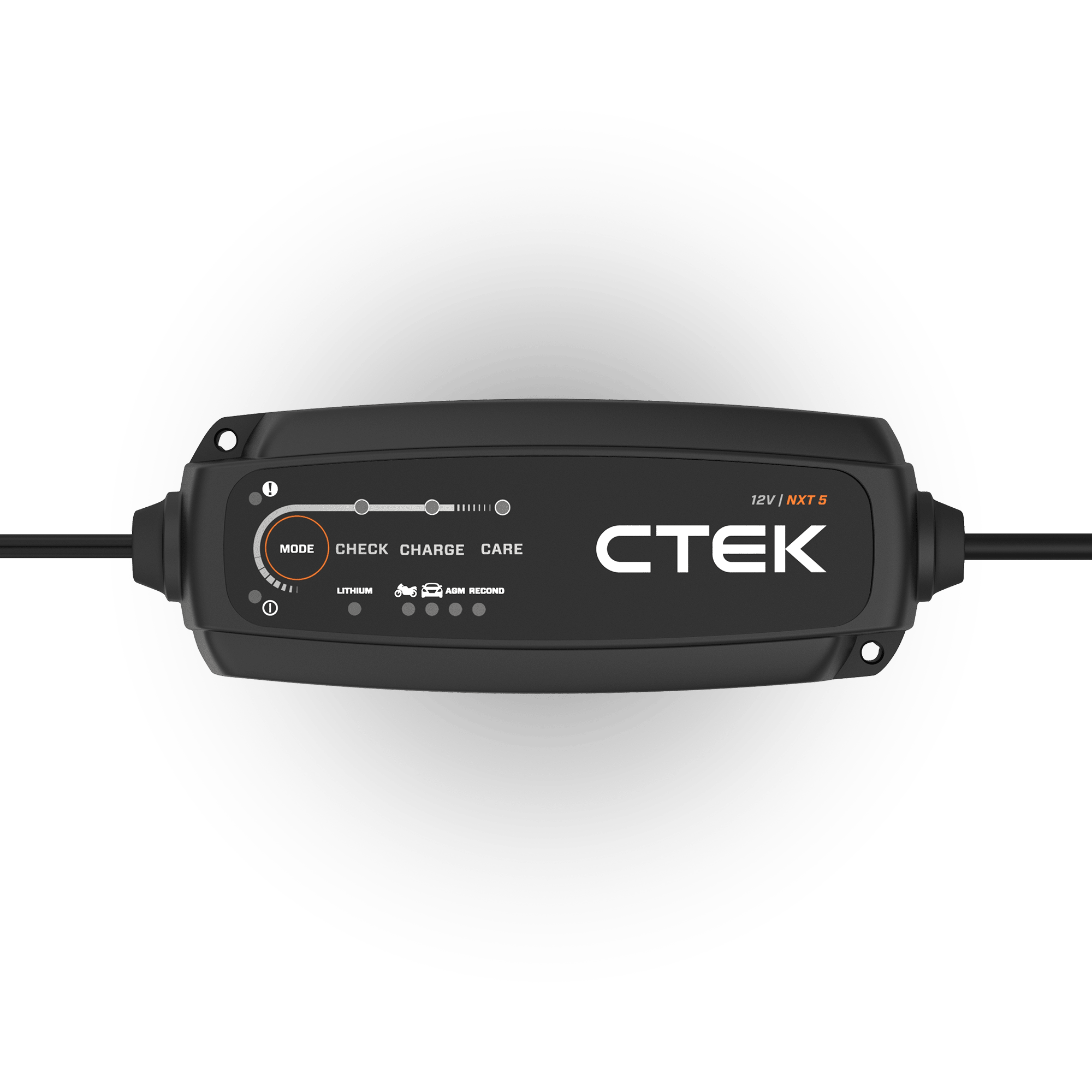
Explore this need in the finder →The CTEK NXT 5 NA (item 40-658) is a portable, single-output 12 V charger rated at 4.3 A. Its useful distinction within CTEK's NXT line is broad battery-type support in a modest-current package: it lists both lead-acid subtypes and LiFePO₄, while the larger NXT 15 adds more current and a separate Supply mode. This assessment uses CTEK's North American product page and manual; it is not a hands-on test.
Read the capacity figures by job
The NXT 5 is not simply a 160 Ah recovery charger. CTEK's current product page gives a 1.2–160 Ah battery-capacity range, but its North American manual makes a more useful distinction: 1.2–110 Ah for charging, with maintenance charging up to 160 Ah. Because those claims are not equivalent, the fit analysis uses 110 Ah as the conservative upper limit for charging a depleted battery. The 160 Ah figure describes the larger maintenance envelope, not a reason to charge a deeply discharged 160 Ah pack with this charger. At 4.3 A, this is a middle-output choice for a single battery, not a high-current shop supply. The exact charge time will depend on battery state, temperature, condition and the battery's own acceptance rate; the rating alone does not predict how quickly a particular car will be ready. The manual lists a 2.0 V starting threshold, but that is not a diagnosis or promise that an aged or damaged battery can be recovered. Follow CTEK's instructions for an error or a battery that does not progress through its cycle.Lead-acid coverage and a lithium setting
CTEK lists 12 V wet/flooded, maintenance-free, calcium, AGM, EFB and gel batteries. Its NXT 5 page describes automatic temperature compensation, reconditioning, and AGM optimization. Reconditioning is not a generic fix for every battery: use it only when the battery maker permits that treatment and the exact manual's warnings fit the application. A 12 V setting also should not be treated as evidence of support for 6 V or 24 V systems; this North American model is specified for 12 V. The manual and page also document a 12 V lithium program for LiFePO₄. That is a material difference from CTEK's MXS 5.0 NA, which is listed for lead-acid only. But the reviewed NXT 5 sources do not state whether the lithium battery must have a built-in battery-management system (BMS). That condition remains unknown, rather than being interpreted as “BMS not required.” Before charging lithium, compare the exact charger instructions with the battery maker's voltage, current and BMS requirements. The LiFePO₄ program is not a license to use lead-acid reconditioning on lithium; CTEK's instructions distinguish those uses.Placement, connection and supervision
The published enclosure rating is IP65, with a stated operating range of -20°C to +50°C and built-in temperature compensation. The manual nevertheless says not to expose the charger to rain or snow. Treat that instruction as a practical boundary: IP65 is not blanket permission to charge a vehicle in a wet location. The manual also says not to extend the charge cable, and calls for the charger to sit bottom-down during use. Plan a safe AC outlet and cable route before buying; do not make a lead extension the workaround for a poor location. CTEK lists battery clamps and a U-terminal connection option. That gives a choice between a temporary clamp connection and a fitted connector arrangement, but it does not establish that every retail package or seller listing contains the same accessories. Confirm item 40-658, the current North American manual, and what the actual box includes. The five-year warranty is a manufacturer statement, not a substitute for checking coverage, the original-purchaser terms or the particular seller's return policy. The North American manual also cautions that lead-acid charging can release explosive gas, forbids charging a frozen battery, and requires careful connection and disconnection. A long-storage maintainer should still be installed according to the vehicle and battery manuals and checked for the charger's end-of-cycle/error behavior; “automatic” does not mean that damaged wiring, a defective battery or an unsuitable location becomes safe.How it differs from the nearby choices
Choose the NXT 5 when one 12 V battery, the specified 4.3 A output and the conservative 110 Ah charging ceiling are enough, and the additional lithium mode matters. The CTEK MXS 5.0 NA has a similar 4.3 A output but is lead-acid only and separately lists 110 Ah for charging and 160 Ah for maintenance. The NXT 15 moves to 15 A and much larger documented capacities, and adds a Supply mode for a different task; it is not a drop-in match for a smaller battery's permitted charging rate. Compare its separate review if greater output or device support is important. For either NXT model, verify nominal voltage, exact chemistry, subtype, the battery's allowed rate and the official manual before connecting. If the battery label or BMS instructions are unclear, pause and ask the battery maker. The finder can narrow by documented features, but it cannot establish that a battery is healthy or compatible with an unlisted charging condition.Key specifications
Key details at a glance
| Output battery voltages | 12 V |
|---|---|
| Supported chemistries | Lead-acid / Lithium-ion |
| Rated DC charging current | 4.3 A |
| Published charge capacity limit | 110 Ah |
| Independent battery outputs | 1 |
| Arrangement | Portable plug-in charger |
| Ingress rating | IP65 |
| Minimum operating temperature | -20 °C |
| Maximum operating temperature | 50 °C |
Use the exact model’s instructions for operating limits, supplied equipment and version differences.
Sources for this review
Sources for this assessment

Keep the next step evidence-led
Use the finder to combine voltage, battery chemistry, charging job and setup requirements; then check the exact model and its manual.