
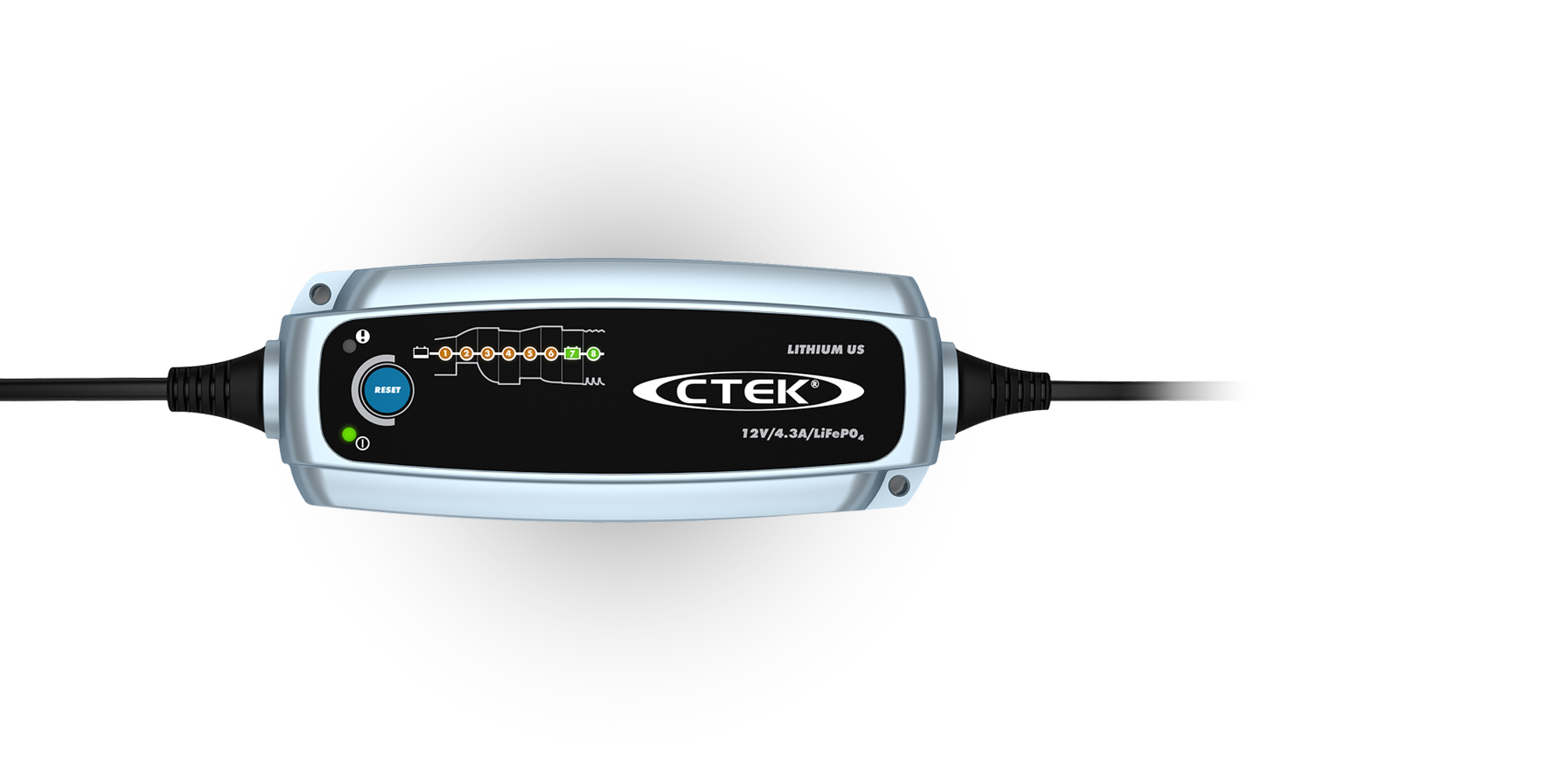
Your needs, this model
Does it fit your priorities?
Can the LITHIUM US recharge a 12 V, 60 Ah LiFePO₄ battery?
CTEK's manual and U.S. sheet list LiFePO₄ charging from 5 to 60 Ah at up to 4.3 A. The exact page's technical row also says 5–120 Ah, but its description separates 5–60 Ah charging from maintenance up to 120 Ah; this assessment uses 60 Ah for recharging.
Explore this need in the finder →Does a 120 Ah battery fit the LITHIUM US charging limit?
No: 120 Ah is CTEK's maintenance ceiling for an already charged battery, not its stated depleted-battery charging ceiling. The manual and U.S. sheet set the charging range at 5–60 Ah, so verify that the battery is already charged before considering the larger maintenance figure.
Explore this need in the finder →Does CTEK state that a LiFePO₄ battery must have a BMS for this charger?
The reviewed exact page and North American documents do not specify the BMS condition. CTEK describes resetting fitted low-voltage protection electronics, but that is not evidence that a battery without a BMS is supported. Check the battery maker's instructions rather than treating this assessment as compatibility confirmation.
Explore this need in the finder →The CTEK LITHIUM US (item 56-926; North American manual model 1082) is a mains-powered charger for one 12 V LiFePO₄ battery. It is not a general-purpose 12 V charger: CTEK's manual says to use it only with LiFePO₄, and the exact-page specification identifies a single output. That narrow brief is its advantage when the battery chemistry is known and its limitation when a vehicle may use lead-acid or another lithium chemistry.
Separate the charge limit from the maintenance limit
The manual and U.S. product sheet give the most useful capacity distinction: a 5–60 Ah charging range and maintenance support up to 120 Ah. The exact product page's descriptive text makes the same distinction, but its technical-data row simply says “5–120 Ah.” Because that shorthand could be mistaken for permission to recharge a depleted 120 Ah battery, this review treats 60 Ah as the charging ceiling and 120 Ah as a separate maintenance figure. The public finder checks the charge ceiling, not the lower 5 Ah edge or the maintenance range; check a small battery against its own instructions before charging.
CTEK rates the normal output at up to 4.3 A. The manual describes an eight-step automatic cycle: it checks whether the battery can accept and retain charge, moves through charging and maximization stages, then uses float and pulse maintenance. The sequence explains what the unit is designed to do; it is not a measured charge-time promise or a diagnosis that a damaged battery can be restored.
Dedicated lithium mode, not an adjustable chemistry selector
The charger is specified for 12 V LiFePO₄ only. Do not apply the “lithium-ion” label broadly to other chemistries, and do not infer lead-acid support from CTEK's wider charger range. The manual lists a 2.0 V minimum battery voltage and charging voltages of 13.8/14.4 V, but a voltage threshold is not permission to force-charge a failed or unsafe battery. Follow the vehicle and battery makers' charging instructions.
CTEK says the charger can reset low-voltage protection electronics fitted to a battery. That wake-up feature does not establish whether the battery must have a built-in battery-management system: the reviewed exact page, manual and product sheet do not answer that question. I therefore leave the BMS field unknown rather than claiming support either with or without one. The North American manual also says not to charge a battery below 32 °F (0 °C) unless its manufacturer says otherwise. Confirm the BMS, temperature and charging instructions with the battery maker before connection.
Connection, outlet and environment checks
The page identifies a U.S. 12 V charger with a 110–120 VAC, 50–60 Hz input; the linked manual agrees. The product sheet instead lists 100–115 VAC. That source discrepancy is not resolved here, so check the label and current instructions for the exact unit and do not rely on a generic plug photo. The manual diagrams CTEK Comfort Connect clamp and M6 eyelet leads. Confirm which accessories are in the exact retail offer and that the connector suits the vehicle's posts.
The current page gives a +5 to +50 °C ambient range, while the linked manual and product sheet state −20 to +50 °C. I preserve the narrower current-page lower limit as a cautious public reference and recommend checking the instructions shipped with the charger. The page lists IP65, but the manual separately says not to expose the charger to rain or snow; an enclosure rating is not an override of that instruction. CTEK lists a five-year warranty, subject to its terms.
Who should shortlist it
This configuration makes sense to investigate when the battery is positively identified as 12 V LiFePO₄, has a capacity within the 5–60 Ah charge range, and its manufacturer permits the charger’s 4.3 A output. For a larger battery that is already charged, the separate 120 Ah maintenance claim may be relevant, but it does not extend the depleted-battery charging range. If the battery is lead-acid, 6 V, 24 V, or another lithium type, choose a charger with a documented plan for that exact chemistry and voltage instead. If you need multiple independent battery outputs, this one-output charger is also the wrong format.
This is a source-based assessment of CTEK's U.S. product page, manual and product sheet—not a hands-on test. It cannot establish the condition of a specific battery, vehicle compatibility, real charging time or real-world water resistance. Before use, verify the exact item, battery chemistry and capacity, BMS guidance, allowable charge current, outlet range, included connection lead and current safety instructions.
Key specifications
Key details at a glance
| Output battery voltages | 12 V |
|---|---|
| Supported chemistries | Lithium-ion |
| Rated DC charging current | 4.3 A |
| Published charge capacity limit | 60 Ah |
| Independent battery outputs | 1 |
| Arrangement | Portable plug-in charger |
| Ingress rating | IP65 |
| Minimum operating temperature | 5 °C |
| Maximum operating temperature | 50 °C |
Use the exact model’s instructions for operating limits, supplied equipment and version differences.
Sources for this review
Sources for this assessment

Keep the next step evidence-led
Use the finder to combine voltage, battery chemistry, charging job and setup requirements; then check the exact model and its manual.