
Your needs, this model
Does it fit your priorities?
What does TRY mean on the CT5 TIME TO GO?
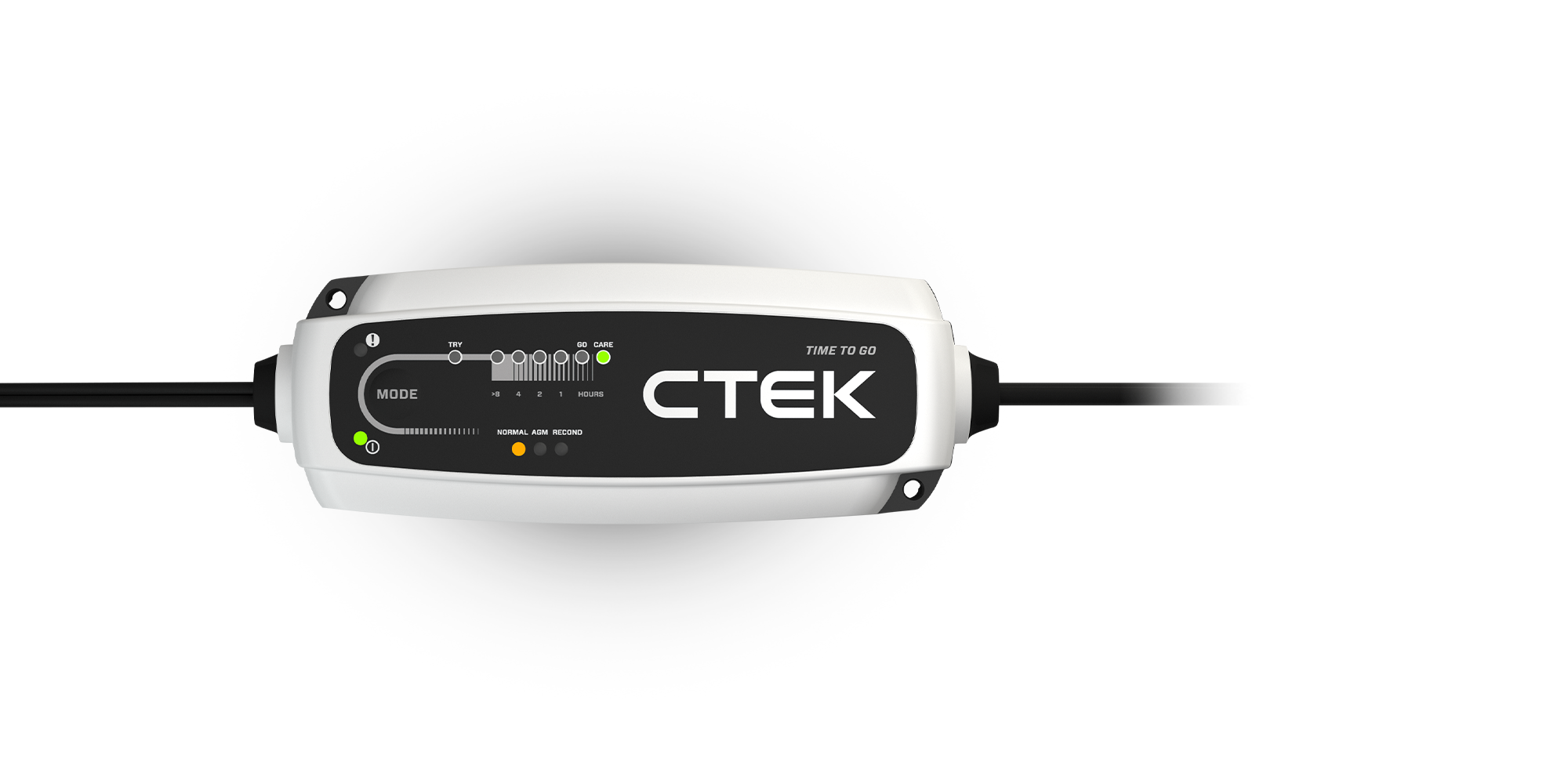
CTEK's manual says the TRY indicator permits one start attempt; it does not mean the battery is fully charged. GO marks the manufacturer's ready-to-use stage at about 80%, while CARE means fully charged and maintenance. If the battery does not start, continue the supported charge cycle rather than treating TRY as a second attempt or a capacity guarantee.
Explore this need in the finder →Does 160 Ah fall within the CT5 TIME TO GO NA charge range?
Yes, 160 Ah is the stated upper edge of the exact U.S. page, manual and U.S. product sheet range. CTEK's example for a 110 Ah battery estimates 28 hours from empty to GO, but that example is not a guaranteed full-charge time. A request above 160 Ah is outside the documented range.
Explore this need in the finder →Can the CT5 maintain an already-charged lead-acid battery?
Yes. The manufacturer describes the CARE stage as fully charged and in maintenance, and lists 20–160 Ah. The countdown is an estimate of charge progress, not a substitute for the battery manufacturer's charging limits or a guarantee of remaining battery life.
Explore this need in the finder →CTEK's North American CT5 TIME TO GO NA, item 40-255, turns the usual charger-status lights into an estimated time-to-ready display. The product identity matters: the page's short marketing copy calls it a “5A charger,” but the detailed technical table, linked North American manual and U.S. sheet all specify 4.3 A maximum. This assessment uses 4.3 A rather than silently treating the marketing line as a verified output rating. It is a source-based review, not a timing test; the hours in CTEK's manual are maker estimates rather than measurements made here.
What TRY, GO and CARE actually tell you
The display is the reason to consider this model. As the charge proceeds, LEDs show estimated remaining time in broad steps; CTEK gives examples of 20 Ah to GO in five hours, 60 Ah in 15 hours and 110 Ah in 28 hours. Those are estimates from a specified manufacturer example, not a promised schedule for every battery: state of charge, health, temperature and the vehicle's electrical loads can alter the experience. The manufacturer's North American FAQ says the time estimate is less accurate below 20 Ah, which is consistent with the published 20 Ah lower rating.
The three milestone names are not interchangeable. TRY means one start attempt can be made if necessary; it is not a “charged enough for repeated starts” signal. GO is the maker's ready-to-use point at roughly 80 percent. CARE indicates full charge and automatic maintenance. That distinction helps with a stranded-car situation, but the device is still a battery charger rather than an emergency jump starter. If the battery fails to crank at TRY, continuing the charge is more appropriate than reading the display as a guarantee.
Capacity and chemistry boundaries
The exact U.S. page, manual and product sheet list a 20–160 Ah 12 V lead-acid range. The manual's example battery is 110 Ah; its estimated 28-hour path to GO reinforces that TIME TO GO is an approximate planning aid, not an exact countdown to 100 percent. CTEK documents a separate maintenance stage after full charge. A request for a large battery should be checked against that 160 Ah upper rating, while a battery below 20 Ah is a poor fit for this particular model and its display.
CTEK identifies WET/flooded, EFB, maintenance-free, calcium/calcium, AGM and GEL lead-acid batteries. The standard program is for many common lead-acid types; the dedicated AGM setting is for AGM. RECOND uses a 15.8 V stage at a lower listed current and is documented for WET, EFB and Ca/Ca batteries in the manual's 27–95 Ah Recond range. That is not a substitute for normal AGM charging, and it should only be used where the battery maker's instructions permit it. There is no lithium, 6 V, 24 V or general-purpose device-power plan.
Although CTEK's exact page says up to 4.3 A in its specification table, its top-level promotional text includes a 5 A phrase. The linked manual and U.S. sheet also state 4.3 A, so compare this as a 4.3 A charger. Its one output is portable, takes North American 110–120 VAC / 50–60 Hz input and has a 2.0 V start threshold. A battery that is below recognition voltage, damaged or frozen needs the proper battery-maker or service procedure, not a promise that this charger will revive it.
Useful maintenance without a false guarantee
CARE is a useful storage cue because CTEK says the unit automatically moves from charging into maintenance. The exact item page says clamps and eyelets are included, but a current offer should still be checked for the exact connector set and North American plug. The built-in temperature sensing compensates charge voltage according to ambient temperature; the manual lists an operating range of -4°F to 122°F (-20°C to 50°C). IP65 is a protection rating, not a reason to ignore the manual's explicit instruction not to expose the charger to rain or snow. The manual also prohibits extending the charge cable, a practical limitation for reaching a remote battery or wall outlet.
At 4.3 A this is aimed at routine 12 V lead-acid cars and start-stop vehicles, not a rapid large-battery recovery tool. Confirm the battery maker's permitted rate, the correct vehicle ground point and the environment around the battery. Do not use TIME TO GO as a laboratory diagnosis of alternator health: unlike the MUS 4.3 TEST&CHARGE, its distinctive display reports charging progress rather than providing the same separate battery/start/alternator test programs.
Choose the display, not the 5 A slogan
This CT5 earns its place when a countdown and a clear stage for “one start try,” “ready for use” and “fully charged/maintenance” solve an everyday planning problem. Choose a different charger if the battery falls below its 20 Ah range, if you need lithium compatibility, a higher documented output or multi-bank charging, or if separate charging-system test modes matter more than a progress estimate. The current page's 5 A phrase and its 4.3 A detailed rating should stay visible in any comparison; the lower, linked specification is the safer number to use.
Primary evidence: CTEK's exact U.S. item 40-255 page, the linked North American model 1090 manual, U.S. product sheet and CTEK's CT5 TIME TO GO FAQ. The answer guide keeps the stated capacity boundary distinct from a maintenance use; the finder provides all currently reviewed matches.
Key specifications
Key details at a glance
| Output battery voltages | 12 V |
|---|---|
| Supported chemistries | Lead-acid |
| Rated DC charging current | 4.3 A |
| Published charge capacity limit | 160 Ah |
| Independent battery outputs | 1 |
| Arrangement | Portable plug-in charger |
| Ingress rating | IP65 |
| Minimum operating temperature | -20 °C |
| Maximum operating temperature | 50 °C |
Use the exact model’s instructions for operating limits, supplied equipment and version differences.
Sources for this review
Sources for this assessment

Keep the next step evidence-led
Use the finder to combine voltage, battery chemistry, charging job and setup requirements; then check the exact model and its manual.