
Your needs, this model
Does it fit your priorities?
Does item 40-687 add charging capacity over the CT5 TIME TO GO NA?
No. CTEK identifies the kit as including its CT5 TIME TO GO charger and the linked kit sheet gives the same 4.3 A and 20–160 Ah charger specifications. The useful distinction is the package: the page lists quick-connect, silicone cover and clamps; its linked sheet also itemizes an M8 indicator eyelet, CONNECT CLAMP, BUMPER 60 and storage case. Verify the current box contents.
Explore this need in the finder →Is the CT5 kit a two-bank charger because it includes extra connectors?
No. The connectors are quick-connect accessories for attaching the same single charger to a battery; the base charger has one 12 V charging output. They do not permit simultaneous charging of a second battery or multiply the 4.3 A rating.
Explore this need in the finder →Is the CT5 kit's battery-size range different from the base CT5?
The exact kit page and linked kit sheet repeat the base charger’s 20–160 Ah range. The extra package items change the connection/protection setup, not the charger's battery chemistry, current or capacity range. Follow the manual and battery maker's charging instructions.
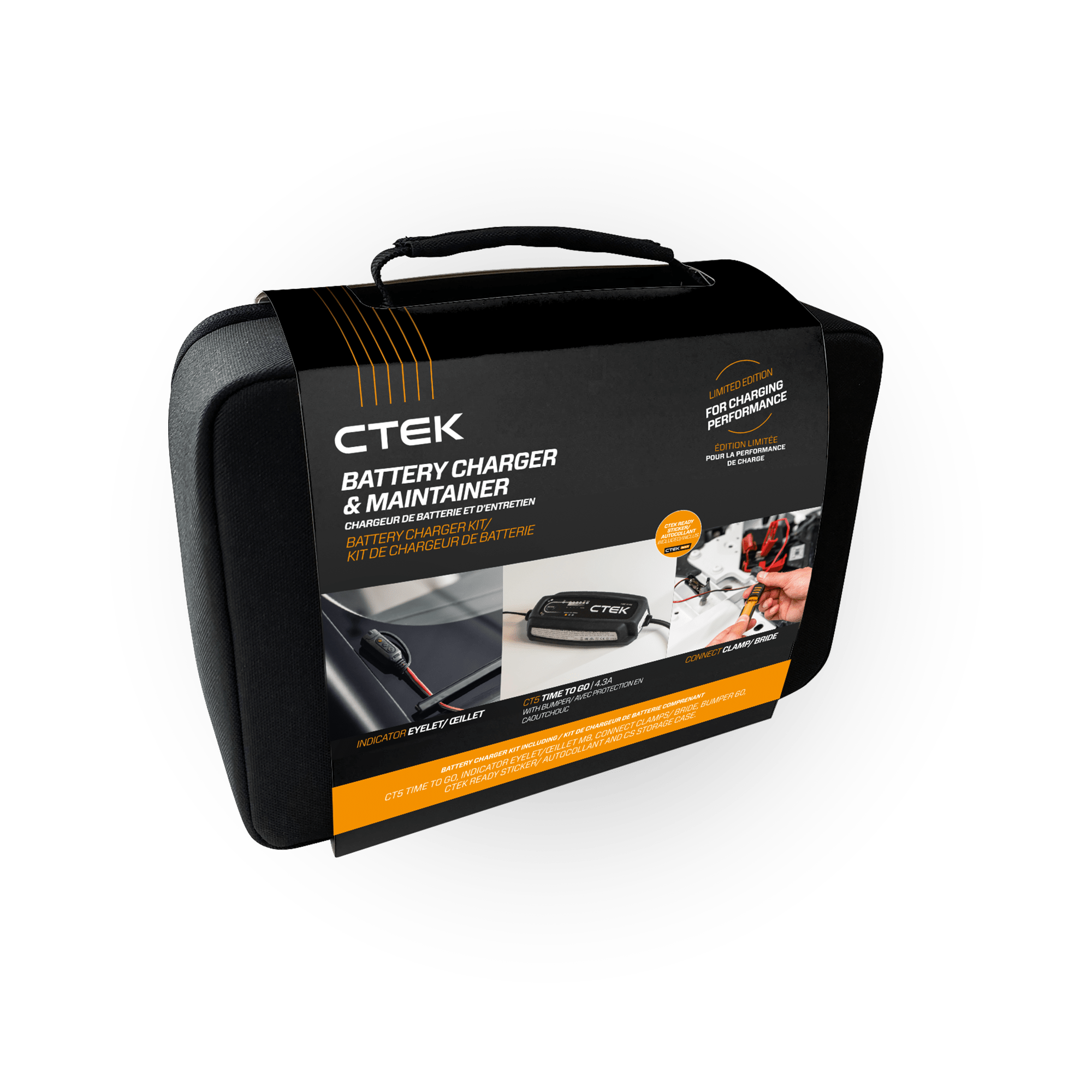
Explore this need in the finder →The CT5 TIME TO GO BATTERY CHARGER KIT NA is a separate North American retail configuration, item 40-687, built around the same CT5 TIME TO GO charger sold as item 40-255. The kit is not a higher-output or multi-bank version: the included charger remains a portable one-output 12 V lead-acid unit, with the same conservative 4.3 A rating and 20–160 Ah range. The point of this package is the connection/protection accessories and the staged countdown display, not a different charging circuit. This is a source-based package assessment, not a physical box inspection.
What changes from the standalone charger
The exact U.S. kit page names the CT5 TIME TO GO, a quick-connect accessory, a silicone protective cover and battery clamps. The product-sheet file linked from that page itemizes the bundle in more detail: an INDICATOR EYELET M8, CONNECT CLAMP, BUMPER 60 and CS STORAGE CASE, alongside the charger. The exact page and older 2024 sheet do not reconcile every component description or current-box contents. The pictured original kit package likewise shows the charger, eyelet and Connect Clamp, bumper and case, but a marketing image cannot prove that every seller's current box is complete. Confirm the item 40-687's actual accessory list and connector type before ordering.
For a buyer who intends to keep a quick-connect eyelet on the car battery, a compatible clip-on connection can make repeated maintenance less fiddly than attaching loose clamps each time. A bumper can protect the charger body from contact with the surrounding work area, and a storage case is useful for keeping a portable kit together. These are package conveniences, not evidence that the charger can be used in wet weather, left in a hot engine bay or permanently wired into a vehicle. The included charger remains portable and requires a household AC outlet.
Same countdown, same capacity and current limits
The kit page and its linked sheet repeat a 20–160 Ah 12 V lead-acid rating and a 4.3 A output for the CT5. Its display moves through TRY, GO and CARE states: TRY allows one start attempt; GO marks the manufacturer-described ready-to-use stage around 80 percent; CARE marks full charge and maintenance. The time-to-go LEDs are estimates, not a reservation that the car will be ready at an exact minute. CTEK's model-family FAQ says the remaining-time estimate is less accurate below 20 Ah. This kit does not add a new battery-size range or charging mode compared with the base charger.
The base page's headline copy briefly calls the charger “5A,” but its detailed table, linked North American manual, U.S. sheet and kit sheet identify 4.3 A. Use 4.3 A for comparison and follow the battery maker's allowed rate. Supported chemistries are lead-acid types—WET/flooded, EFB, maintenance-free, Ca/Ca, AGM and GEL—not lithium. Its dedicated Recond procedure applies to the manual's specified WET/EFB/Ca-Ca types within the stated Recond range; it should not be casually selected for AGM or GEL. CARE maintenance after full charge is a different task from recovery charging.
Questions the bundle does not solve
Extra accessories do not create an independent charging bank, another 4.3 A output, an onboard charger arrangement, a jump-start function or general-purpose 12 V device power. The manual's 2.0 V minimum start threshold also means a profoundly discharged or damaged battery may not be recognized; do not buy the kit on an assumption that it will revive any dead battery. Nor should the TIME TO GO estimate be treated as a battery-health report. CTEK's other MUS 4.3 TEST&CHARGE has separate battery, starting-power and alternator test modes; the kit's differentiator is packaging, not those test functions.
The exact charger instructions still govern setup: connect using the vehicle maker's specified ground point, ventilate the charging area and do not charge a frozen or damaged battery. The North American manual says not to expose the charger to rain or snow and not to extend the charge cable. IP65 does not override those instructions. These constraints matter even if the bundle includes a storage case or rubber bumper; those accessories protect the device during handling, not during outdoor charging.
Who should pay attention to item 40-687?
This configuration merits consideration when the CT5's countdown display fits a 12 V lead-acid battery within 20–160 Ah and the exact kit's permanent eyelet/quick-connect, cover or carry/storage extras are useful. If those accessories are already owned, compare item 40-255 instead and do not assume the kit changes battery performance. If a long cable, a different connector or guaranteed replacement parts matter, compare the current seller's box list with the official sheet and ask which edition is being supplied. The article makes no claim about current retail stock or price.
Primary evidence: CTEK's exact U.S. item 40-687 kit page and its linked U.S. product sheet, checked against the base item 40-255 page and North American manual. Read the answer guide for the same-condition choice and open the 12 V lead-acid finder for every currently reviewed model.
Key specifications
Key details at a glance
| Output battery voltages | 12 V |
|---|---|
| Supported chemistries | Lead-acid |
| Rated DC charging current | 4.3 A |
| Published charge capacity limit | 160 Ah |
| Independent battery outputs | 1 |
| Arrangement | Portable plug-in charger |
| Ingress rating | IP65 |
| Minimum operating temperature | -20 °C |
| Maximum operating temperature | 50 °C |
Use the exact model’s instructions for operating limits, supplied equipment and version differences.
Sources for this review
Sources for this assessment
- CTEK CT5 TIME TO GO BATTERY CHARGER KIT NA exact U.S. product page, item 40-687
- CTEK CT5 TIME TO GO BATTERY CHARGER KIT NA U.S. product sheet
- CTEK CT5 TIME TO GO BATTERY CHARGER KIT NA exact package image
- CTEK CT5 TIME TO GO NA charger page for the included charger, item 40-255
- CTEK CT5 TIME TO GO North American user manual, technical model 1090
- CTEK North American CT5 TIME TO GO FAQ, product-family behavior and display definitions

Keep the next step evidence-led
Use the finder to combine voltage, battery chemistry, charging job and setup requirements; then check the exact model and its manual.