
Your needs, this model
Does it fit your priorities?
Can the CS ONE (Gen 2) NA charge a 12 V AGM battery near 180 Ah?
CTEK lists AGM and a 3–180 Ah battery-capacity range for this 12 V charger. It is rated at up to 8 A, so the battery maker's permitted charge rate still matters. Use APTO for normal charging; CTEK says not to use RECOND with AGM.
Explore this need in the finder →Does its lithium listing prove an undocumented BMS condition?
No. CTEK lists 12 V LiFePO4 charging, but the reviewed product sheet and manual do not state a general BMS requirement for ordinary APTO charging. The manual separately says not to use SUPPLY or WAKE UP on deeply discharged LiFePO4 without a BMS; verify the exact battery instructions before any such mode.
Explore this need in the finder →Can SUPPLY power any 12 V accessory while the battery is disconnected?
The North American manual describes app-controlled 13.6 V SUPPLY for maintaining vehicle contact power during service or battery replacement, up to 8 A/100 W. It does not describe a general accessory outlet, and its safety text limits low-voltage-system supply to a starter-motor application. Do not treat this as a general-purpose device-power match.
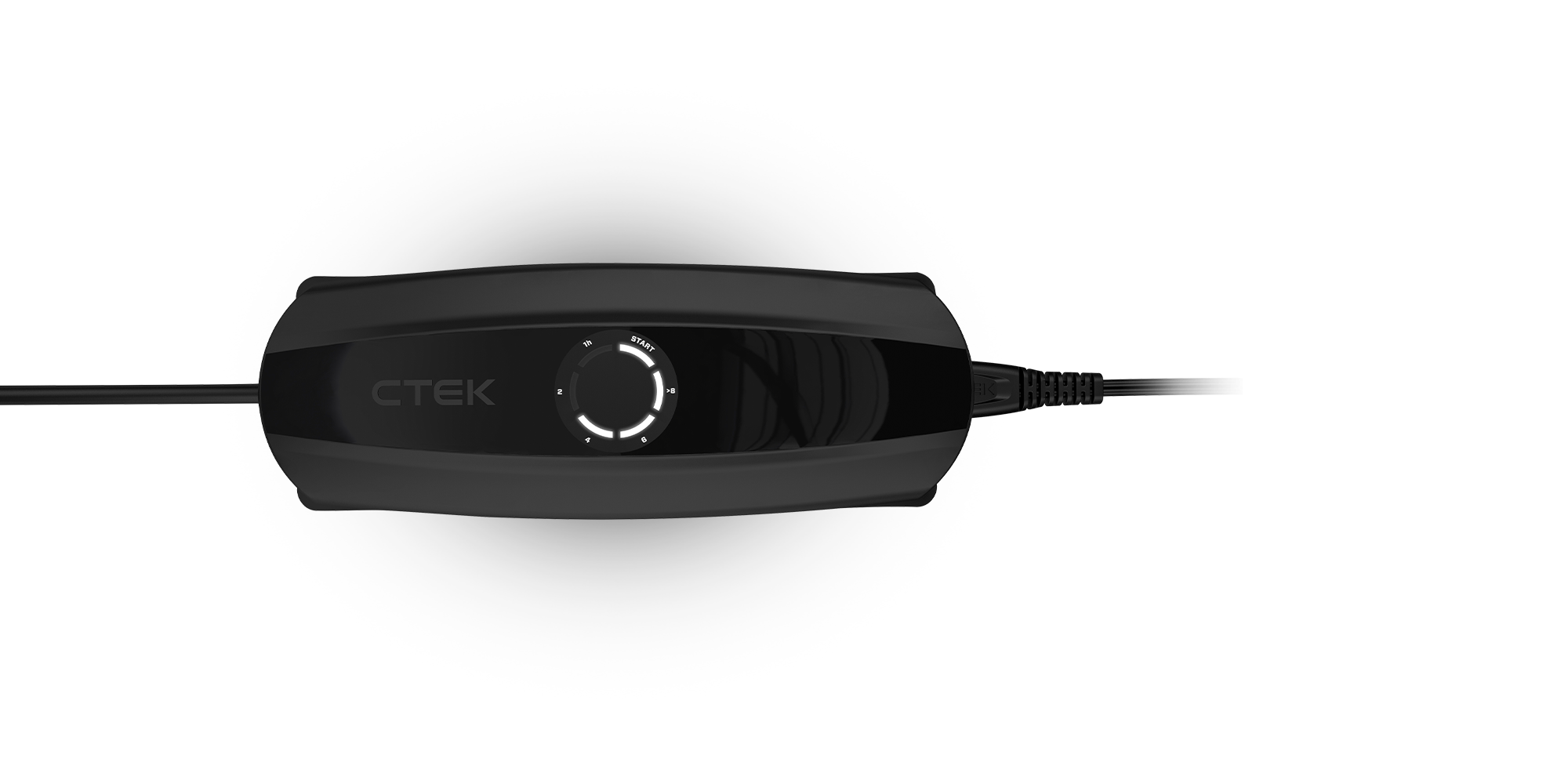
Explore this need in the finder →The CTEK CS ONE (Gen 2) NA (item 40-704) is a portable, single-output 12 V charger rated at 8 A. CTEK lists it for 3–180 Ah lead-acid and LiFePO₄ batteries, with automatic charging and maintenance. This is a source-based assessment of the exact North American product page, manual and product sheet—not a hands-on test.
Broad chemistry support, one 12 V plan at a time
The model supports common 12 V lead-acid types: wet/flooded, maintenance-free, calcium, AGM, EFB and GEL. CTEK also lists 12 V LiFePO₄. That breadth is useful when a household has multiple battery chemistries, but it does not add 6 V or 24 V capability or support two batteries at once. The included clamps serve one output.
CTEK rates the charger at 8 A and gives a 3–180 Ah capacity range. Treat that as the stated compatibility window, not a promise about charge time or a safe current for every battery. Eight amps can exceed a small battery's maker-specified rate. Check the battery instructions and vehicle connection points before connecting it. The 110–120 VAC, 60 Hz input makes this a plug-in North American unit rather than an onboard charger.
The lithium listing needs care. The reviewed sources do not state a general BMS requirement for ordinary APTO charging, so this assessment claims neither that a BMS is required nor that it is unnecessary. CTEK does restrict special modes: do not use SUPPLY or WAKE UP on deeply discharged LiFePO₄ without a BMS. Confirm the exact battery's instructions; a 12 V label alone does not make lithium batteries interchangeable.
APTO does the routine charging; the app is for advanced functions
In the normal APTO path, the manual says the charger recognizes the battery and selects a program automatically. CTEK describes the clamps as polarity-free for routine charging. After a full charge, the unit changes to maintenance and may remain connected for long-term storage. Confirm that Maintenance begins within 80 hours; if not, CTEK recommends checking whether the battery is faulty rather than leaving the setup unattended indefinitely.
Gen 2 adds Wi-Fi and Bluetooth connectivity to CTEK's app. APTO charging does not require choosing a mode; the app unlocks RECOND, WAKE UP, SUPPLY, charging history and updates. This adds special controls and records, but buyers who prefer a local, button-only workflow should account for phone setup. CTEK lists 2.4 GHz Wi-Fi and Bluetooth LE 5.1; the phone must be nearby over Bluetooth to activate SUPPLY and WAKE UP.
WAKE UP is intended for deeply discharged lead-acid or lithium batteries with undervoltage protection that the charger may not initially detect. It is an attempt to make a battery detectable, not proof that an aged, damaged or failed battery can be recovered. CTEK warns that WAKE UP disables spark protection and is not for deeply discharged LiFePO₄ without a BMS. If a battery remains undetected, follow the manual's troubleshooting and battery-test guidance.
RECOND is narrower still. CTEK says it is for deeply discharged lead-acid and limits use to one or two times per year. The manual excludes AGM, GEL and LiFePO₄. It is not a generic repair setting or a substitute for the battery maker's instructions.
SUPPLY is vehicle support, not a general accessory outlet
The app's SUPPLY mode provides 13.6 V at up to 8 A, with a 100 W output limit. CTEK describes it as maintaining vehicle contact power during service or battery replacement. This is a specialized workshop task, not a second battery-charging plan. The North American manual warns that the charger is not intended to supply a low-voltage system except in a starter-motor application; neither source establishes a general-purpose 12 V accessory outlet. This assessment therefore does not treat SUPPLY as a match for a standalone device-power need. In SUPPLY, unlike APTO charging, the clamps are not polarity-free: follow the marked polarity and app sequence.
Weather, cord reach and exact package checks
The sheet lists IP65 and an ambient range of −30 °C to +50 °C with temperature compensation. The manual still says not to expose it to rain or snow, so IP65 is not blanket permission for wet outdoor use. Keep the setup ventilated and do not charge frozen batteries. CTEK lists a five-year limited warranty, subject to the manual's terms, proof-of-purchase and handling conditions.
The manual lists the CS ONE, clamps, user manual, safety sheet and gift box. The U.S. sheet calls the mains input cord 6.23 ft (1.9 m), while the page's generic cable field says 1.4 m without identifying the lead. Check the actual outlet-to-vehicle layout rather than relying on a broad reach claim. The charger is about 9.25 × 3.46 × 2.05 in and roughly 1.5 lb.
The CS ONE (Gen 2) makes sense when one portable 12 V charger must cover the listed lead-acid subtypes and LiFePO₄, and its 8 A output fits the battery maker's limit. It is not a fit for 6 V or 24 V batteries, multiple independent banks, a permanent onboard installation or a documented general-purpose DC supply. Verify item number, chemistry, Ah range, current limit, BMS guidance, app needs and connection points before purchase.
Key specifications
Key details at a glance
| Output battery voltages | 12 V |
|---|---|
| Supported chemistries | Lead-acid / Lithium-ion |
| Rated DC charging current | 8 A |
| Published charge capacity limit | 180 Ah |
| Independent battery outputs | 1 |
| Arrangement | Portable plug-in charger |
| Ingress rating | IP65 |
| Minimum operating temperature | -30 °C |
| Maximum operating temperature | 50 °C |
Use the exact model’s instructions for operating limits, supplied equipment and version differences.
Sources for this review
Sources for this assessment
Keep the next step evidence-led
Use the finder to combine voltage, battery chemistry, charging job and setup requirements; then check the exact model and its manual.