
Your needs, this model
Does it fit your priorities?
Can I maintain four separate 12 V AGM batteries at once?
The exact PL4050 page and manual describe four independent channels and 5 A per channel. Each 12 V battery can use a separate channel; do not add the outputs together as one higher-current single-battery mode.
Explore this need in the finder →How many 6 V batteries can the PL4050 serve?
Only bank 4 has a 6/12 V selector. It can serve one 6 V battery; banks 1–3 are 12 V channels. The 6 V plan therefore has one bank, even though the station has four channels overall.
Explore this need in the finder →Can four 5 A channels deliver 20 A to one battery?
No. The PL4050 has four independent channels, each rated at up to 5 A. Its combined channel count does not create an approved 20 A single-battery output.
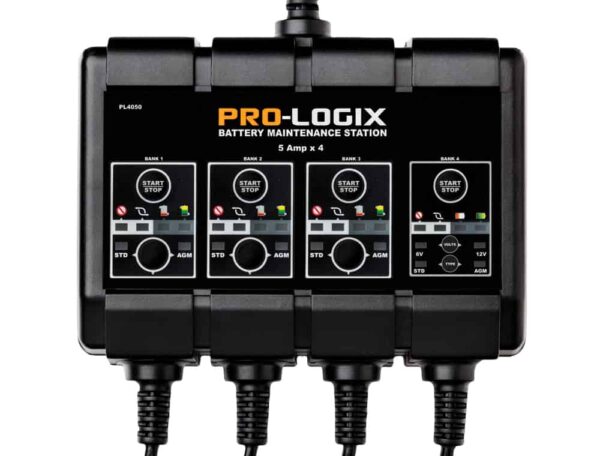
Explore this need in the finder →The PRO-LOGIX PL4050 is a four-channel battery maintenance station rated at 5 A per channel. Three banks are 12 V only; bank 4 can be set to 6 V or 12 V. That arrangement makes the PL4050 more flexible than the 12 V-only PL4020 when a shop or storage routine has a 6 V battery to accommodate, but it does not create four 6 V outputs. This is a review of the current U.S. product documentation, not a performance test.
Four outputs, with a one-bank 6 V exception
Each of the PL4050’s four outputs is independent and limited to 5 A. With every bank set for 12 V, the station can serve up to four separate 12 V batteries, each with its own battery-type selector and status lights. The four-channel total is not a 20 A output for one battery. Connecting one battery to multiple outputs is not a supported way to combine current.
Bank 4 is the important exception. It adds the 6 V setting; banks 1–3 remain 12 V channels. The manual and maker’s diagram make this difference visible on the control panel. For a 6 V job, the model has one suitable bank, not four. In a mixed shop routine the source documents allow the independent channels to serve different battery types at once, but verify each individual connection and voltage setting. The finder cannot express a mixed-voltage arrangement as one answer, so its 6 V match should be read as a single-bank 6 V task.
Battery support is lead-acid, not a blank check
The product page and PL4050-specific control layout identify standard/flooded and AGM lead-acid batteries, including spiral-wound AGM. The manual says to select STD for conventional and maintenance-free flooded batteries, and AGM for AGM. No lithium profile is established by the exact model page, sheet or product-specific selector, so this assessment does not treat the PL4050 as a lithium charger. Do not infer LiFePO₄ support from another PRO-LOGIX model or a generic manual paragraph.
Clore lists an enhanced maintenance mode, seven-phase charging, temperature compensation, Soft Start, Recondition and power-outage recovery. Those are useful features for repeated shop or storage jobs, but neither the page nor the manual states a compatible Ah range. Five amperes per bank is not enough to create a manufacturer-approved battery-size limit. Confirm the battery’s own instructions and ask Clore if the capacity ceiling matters to your use.
Lead reach and mounting
The exact page lists four clamp leads and 72 inches per channel. A 10-foot extension, shorter clamp leads and shorter ring-terminal leads are optional accessories. The manual warns not to use the standard-length output leads with the extension because voltage drop could undercharge a battery; it specifies shorter accessories for that route. Check the exact package, accessory model and physical distance before ordering. The product sheet describes a mountable design, and the 5.5 lb station can also be hung with its supplied hook as the instructions allow.
Weather, marine use and supervision
The information sheet describes a sealed case, but the manual says not to expose the charger to rain or snow. No IP rating or exposed wet-weather approval is established, so do not treat “sealed” as permission to leave it outdoors in the weather. The manual also calls for daily monitoring during extended battery maintenance. A marine battery must be removed and charged on shore; aboard charging requires equipment designed specifically for marine use.
As with other lead-acid chargers, use correct polarity, ventilation and connection steps, and follow the vehicle and battery makers’ precautions. A maintainer cannot determine whether an old battery is healthy, and a recondition label does not prove it can repair damaged cells.
Choosing between PL4050, PL4020 and PL2140
The PL4020 has four 12 V channels rated at 2 A each. The PL4050 raises each channel to 5 A and adds just one 6/12 V bank. The PL2140 is the portable single-output option at 4 A for one selected 6 V or 12 V battery. Choose based on per-battery current, number of simultaneous batteries and voltage by channel—not on a summed output figure.
Who should shortlist the PL4050
It is a plausible fit for a repeated four-battery 12 V lead-acid routine at 5 A per channel, or a station that needs three 12 V channels and one 6 V-capable channel. Before purchase, verify PL4050 identity, battery chemistries, clamp/lead package, optional extension compatibility, outlet access and the actual 6 V channel count. If you need several 6 V banks, a lithium mode or a documented Ah range, these exact sources do not establish that the PL4050 meets the requirement.
Key specifications
Key details at a glance
| Output battery voltages | 6 / 12 V |
|---|---|
| Supported chemistries | Lead-acid |
| Rated DC charging current | 5 A |
| Independent battery outputs | 4 |
| Arrangement | Portable plug-in charger |
Use the exact model’s instructions for operating limits, supplied equipment and version differences.
Sources for this review
Sources for this assessment
Keep the next step evidence-led
Use the finder to combine voltage, battery chemistry, charging job and setup requirements; then check the exact model and its manual.