
Your needs, this model
Does it fit your priorities?
Can it maintain four separate 12 V AGM batteries?
The exact page describes four independent 12 V outputs, 2 A per channel, and flooded/AGM support. The current and chemistry apply to each battery separately; follow the manual’s daily-monitoring and safety directions for extended maintenance.
Explore this need in the finder →Can its four 2 A channels provide 8 A to one battery?
No. The PL4020 manual and product page describe four independent outputs. The rated 2 A is per channel; do not parallel the outputs or treat their sum as a supported 8 A single-battery mode.
Explore this need in the finder →Will it charge a 6 V battery?
The exact PL4020 page identifies a 12 V four-channel station, and its per-bank controls do not establish 6 V support. For a documented 6 V option, compare the PL2140 or the PL4050’s bank 4, whose voltage selector is 6/12 V.
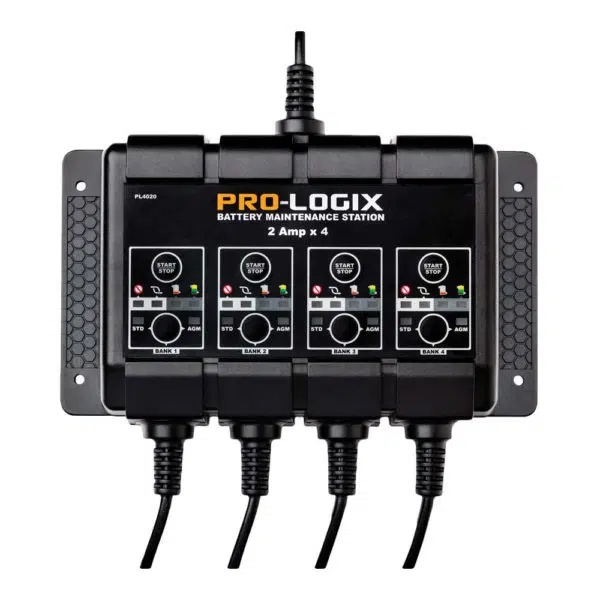
Explore this need in the finder →The PRO-LOGIX PL4020 is a 12 V battery-maintenance station with four independent 2 A outputs. Its main distinction is not a large current rating; it is the ability to charge or maintain up to four separate batteries at once, each on its own channel. That can be useful in a shop, fleet, marina ashore or storage area. This review follows the exact U.S. model page and manual and does not claim a test or a measured result.
Four channels mean four separate batteries
Clore rates the PL4020 at 2 A per channel and gives each output its own control panel. The manual says a fault or reverse connection on one channel does not stop the other channels. Four independent outputs are therefore a practical difference if several vehicles or batteries need attention at the same time. The rating is 2 A for each battery—not 8 A that can be combined for one battery. If your goal is a quicker single-battery charge, the portable 4 A PL2140 or the 5 A-per-channel PL4050 is a different tool.
The station is 12 V only. The model page and its control layout identify standard/flooded and AGM selections, including spiral-wound batteries under the maker’s AGM guidance. Clore’s page says it charges flooded or AGM batteries, and the manual directs conventional and maintenance-free flooded batteries to STD. The exact sources do not establish a separate LiFePO₄ profile for the PL4020. A generic LiFePO₄ warning paragraph appears in the operator’s manual, but the product-specific page and four-channel selector show only STD and AGM. Because those sources do not reconcile, this review does not recommend or match the unit for lithium charging.
Useful when the job is repeated
Each channel has a seven-phase charging process and an enhanced maintenance mode, with temperature compensation and page-listed power-outage recovery. Clore also lists Soft Start and Recondition modes. These functions support a multi-battery storage or service routine, but they do not guarantee a weak battery can be recovered. The product page gives no Ah capacity range. Do not infer how large a battery it suits from the per-channel current; check the battery maker’s requirements and ask Clore if a size limit is material.
The page lists four clamp output leads, a 72-inch length per channel and an optional 10-foot extension cord. The PL4020 weighs 5.5 lb and has mounting holes and a hang hook, so it can sit on a bench, be mounted in a suitable shop location or be suspended where the instructions allow. The extension needs extra care: the manual warns that standard-length output leads used with the 10-foot extension can create enough voltage drop to undercharge batteries. It directs users to the specified reduced-length clamp or ring leads with the extension. The extension is optional, not an assumed box item.
Safety and operating boundaries
The manual says not to expose the charger to rain or snow, to monitor it daily during extended maintenance, and to remove marine batteries for charging ashore; aboard use requires marine-specific equipment. No IP rating or wet-weather approval is established. Follow the connection sequence, correct battery-type selection, ventilation requirements and vehicle instructions. Four channels make management easier, but each battery still needs a compatible voltage, chemistry, healthy connection and suitable charge rate.
PL4020 or PL4050?
The PL4020 supplies four 12 V channels at 2 A each. The PL4050 is also a four-bank station, but it is rated at 5 A per channel and adds a 6/12 V selector only on bank 4. That is a meaningful difference if one 6 V battery must share a station with other 12 V batteries. The PL2140 instead offers a portable single 4 A output for one battery. None of these ratings should be combined across independent outputs.
Who should shortlist it
Consider the PL4020 when you need four independently controlled 12 V channels for flooded or AGM lead-acid batteries, and 2 A per battery is appropriate. Check the exact PL4020 identity, the four included clamp leads, outlet and cable access, whether you need optional extension hardware, and the battery’s type and charge-rate instructions. If your requirement is faster charging for one battery, 6 V service, a documented lithium profile, or a specific capacity range, the PL4020’s reviewed specifications do not answer that need.
Key specifications
Key details at a glance
| Output battery voltages | 12 V |
|---|---|
| Supported chemistries | Lead-acid |
| Rated DC charging current | 2 A |
| Independent battery outputs | 4 |
| Arrangement | Portable plug-in charger |
Use the exact model’s instructions for operating limits, supplied equipment and version differences.
Sources for this review
Sources for this assessment
Keep the next step evidence-led
Use the finder to combine voltage, battery chemistry, charging job and setup requirements; then check the exact model and its manual.