
Your needs, this model
Does it fit your priorities?
Will this model charge a 24 V AGM battery?
Yes. Clore identifies a 24 V charging setting and the manual maps AGM batteries to the AGM profile. The selectable lead-acid output tops out at 10 A; check the battery maker’s approved rate and the PL2410 manual before connecting.
Explore this need in the finder →Can its LiFePO4 mode be treated as a 20 A charger?
No. The manual limits the PL2410’s LiFePO4 setting to 10 A. The separate 0–20 A Supply mode is for maintaining an on-vehicle system voltage, not lithium battery charging. The manual does not state a BMS requirement or an Ah range.
Explore this need in the finder →Can I leave it on a stored battery for months without checking it?
The model has a multi-stage maintenance routine, but its operator manual says to monitor the charger daily during extended maintenance. It also says to keep the unit dry and ventilated and to charge marine batteries ashore.
Explore this need in the finder →This is a source-based assessment of the exact PRO-LOGIX PL2410, not a use report or charging-time test. Clore’s current product page and model manual document a portable one-output 12/24 V unit with distinct selectable battery-charge rates and a separate vehicle-system repair mode.
Its useful distinction is 24 V support in a compact unit
The PL2410 offers a single set of output leads and 2, 6 or 10 A battery charging. Its voltage control covers both 12 V and 24 V batteries, which distinguishes it from 12 V-only models such as the PL2545 and the larger PL6100/PL6800. That does not make it a universal shop charger: it serves one battery output at a time, and its maximum charging setting is 10 A. Check the vehicle battery’s nominal voltage and the battery maker’s permitted rate before connecting.
For lead-acid use, Clore’s manual maps the FLD selection to conventional and maintenance-free flooded batteries, and AGM to AGM and spiral-wound types. It is sensible to identify construction from the battery label rather than infer it from a vehicle application. The selectable 10 A ceiling is not a recommendation that every battery should receive 10 A; the lowest setting can be more appropriate for a smaller battery or a battery maker that specifies a conservative rate.
LiFePO4 is supported, but not every lithium question is answered
The dedicated LiFe mode is for LiFePO4, not lithium-ion as an undifferentiated category. Clore caps that mode at 10 A, so the lead-acid selector’s rate does not imply a higher lithium rate. The model manual allows 12 V and 24 V voltage choices with the LiFe setting, and records both plans separately. The exact page, sheet and manual state no amp-hour charging range. The documentation also does not say whether the lithium battery must have a BMS or what BMS behavior is expected. Those unknowns should remain unresolved at purchase and setup; verify the exact battery and charger instructions with their makers rather than treating silence as approval.
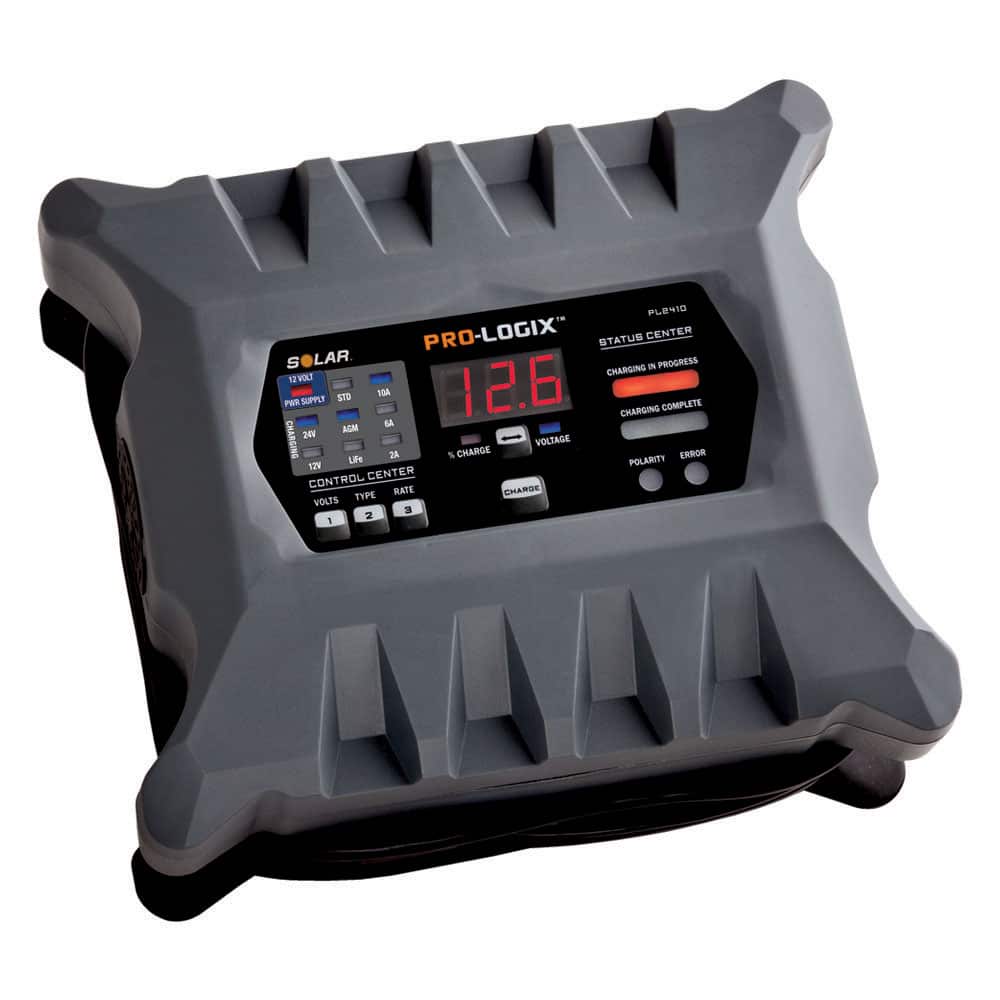
The PL2410’s front-panel image visibly identifies the model and shows 12/24 V, FLD/AGM/LiFe and 10/6/2 controls. This supports image identity, not package contents or measured performance. Clore lists 72-inch 12 AWG leads, 4.7 lb weight and a one-year limited warranty. Confirm the exact SKU and that the lead length, clamps and outlet location suit the intended job.
Maintenance is still a supervised routine
The manual describes multi-stage charging and maintenance, but specifically instructs the operator to monitor the charger daily during extended maintenance. That is a material limitation for someone seeking a set-and-forget seasonal connection. It also requires a dry, ventilated location and prohibits rain and snow exposure. A marine battery should be removed and charged ashore unless the equipment is designed for onboard use; the page’s portable designation does not make the unit weatherproof.
The manual includes low-voltage and fault procedures, but an override is not a battery-health diagnosis. Stop and check the battery’s condition, polarity and instructions if the charger reports a fault. No independent recovery test was performed for this review, and a multi-stage or reconditioning label does not guarantee a damaged or deeply discharged battery can be restored.
Do not confuse the Supply mode with charging
The PL2410 also has a 14.1 V Power Supply mode with a separate 0–20 A range for on-vehicle repair support. That is not the battery-charging mode, a second output, or a general-purpose DC accessory socket. Clore’s manual says it is not intended for module-flash reprogramming. Workshop buyers needing stable programming support should compare the precise voltage and ripple requirements of their vehicle equipment rather than assume the Supply label covers every service procedure.
Who should consider it
It is a plausible shortlist candidate when one 12 V or 24 V battery needs a portable charger with a 10 A maximum lead-acid rate, or a documented LiFePO4 setting capped at 10 A. Its 24 V support is a meaningful step beyond 12 V-only portable models, but a higher-current shop unit may be a better fit for larger permitted charge rates and sustained workshop service. For simultaneous batteries, choose a true multi-bank product rather than treating this single output as several channels.
Before ordering, confirm the battery’s voltage, lead-acid subtype or LiFePO4 chemistry, allowed charge current, connector fit, and whether its maker’s BMS requirements are compatible. The model’s supported Ah range and lithium BMS condition are not published. If the intended use is long-term maintenance, plan for the manual’s daily checks; if the location is exposed to moisture, this model’s stated restrictions rule out that placement.
Sources: Clore’s PL2410 product page, PL2410 operator manual and 12/24 V information sheet. This assessment does not claim ownership, personal use, independent testing or customer experience.
Key specifications
Key details at a glance
| Output battery voltages | 12 / 24 V |
|---|---|
| Supported chemistries | Lead-acid / Lithium-ion |
| Rated DC charging current | 10 A |
| Independent battery outputs | 1 |
| Arrangement | Portable plug-in charger |
Use the exact model’s instructions for operating limits, supplied equipment and version differences.
Sources for this review
Sources for this assessment
- Clore Automotive current U.S. SOLAR Portable Battery Chargers category snapshot
- Clore Automotive PRO-LOGIX PL2410 exact U.S. product page
- Clore Automotive PL2410 operator manual 842-460-530-C
- Clore Automotive PL2410 12/24 V information sheet
- Clore Automotive PRO-LOGIX PL2410 exact-model manufacturer image

Keep the next step evidence-led
Use the finder to combine voltage, battery chemistry, charging job and setup requirements; then check the exact model and its manual.