
Your needs, this model
Does it fit your priorities?
Can the PL2310 charge a 6 V AGM battery?
The current model page and shared manual document 6/12 V selection, an AGM setting and selectable 10/6/2 A rates. Use the battery maker's permitted rate; for small batteries, the manual directs the operator to the lowest available setting. It is one battery output, not two banks.
Explore this need in the finder →Does the PL2310's lithium setting support any lithium battery or prove the BMS requirement?
No. Clore limits the shared lithium selection to LiFePO₄ and caps that charging setting at 10 A, but the sources do not state a BMS requirement. The reviewed match record is conservative about 6 V lithium because the sources do not expressly pair that voltage with the lithium profile; check both makers' instructions.
Explore this need in the finder →Can it be left connected for seasonal storage without checking it?
The model has an enhanced maintenance routine for storage, but the shared manual specifically says to monitor the charger daily during extended maintenance. It also says not to expose the unit to rain or snow. Treat the routine as a documented feature, not as approval for unattended wet-weather storage.
Explore this need in the finder →This is a source-based assessment of the current PL2310 configuration, not a hands-on test. The exact Clore page identifies a 6/12 V unit with 10/6/2 A charging, and its linked operator manual explains the battery selections, operating cautions and the separate power-supply function.
What the 10/6/2 A label means
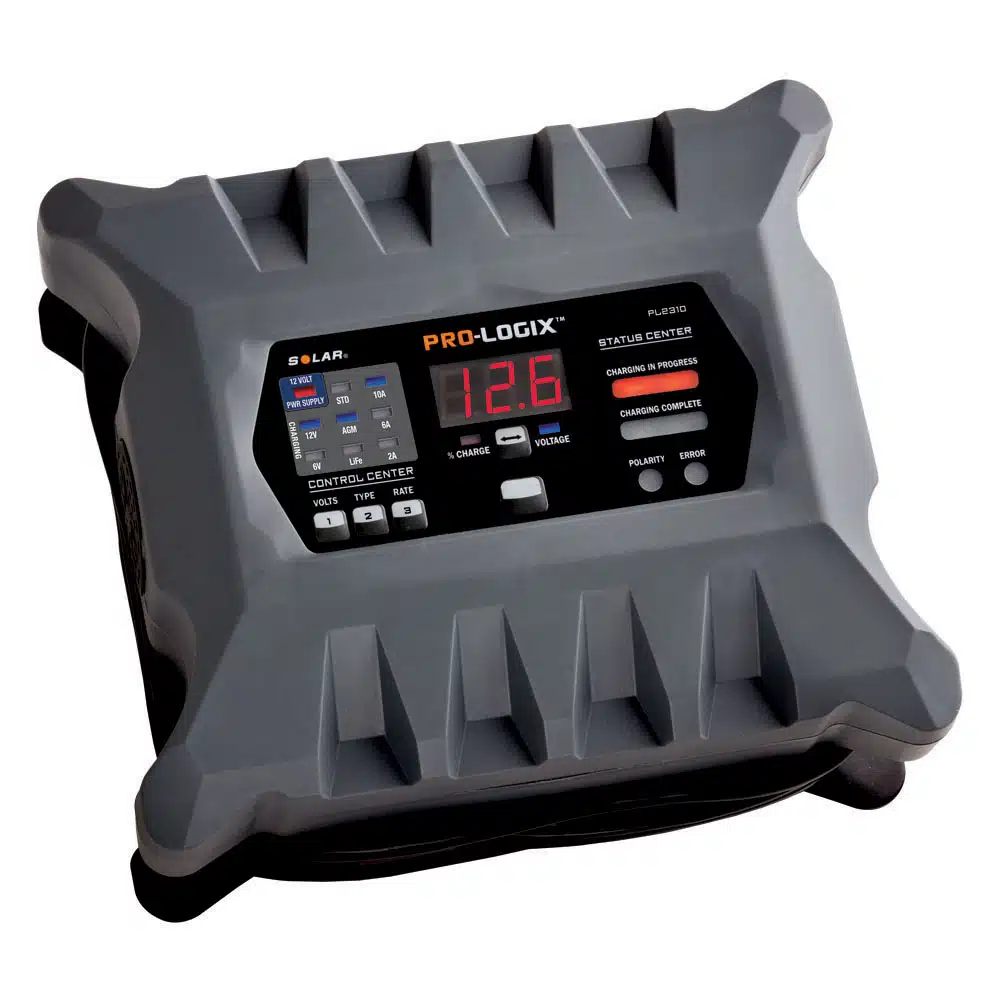
The PRO-LOGIX PL2310 is a portable, single-output charger and maintainer. Its 10 A figure is the highest selectable battery-charge rate; the lower 6 A and 2 A settings matter just as much when the battery maker calls for a gentler rate. The shared manual explicitly directs users to charge small motorcycle, lawn and similar batteries at the lowest available setting. The correct selection depends on the battery instructions, not simply on how quickly a charger can deliver its maximum.
It is a genuine 6/12 V configuration. Both the current PL2310 item page and the exact manual identify 6 V and 12 V operation. An older linked series sheet presents a 12 V-only PL2310, so this review relies on the current exact-model page and the manual whose cover names parts 141-620-000 and 141-630-000. That version distinction is worth checking when comparing older listings or stored paperwork.
Battery compatibility needs a closer read
For lead-acid batteries, the manual provides a standard flooded setting, an AGM setting, and explains that maintenance-free flooded batteries use the standard setting. It also says most spiral-wound batteries use AGM mode; for deep-cycle and marine batteries, the actual construction determines the appropriate selection. That is more useful than a broad “all battery types” slogan because the label names the charging program the user must select.
Clore also documents a lithium setting, but it is for LiFePO4 batteries only. The manual caps the LiFe setting at 10 A. It does not say whether a built-in battery-management system is required, so the available evidence cannot answer that either way. Nor does the manual expressly confirm a 6 V LiFePO4 operating arrangement; this assessment matches the lithium plan at 12 V rather than treating separate voltage and chemistry controls as proof of every possible combination. Confirm an essential edge case with both battery and charger makers.
No supported amp-hour range is published on the exact page or in the manual. The 10 A maximum is not a capacity specification, and it should not be turned into one by rule of thumb. The PL2310 also has one battery output: its current cannot be divided into multiple independent banks.
Maintenance is a feature, not a promise of unattended use
The product page describes seven-phase charging, temperature compensation, soft start, battery reconditioning and enhanced maintenance for storage. Those are useful capabilities when the charger is matched to a compatible battery and the correct mode. The manual describes a resting/exercising sequence after a charge and permits a low-voltage override only after the operator has disconnected AC, checked the connections and verified the settings. A battery below 1 V may trigger a fault first; holding START for three seconds can override that protection when low voltage alone caused the fault. This procedure does not prove a damaged battery is safe or recoverable.
For long storage use, the manual says to monitor the charger daily. That instruction is more specific than the general maintenance label and should shape the owner’s routine. The manual also says not to expose the charger to rain or snow. It treats a marine battery as a shore-charging job: remove it and charge on shore unless using equipment specifically designed for onboard marine charging.
Keep Power Supply mode separate from charging
The PL2310 has an additional Power Supply mode for maintaining vehicle-system voltage during on-vehicle repair. Clore’s exact PL2310 page lists 0–10 A in this mode; the page and shared manual describe a 14.1 V target. This is not a 10 A charging program for a battery, and selecting it disables the battery-type and charge-rate controls. The manual recommends beginning with a fully charged vehicle battery and warns that the mode is not intended for flash reprogramming vehicle modules. Buyers seeking high-current reprogramming support should compare a purpose-built service supply rather than infer that function from the word “power.”
Who should shortlist it
The PL2310 is a reasonable source-backed candidate for one compatible 6 V or 12 V battery when 2, 6 or 10 A is an appropriate selectable range and storage maintenance is useful. Its small format, 4.7 lb listed weight and 72-inch, 12 AWG output lead are practical details to compare against the actual outlet and terminal reach. The exact page lists a one-year limited warranty.
Compare the PL2320 if a battery’s approved charging rate calls for more than 10 A: that model raises the lead-acid maximum to 20 A while keeping one output and the same broad voltage options. This does not mean the higher-current model is automatically better for every battery; the same manual’s low-rate caution still applies. Before buying, confirm the model code, battery chemistry and voltage, the battery maker’s charge-rate instructions, the outlet/grounding arrangement, lead reach and whether the daily-monitoring requirement fits the planned storage routine.
Source checks: Clore PL2310 product page and its PL2310/PL2320 operator manual. Neither the article nor the official product image represents independent performance testing.
Key specifications
Key details at a glance
| Output battery voltages | 6 / 12 V |
|---|---|
| Supported chemistries | Lead-acid / Lithium-ion |
| Rated DC charging current | 10 A |
| Independent battery outputs | 1 |
| Arrangement | Portable plug-in charger |
Use the exact model’s instructions for operating limits, supplied equipment and version differences.
Sources for this review
Sources for this assessment
- Clore Automotive SOLAR Portable Battery Chargers category snapshot
- Clore Automotive PRO-LOGIX PL2310 exact-model page
- Clore Automotive shared PL2310/PL2320 operator's manual 842-460-000-H
- Clore Automotive PL2310/PL2320/PL2410 series information sheet (older 12 V presentation)
- Clore Automotive PRO-LOGIX PL2310 official product image

Keep the next step evidence-led
Use the finder to combine voltage, battery chemistry, charging job and setup requirements; then check the exact model and its manual.