
Your needs, this model
Does it fit your priorities?
Can I charge a 6 V AGM battery with a portable model?
The exact PL2140 manual documents a 6 V voltage setting, an AGM selection and a 4 A output. It is a single-output charger, so it handles one 6 V battery at a time; follow the battery’s specified rate and the manual’s safety steps.
Explore this need in the finder →Does its lithium setting prove that every 6 V lithium pack is supported?
No. The manual limits the lithium setting to LiFePO₄ but does not explicitly describe a 6 V LiFePO₄ operating plan or state a BMS requirement. The reviewed match profile is 12 V LiFePO₄ only; ask Clore and the battery maker about other pack voltages and protection.
Explore this need in the finder →Will it restart after an AC power interruption?
The exact manual says Recovery Mode is on by default; the charger monitors for power and resumes with its existing settings when AC returns. The mode can be turned off. This does not remove the manual’s instruction to monitor extended maintenance use daily.
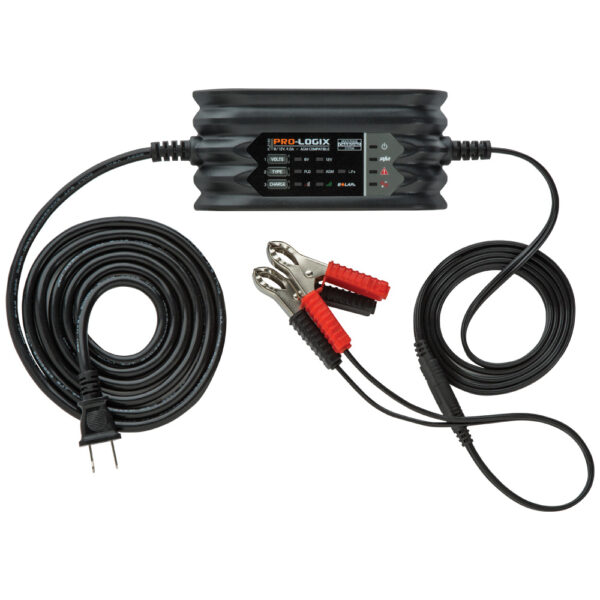
Explore this need in the finder →The PRO-LOGIX PL2140 is a portable, single-output 4 A charger/maintainer with selectable 6 V or 12 V operation. It is the Clore choice in this group when one compatible battery needs a faster charge than a 1 A maintainer can provide, or when the battery voltage is 6 V rather than 12 V. Its LiFePO₄ mode is documented, but the exact manual does not state a BMS requirement or explicitly describe a 6 V lithium combination. This is a source-based review, not a bench test.
Voltage selection without adding a second bank
The PL2140 lets the operator select 6 V or 12 V. The current model page lists a 4 A charge rate and one 72-inch output cable, including its output attachment. The 6 V and 12 V options are alternative settings on the same output, not two independent connections. A selector does not make the PL2140 a two-bank charger, and the 4 A rating should not be treated as a combined current that can be shared across batteries.
That difference matters when shopping for a vintage 6 V vehicle, a 12 V car, or several batteries. The PL2140 can address a single battery whose voltage matches the chosen setting. If multiple batteries need simultaneous service, the PL4020 and PL4050 use four independent channels; those stations have a different footprint and per-channel output.
Battery types and a precise lithium caveat
The exact manual directs conventional and maintenance-free flooded batteries to STD, AGM batteries to AGM, and LiFe batteries to a lithium-iron-phosphate setting. It also describes spiral-wound and deep-cycle batteries, but tells the user to identify the battery’s construction before choosing its profile. The documents do not establish a separate GEL or EFB profile, so “intelligent” should not be expanded into unsupported compatibility.
The manual is especially clear that the lithium setting is for LiFePO₄ only, not other lithium chemistries. It does not say whether a built-in BMS is required. It also separates a voltage-selection instruction from the LiFe profile without expressly stating that 6 V LiFePO₄ batteries are an intended combination. For that reason, the reviewed matching plan recognizes 12 V LiFePO₄ only and leaves BMS status unknown. If either the battery’s voltage or its required protection is uncertain, confirm with Clore and the battery maker before using the charger.
More than a simple float charger
Clore lists a seven-phase process, temperature compensation, Soft Start, Recondition and an enhanced maintenance mode. The manual describes a rest/exercise sequence after charging and a recovery feature for AC interruptions. Recovery Mode is on by default: the charger resumes the existing settings when power returns, though the operator can turn that mode off. These functions help explain the PL2140’s role in charging and storage routines; they do not promise that a sulfated battery will recover or remove the need to check the battery itself.
At 1.9 lb and with a portable format, it can move between compatible batteries, but one output still means one connection at a time. The page lists a clamp set, ring-terminal kit and 12 V plug among included output accessories. Those are alternative ways to use the same charger output—not three simultaneous battery banks. Check the seller’s exact package and the physical reach you need rather than relying on the page image.
Operating limits and safety
The maker does not state an Ah capacity range for the PL2140. The 4 A rating alone cannot supply the missing lower or upper battery-size boundary. The manual says to use the correct voltage and battery profile, to monitor extended maintenance use daily, and not to expose the charger to rain or snow. No IP rating or exposed outdoor approval was found. It also states that a marine battery must be removed and charged ashore; aboard charging calls for equipment designed for marine use.
Follow the manual’s connection sequence, ventilation guidance and vehicle grounding directions. Its battery recondition and soft-start functions are not evidence that it can safely repair any weak or damaged battery. The one-year limited warranty is Clore’s listed term; verify the warranty terms that apply to the exact offer.
Who should shortlist the PL2140
Consider it for one 6 V or 12 V lead-acid battery when the selectable voltage and 4 A output fit the battery maker’s instructions. A 12 V LiFePO₄ user may also consider it after confirming battery protection requirements. Choose the PL2112 if a lower-output 12 V charger is enough; choose a four-channel station if separate batteries need separate outputs. Before buying, verify exact PL2140 identity, connector package, outlet access, cord reach and the battery’s voltage and chemistry.
Key specifications
Key details at a glance
| Output battery voltages | 6 / 12 V |
|---|---|
| Supported chemistries | Lead-acid / Lithium-ion |
| Rated DC charging current | 4 A |
| Independent battery outputs | 1 |
| Arrangement | Portable plug-in charger |
Use the exact model’s instructions for operating limits, supplied equipment and version differences.
Sources for this review
Sources for this assessment
Keep the next step evidence-led
Use the finder to combine voltage, battery chemistry, charging job and setup requirements; then check the exact model and its manual.