
Your needs, this model
Does it fit your priorities?
Can it maintain one 12 V AGM battery in storage?
The exact manual documents an AGM selection and a long-term maintenance routine with rest and exercise phases. Its 1 A output is modest, and the manual says to monitor the charger daily during extended maintenance.
Explore this need in the finder →Will the lithium setting work for any lithium battery?
No. The exact instructions limit the lithium profile to LiFePO₄ and specify a 0–50 °C ambient range while charging that chemistry. They do not state the built-in-BMS requirement, so ask Clore and the battery maker if that detail is essential.
Explore this need in the finder →Can I use it on a boat battery without removing the battery?
The exact PL2112 manual says to remove a marine battery and charge it on shore; aboard charging requires equipment specifically designed for marine use. Do not treat this general charger as an onboard marine charger.
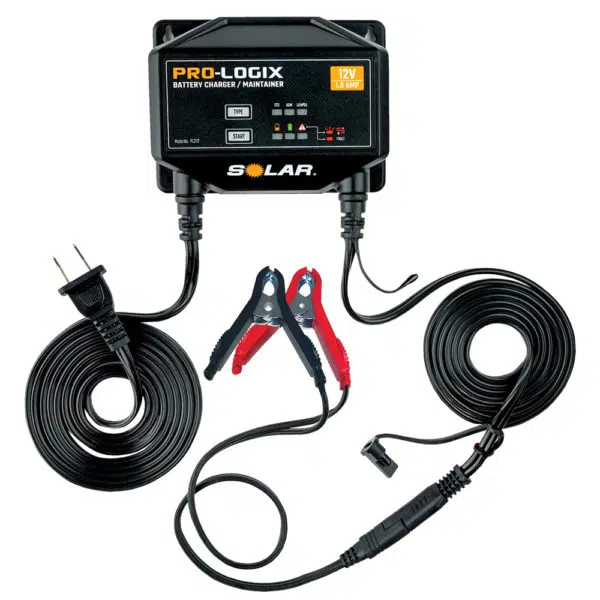
Explore this need in the finder →The PRO-LOGIX PL2112 is a portable, single-output 12 V charger/maintainer rated at 1 A. Its strongest case is a small, deliberate charging routine: the exact manual describes flooded/maintenance-free, AGM and LiFePO₄ selections, plus staged maintenance for a battery that will remain connected. It is not a high-current recovery charger, and Clore does not publish an Ah capacity range for this exact model. This assessment is based on the official PL2112 page, sheet and instructions, not hands-on testing.
What the 1 A PL2112 is built to do
The PL2112’s single output is 12 V only. There is no selectable 6 V or 24 V option and no way to split the output among separate batteries. Clore lists a 1 A charge rate, seven charging phases, temperature compensation, soft start, battery-fault detection and a recondition mode. Its manual describes a rest phase after charging that monitors the battery, and a later exercise phase that applies and replenishes a load during extended storage. These are meaningful maintenance features, but they do not raise the current rating or turn the device into a battery diagnostic tool.
A low 1 A rating can be useful when the goal is steady charging or storage care rather than a fast turnaround. Clore does not publish a compatible Ah range, so the manual’s behavior should not be mistaken for capacity approval. Check the battery maker’s charge-rate advice and ask Clore about the exact battery if its size or condition matters to the decision.
Choose the documented battery profile
The manual’s control panel separates standard flooded, AGM and LiFePO₄ settings. It directs conventional and maintenance-free flooded batteries to STD, AGM batteries to AGM, and LiFe batteries to the LiFePO₄ selection. For spiral-wound batteries, it points to the AGM setting. Deep-cycle and marine batteries need their construction identified before choosing a profile. The documents do not identify a GEL or EFB setting, so do not assume that a generic “smart” label covers every lead-acid subtype.
The lithium mode is specifically for lithium iron phosphate; the manual warns against charging other lithium chemistries and gives a 0–50 °C ambient range for charging LiFePO₄. The reviewed materials do not say whether a built-in battery-management system is required. That remains a real unknown: do not treat silence as proof that the pack can be used without a BMS. Confirm the charger and battery instructions together before connecting a lithium pack.
Reach, leads and the place of use
The page lists a 72-inch output cable including the attachment. The information sheet describes clamp, ring-terminal and 12 V male-plug output options. Those named options do not establish that every seller package contains all three at once, so verify the exact retail kit and measure the outlet-to-battery path. The PL2112 is portable, but its manual says not to expose it to rain or snow and provides battery-gas and ventilation cautions. No IP rating or exposed outdoor approval was established in the reviewed documents.
There is an important marine restriction. The exact manual says a marine battery must be removed and charged on shore; charging aboard requires equipment designed specifically for marine use. A generic match on voltage and chemistry is not permission to use this product as an onboard marine charger.
How it differs from nearby Clore choices
The underhood SOLAR 1002 is an installed 12 V, 1.5 A lead-acid unit; it is not a more portable version of the PL2112. The PL2140 is portable and increases output to 4 A, with a 6/12 V selector and a recovery setting for power interruptions. The PL2112 is smaller at 1.1 lb and has a direct 12 V LiFePO₄ selection, although its BMS condition is unstated. For several separate batteries, Clore’s PL4020 and PL4050 provide four independent channels rather than combining four outputs into one battery.
Limits and purchase checks
The manual says to monitor the charger daily during extended maintenance. It also describes a forced-start procedure when a battery is below 1 V, but instructs the user to check connections and the cause of the fault first; that override is not evidence that a damaged battery can be restored. Follow the charger, vehicle and battery instructions, observe ventilation and polarity precautions, and do not charge a frozen battery.
Before ordering, confirm the exact PL2112 model, 12 V battery, supported chemistry/profile, required lead or adapter, cable reach and seller package. The one-year limited warranty is the maker’s stated term; check which current warranty applies to your purchase. Shortlist the PL2112 when its 1 A output and single portable connection suit a modest 12 V charging or storage task. If you need faster charging, another voltage, multiple independent banks or a documented Ah boundary, compare the appropriate exact model instead.
Key specifications
Key details at a glance
| Output battery voltages | 12 V |
|---|---|
| Supported chemistries | Lead-acid / Lithium-ion |
| Rated DC charging current | 1 A |
| Independent battery outputs | 1 |
| Arrangement | Portable plug-in charger |
Use the exact model’s instructions for operating limits, supplied equipment and version differences.
Sources for this review
Sources for this assessment
Keep the next step evidence-led
Use the finder to combine voltage, battery chemistry, charging job and setup requirements; then check the exact model and its manual.