
Your needs, this model
Does it fit your priorities?
Can the 4506 charge a 6 V AGM battery?
Clore identifies the exact 4506 as a 6/12 V model, and its shared manual provides AGM and 6 V selections. It offers 2 A and 6 A settings; check the battery maker’s permitted rate and select the correct voltage before starting.
Explore this need in the finder →Can I leave the 4506 connected as a maintainer during storage?
Clore says the charger enters maintenance mode after full charge, but the shared manual directs daily monitoring during extended maintenance. It also prohibits rain/snow exposure, so use a dry setup and do not treat the automatic mode as unattended outdoor storage approval.
Explore this need in the finder →Is the 4506 suitable for LiFePO₄ or a 24 V battery?
No documented fit. The exact model is a selectable 6/12 V product and the shared owner’s manual says to charge lead-acid batteries only. It does not document a lithium profile, a BMS condition or 24 V operation.
Explore this need in the finder →The CHARGE IT! 4506 is a portable, one-output charger for 6 V or 12 V lead-acid batteries. Its key distinction within the 4500-series portable range is that it combines a selectable battery-voltage control with two charge settings, 2 A and 6 A. That makes it a more flexible choice than a fixed-voltage maintainer, but not a universal charger: it has no lithium mode, no published Ah range, and its highest setting is not a recommendation for every battery. This assessment is based on Clore’s exact model page, shared owner’s manual and official image—not hands-on testing.
Two voltages, two charge settings
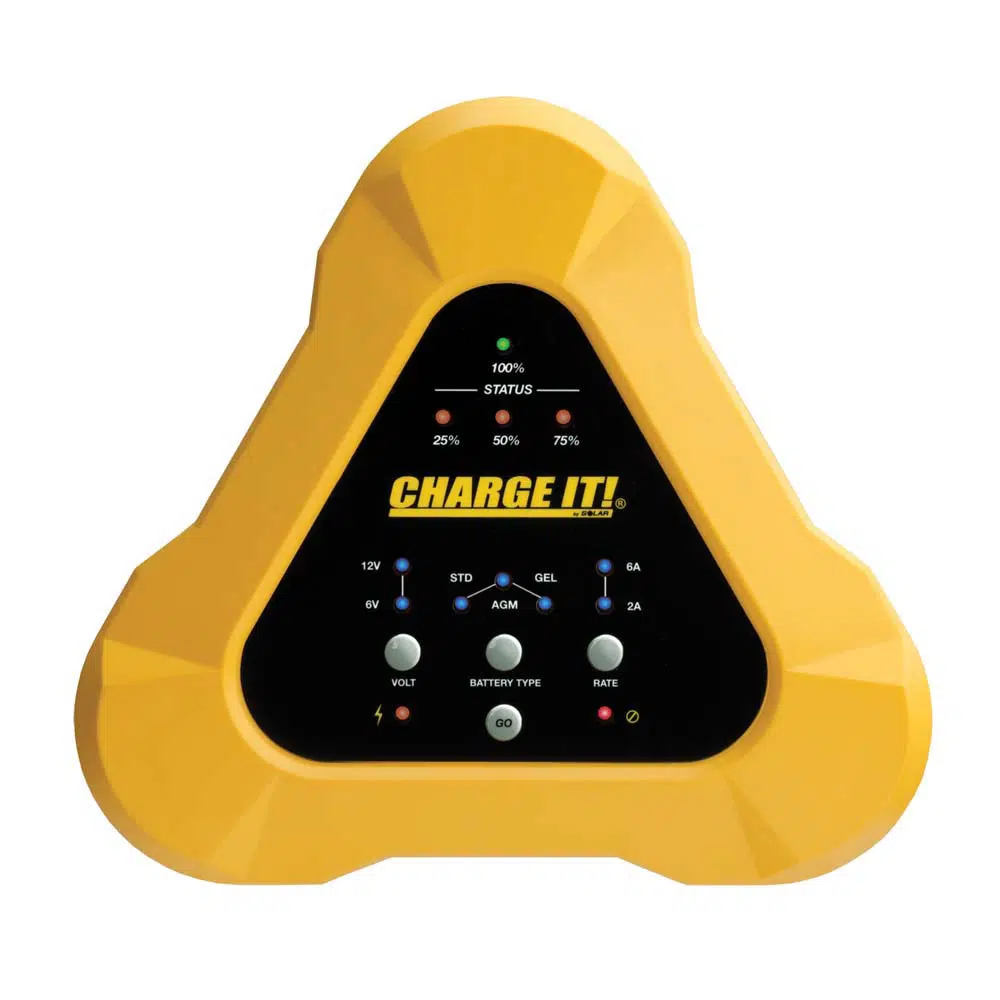
Clore’s 4506 page and device face identify 6/12 V operation and 6/2 A charging. The manual says the voltage selector applies to model 4506 only; it also explains that 12 V is the default and the user must select 6 V when that is the battery’s nominal voltage. This matters if one household maintains a mix of older equipment and ordinary 12 V vehicles: voltage selection is a real capability, not a label that can be ignored.
The rate control provides a 2 A low setting and a 6 A high setting. The manual recommends the lowest possible rate for small batteries found in lawn-and-garden, motorcycle, ATV and similar applications; it says higher rates may suit larger vehicle batteries but still directs users to the battery or vehicle manufacturer’s specific instructions. The 6 A rating therefore describes an available ceiling, not a safe-rate verdict. The matching quiz’s minimum-current answer is only a screen for published output; it cannot choose a proper setting for a particular battery.
For chemistry, Clore draws a bright boundary: the shared manual says to use this unit for lead-acid batteries only. It provides STD selection for conventional and maintenance-free flooded batteries, AGM for AGM batteries, and GEL for gel cells. It also discusses spiral-wound and deep-cycle batteries in terms of their underlying construction. The reviewed sources do not name an EFB or calcium profile, and there is no documented LiFePO₄ mode or BMS condition. A lead-acid label alone is not enough to skip the battery maker’s instructions.
Automatic charging with an explicit maintenance limit
Clore describes an automatic, multi-stage sequence with a soft-start stage and automatic transition into maintenance after charge completion. It also describes a recondition behavior when a battery is not accepting charge as expected. Those features explain the 4506’s role as a charger that can continue caring for a charged battery, rather than an adjustable bench power supply or a jump starter. The manual says maintenance mode can continue until the unit is disconnected, but separately calls for daily monitoring during extended maintenance. Treat those as two parts of the same operating instruction: automatic maintenance does not mean unattended installation.
The manual also puts practical boundaries on setup. It specifies a nominal grounded 120 V AC circuit, ventilation, no operation in a closed or restricted space, and no placement where rain, snow or other moisture can drip onto the charger. It says not to charge a frozen battery and directs marine batteries to be removed and charged ashore; on-board marine charging requires equipment specifically designed for that use. These restrictions make the 4506 a dry, supervised portable shop or garage option—not a weatherproof dock installation.
What the specifications do not settle
The exact product page lists a 2.8 lb weight, LED progress indicators, smart-clamp technology, reverse-polarity protection and a one-year limited warranty. The manual adds fault and short-circuit protections. These are useful design details, but they do not establish the condition of a battery or guarantee a charge outcome. In particular, Clore does not publish a minimum or maximum battery capacity in Ah for the exact 4506 sources reviewed here. Do not derive an Ah ceiling or a charge-time estimate from the 6 A output alone.
The image shows the triangular 4506 face with 6 V and 12 V controls, STD/AGM/GEL indicators and the 6 A/2 A rate choices. It is an exact-model visual reference, not a package inventory. Clore’s accessible exact page and manual sections do not give a definitive seller-kit list or a usable output-lead length. Before ordering, check that the offer is part number 141-410-000, confirm the actual clamps or other connection leads supplied, and measure the route from a properly grounded outlet to the battery. Do not assume a cable length or accessory just because an image shows the charger body.
Where it sits among the family
Choose the 4506 over a 12 V-only model when the documented 6 V selector matters. The 4512 and 4520 are fixed 12 V products with digital displays and higher 12 A and 20 A maximum settings respectively; neither replaces the 4506’s 6 V capability. The neighboring 4502 also selects 6/12 V, but Clore specifies its 2.5 A rate for 12 V mode only and does not separately state its 6 V current. That difference makes the 4506’s two published rate choices particularly relevant if the job requires a known selectable output at either voltage.
Shortlist the 4506 for one compatible lead-acid battery when you need 6 V or 12 V selection, want a choice between 2 A and 6 A, and can provide the dry, ventilated, supervised setup the manual describes. Look elsewhere for lithium, multiple independent outputs, a supported capacity range that must be guaranteed, an outdoor charger, or a marine onboard system. Verify battery chemistry, nominal voltage, permitted current, exact part number, seller package and lead reach before use, and consult the manufacturer’s instructions for both the vehicle and battery.
Read the official CHARGE IT! 4506 product page and its 4506/4512/4520 owner’s manual alongside the vehicle and battery instructions.
Key specifications
Key details at a glance
| Output battery voltages | 6 / 12 V |
|---|---|
| Supported chemistries | Lead-acid |
| Rated DC charging current | 6 A |
| Independent battery outputs | 1 |
| Arrangement | Portable plug-in charger |
| Included connection | The exact page and shared manual sections reviewed do not establish a complete seller-package inventory or a published lead length. Verify the exact SKU’s included leads and reach before purchase. |
Use the exact model’s instructions for operating limits, supplied equipment and version differences.
Sources for this review
Sources for this assessment

Keep the next step evidence-led
Use the finder to combine voltage, battery chemistry, charging job and setup requirements; then check the exact model and its manual.