
Your needs, this model
Does it fit your priorities?
Can the 4502 charge a 6 V battery as well as a 12 V car battery?
Yes. The exact model page/manual identify 6 V and 12 V operation, and the manual says to select the setting matching the battery's nominal voltage. Clore gives 2.5 A in 12 V mode; the sources do not separately state the 6 V output current.
Explore this need in the finder →Will it maintain a 12 V AGM battery after charging?
Clore describes the 4502 as safe for lead-acid battery types and says it enters maintenance mode at full charge. The manual also says to monitor it daily during extended maintenance and prohibits rain or snow exposure.
Explore this need in the finder →Can it charge a lithium starter battery?
No documented match. The exact 4502 manual limits use to lead-acid batteries; the page does not establish a LiFePO4 or other lithium mode.
Explore this need in the finder →The CHARGE IT! 4502 is a compact, single-output lead-acid charger/maintainer with selectable 6 V or 12 V operation. Clore specifies a 2.5 A charging rate in 12 V mode; the manufacturer sources reviewed here do not separately publish the 6 V current. Automatic multi-stage charging and maintenance after full charge are useful for a household that needs both voltage options, but the 4502 is not a high-current recovery unit and has no published amp-hour limit. This is a source-based assessment, not a hands-on test.
Set voltage before charging
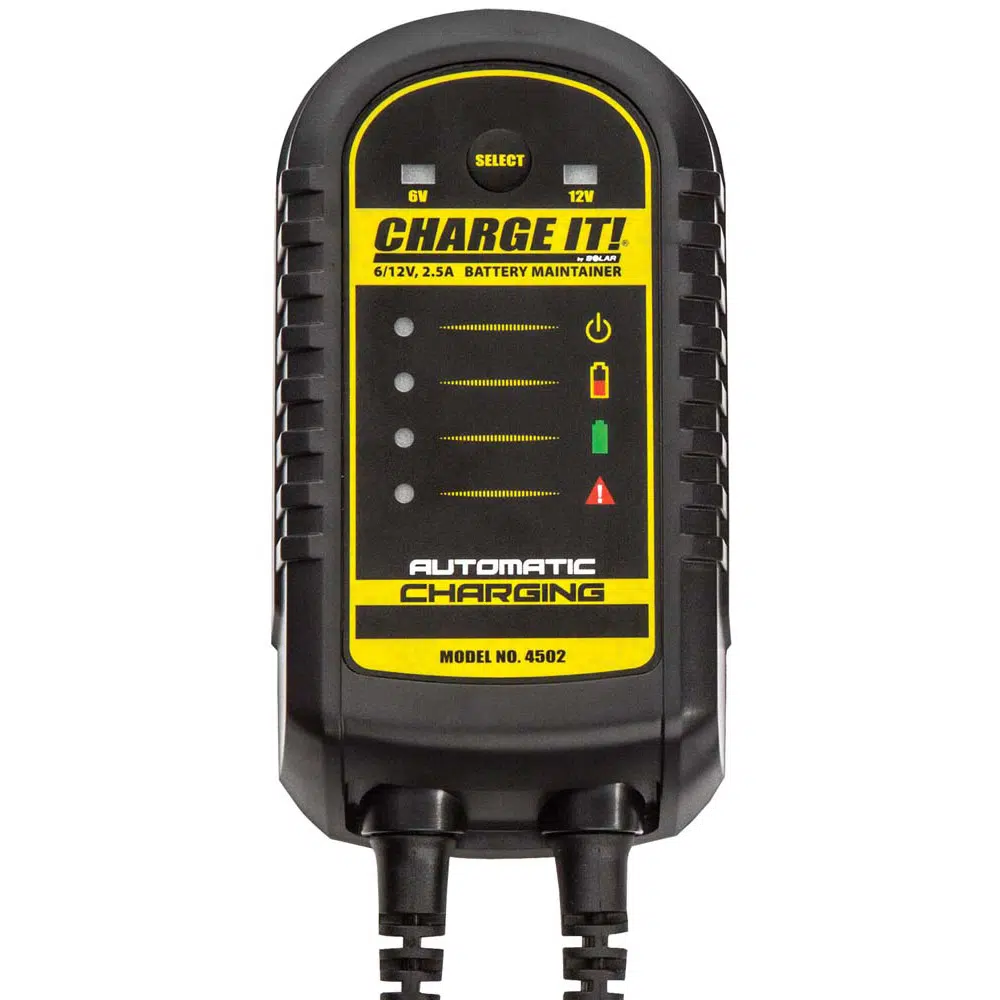
The 4502’s key difference from the CHARGE IT! 4501 is its selectable output voltage. The exact model page and manual document 6 V and 12 V operation, and the instructions say to select the setting that matches the battery’s nominal voltage. The product page identifies 2.5 A charging at 12 V. Its image labels the unit 6/12 V, 2.5 A, but the manual and product copy do not give separate current figures by voltage; do not assume a precise 6 V rate from the 12 V specification.
The page describes charging and maintaining car, truck, SUV, van, personal-watercraft, powersports and motorcycle batteries. It calls the charger safe for all lead-acid battery types. The exact manual draws a firm line at chemistry: this is for lead-acid batteries only, not lithium-ion. Use the battery maker’s advice for a flooded, AGM, gel or other lead-acid subtype, and never mistake multiple voltage settings for support for a different chemistry.
Maintenance mode still needs supervision
After reaching full charge, the 4502 enters maintenance mode. Its manual says the battery may remain connected and describes maintaining full charge until service is needed. The same manual directs users to monitor the charger daily during extended maintenance, so the long-term claim is not an invitation to install it and forget it. Keep the setup ventilated, follow correct connection order and polarity, and do not charge a frozen battery.
The instructions also say not to expose the charger to rain or snow or put it where moisture can drip on it. For a marine battery, Clore directs the user to remove it and charge it ashore; charging aboard needs equipment specifically designed for marine use. This is a portable plug-in charger, not a weatherproof or onboard marine system. The exact page lists a 72-inch output cable and a 1.5 lb weight. Measure the actual route from a safe AC receptacle and confirm the seller’s box contents before treating that cable figure as usable reach.
Small clamps and package verification
Clore highlights the 4502’s small clamps as useful where access is tight, such as a powersports or watercraft battery. That detail may help in a crowded battery compartment, but it does not change the need for secure contact or the manual’s safety procedure. The available exact page identifies the clamp feature but does not make every seller package variation clear; confirm whether the specific offer includes the lead or accessory you need. Do not infer compatibility with a vehicle accessory socket or a permanent ring-terminal install from a product image.
The original manufacturer image shows the distinct 4502 face, 6 V and 12 V selectors, 2.5 A label and exact model number. It helps differentiate this configuration from the 4501’s 12 V/800 mA maintainer, but artwork is not a reliable package inventory. Clore lists a one-year limited warranty; read the current terms and keep dated purchase documentation.
Where it fits beside other chargers
The 4501 is a slower 0.8 A, 12 V-only CHARGE IT! model; choose it only when that current and voltage fit the job. The 4502 is more versatile on voltage and stronger at 2.5 A in 12 V mode. Clore’s PRO-LOGIX PL2140 moves to a selectable 4 A output and documents 6/12 V lead-acid plus a separate 12 V LiFePO₄ mode, with its own BMS and Ah unknowns. The higher-output unit may be more suitable for a faster compatible charge, but neither current setting should override battery-maker limits.
Who should shortlist it?
Shortlist the 4502 for a modest 6 V or 12 V lead-acid job where automatic charging and storage maintenance matter, a 12 V 2.5 A output is suitable, and a small clamp can reach the terminals. Do not choose it for lithium, fast recovery charging, a known Ah capacity boundary, several batteries at once or outdoor exposure. Its 6 V current is a real information gap rather than a value to estimate from the 12 V rating.
Before buying, check the exact 4502 model, nominal battery voltage, battery chemistry, charge-rate guidance, clamp fit, lead reach, dry placement and current seller package. Consult the official CHARGE IT! 4502 page and operator’s manual with the vehicle and battery instructions before connection.
Key specifications
Key details at a glance
| Output battery voltages | 6 / 12 V |
|---|---|
| Supported chemistries | Lead-acid |
| Rated DC charging current | 2.5 A |
| Independent battery outputs | 1 |
| Arrangement | Portable plug-in charger |
| Included connection | The exact product page describes small clamps for confined access. Confirm the seller's current package and connector details. |
Use the exact model’s instructions for operating limits, supplied equipment and version differences.
Sources for this review
Sources for this assessment

Keep the next step evidence-led
Use the finder to combine voltage, battery chemistry, charging job and setup requirements; then check the exact model and its manual.