
Your needs, this model
Does it fit your priorities?
Can the 4501 keep a 12 V AGM battery maintained during storage?
Clore lists the 4501 as safe for lead-acid types and says it maintains a battery after full charge. It is rated at 0.8 A; the manual requires daily monitoring during extended maintenance and prohibits rain or snow exposure.
Explore this need in the finder →Is the 4501 a quick way to recharge a depleted car battery?
It is a low-current 0.8 A unit that Clore positions for charging smaller batteries and maintaining larger batteries after they are full. No exact Ah range or charging-time claim is supplied, so use the battery maker's approved rate and allow for a slow charge.
Explore this need in the finder →Will the 4501 charge a 6 V or lithium battery?
No documented fit. The exact model page identifies 12 V operation, and the manual says the charger is for lead-acid batteries only. It is not a 6 V or lithium charger.
Explore this need in the finder →The CHARGE IT! 4501 is a small, single-output 12 V charger/maintainer rated at 0.8 A. Clore positions it for charging smaller lead-acid batteries and maintaining larger ones after they are full. That makes the 4501 a storage-care or slow-charge option, not a substitute for a higher-output charger when a depleted automotive battery needs a faster turnaround. This is a source-based assessment of Clore’s exact product page and manual, not a hands-on test.
A low-current, one-battery routine
The 4501 connects to one 12 V battery. Its automatic multi-stage sequence runs without an adjustable current selector, and the maker says it maintains a battery after reaching full charge. That simple approach can suit a battery that is already healthy and will sit for a period, or a smaller lead-acid battery whose maker permits a 0.8 A input. Clore does not publish a maximum or minimum amp-hour range, so the rated current does not establish a size limit or a charging-time estimate. Check the battery label and its own allowed charging rate before relying on any charger.
The exact product page calls out all lead-acid battery types. The manual narrows the chemistry boundary clearly: the 4501 is for lead-acid batteries only. There is no lithium profile, and no 6 V or 24 V output. AGM, gel or other subtype matching should still follow the battery’s instructions; “all lead-acid” is not permission to ignore a battery-specific rate or connection procedure.
Maintenance is not unattended storage
Clore says the 4501 maintains a battery once it reaches full charge. Its instructions also say to monitor the charger daily when it is used for extended maintenance. Those points belong together: a maintenance mode does not remove the need to inspect a long-running setup. The manual gives ordinary lead-acid safety directions, including ventilation, correct polarity, avoiding sparks and not charging a frozen battery. Follow the battery and vehicle maker’s instructions as well, particularly when the battery remains installed.
The manual says not to expose the charger to rain or snow or place it where moisture can drip on it. It also says a marine battery must be removed and charged on shore; charging aboard requires equipment specifically designed for marine use. So although this is a portable wall-powered device, it is not documented as an outdoor or onboard marine charger. The 72-inch output-cable figure includes the selected output attachment, so measure the route rather than assuming a long reach.
Connection kit details need a check
Clore’s product page lists clamp and ring-terminal output options. The linked operator’s manual lists those options plus a 12 V adapter. Since the page and manual do not present the exact package list in the same way, confirm the seller’s current box contents before buying. Choose the connection that fits the actual battery and follow the manual’s sequence; do not leave a lead permanently installed unless the maker and battery instructions permit it.
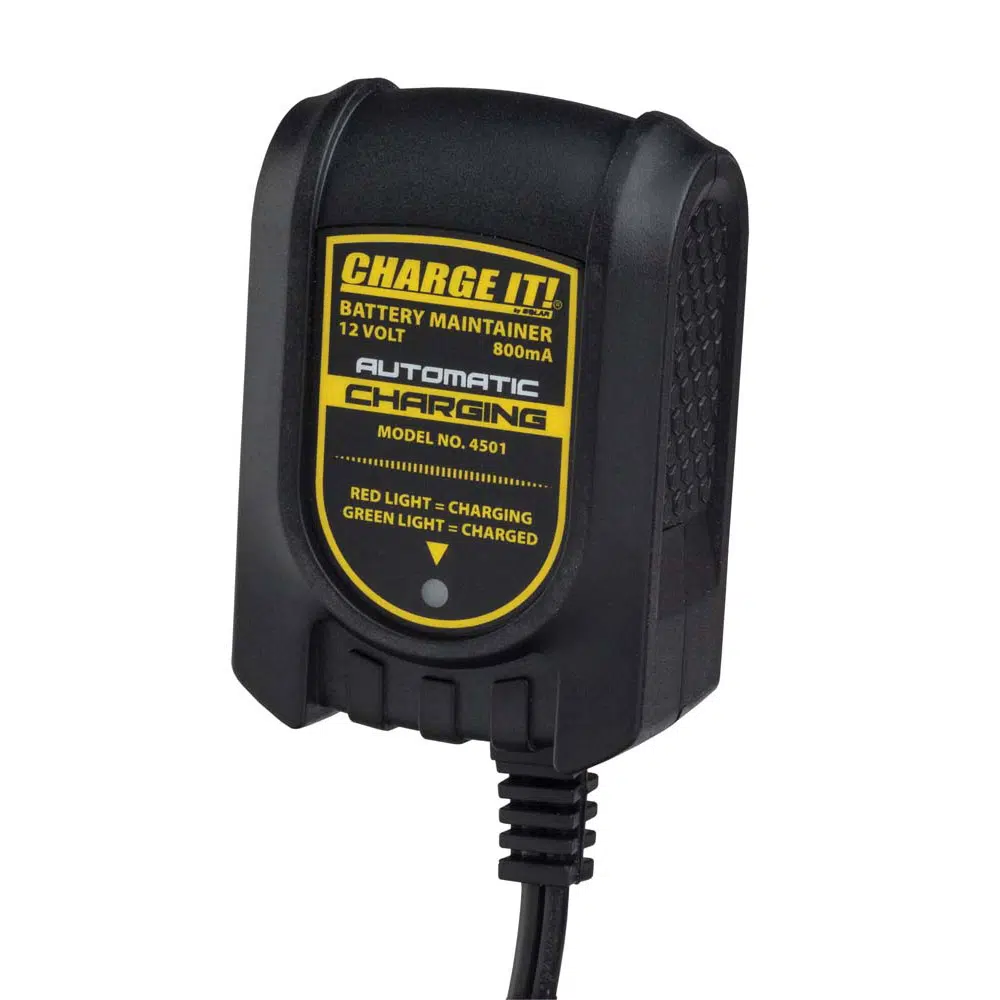
The original manufacturer image identifies a CHARGE IT! 4501 unit labeled 12 Volt Battery Maintainer, 800 mA and model 4501. That helps distinguish it from the higher-current 4502, but an image alone does not prove which cables a seller includes. The exact model page lists 1.6 lb and a one-year limited warranty; check the warranty terms that apply to the specific purchase.
How it compares with nearby Clore choices
The CHARGE IT! 4502 adds selectable 6 V operation and a 2.5 A 12 V rate, making it more flexible if one charger serves 6 V and 12 V lead-acid batteries. It still does not publish an Ah range, and its 6 V current is not separately stated in the sources reviewed here. The PRO-LOGIX PL2112 is a 1 A, 12 V charger with documented LiFePO₄ mode, although that model’s lithium BMS condition is unknown and its manual also limits chemistry-specific use. The 4501 is the slower and simpler of these options, but not a fast-recharge pick or lithium choice.
Who should shortlist it?
Consider the 4501 when you need a compact, one-battery, 12 V lead-acid charger for modest charging or maintenance after full charge; 0.8 A fits the battery maker’s permitted rate; the cable reaches; and the charger can stay dry while receiving the manual’s required daily attention. Skip it if you need faster charging, a 6 V mode, a documented Ah threshold, a lithium profile, multiple independent outputs, or an unattended rain-exposed installation.
Before ordering, confirm the exact 4501 model, included output leads, cable path, battery chemistry and the appropriate charging routine. Read the official CHARGE IT! 4501 page and its operator’s manual alongside the vehicle and battery instructions.
Key specifications
Key details at a glance
| Output battery voltages | 12 V |
|---|---|
| Supported chemistries | Lead-acid |
| Rated DC charging current | 0.8 A |
| Independent battery outputs | 1 |
| Arrangement | Portable plug-in charger |
| Included connection | The exact product page lists clamp and ring-terminal output options. Its linked manual also lists a 12 V adapter, a package-detail difference; verify the exact seller's kit before purchase. |
Use the exact model’s instructions for operating limits, supplied equipment and version differences.
Sources for this review
Sources for this assessment

Keep the next step evidence-led
Use the finder to combine voltage, battery chemistry, charging job and setup requirements; then check the exact model and its manual.