
Your needs, this model
Does it fit your priorities?
Can the 022-0150 maintain a 12 V AGM battery indoors?
The exact manual identifies a 12 V lead-acid/AGM mode and an automatic float/storage phase. Its instructions say indoor use only and not to expose the charger to rain or snow, notwithstanding the page's weather-resistant label. Confirm the battery is already charged and follow the manual.
Explore this need in the finder →Does the 022-0150 support a 12 V LiFePO₄ battery?
The SKU-matched manual names a four-cell LiFePO₄ mode with selectable charging and maintenance. It does not establish the required BMS condition, so verify the battery's protection and charging instructions with both manufacturers before use.
Explore this need in the finder →Can I mount the Weather Resistant 022-0150 outside?
Not on the evidence currently available. Although the exact product page advertises IP67 and outdoor mounting, the SKU-matched manual says indoor use only and not to expose the charger to rain or snow. Ask Battery Tender for a current manual that reconciles those instructions before any exposed installation.
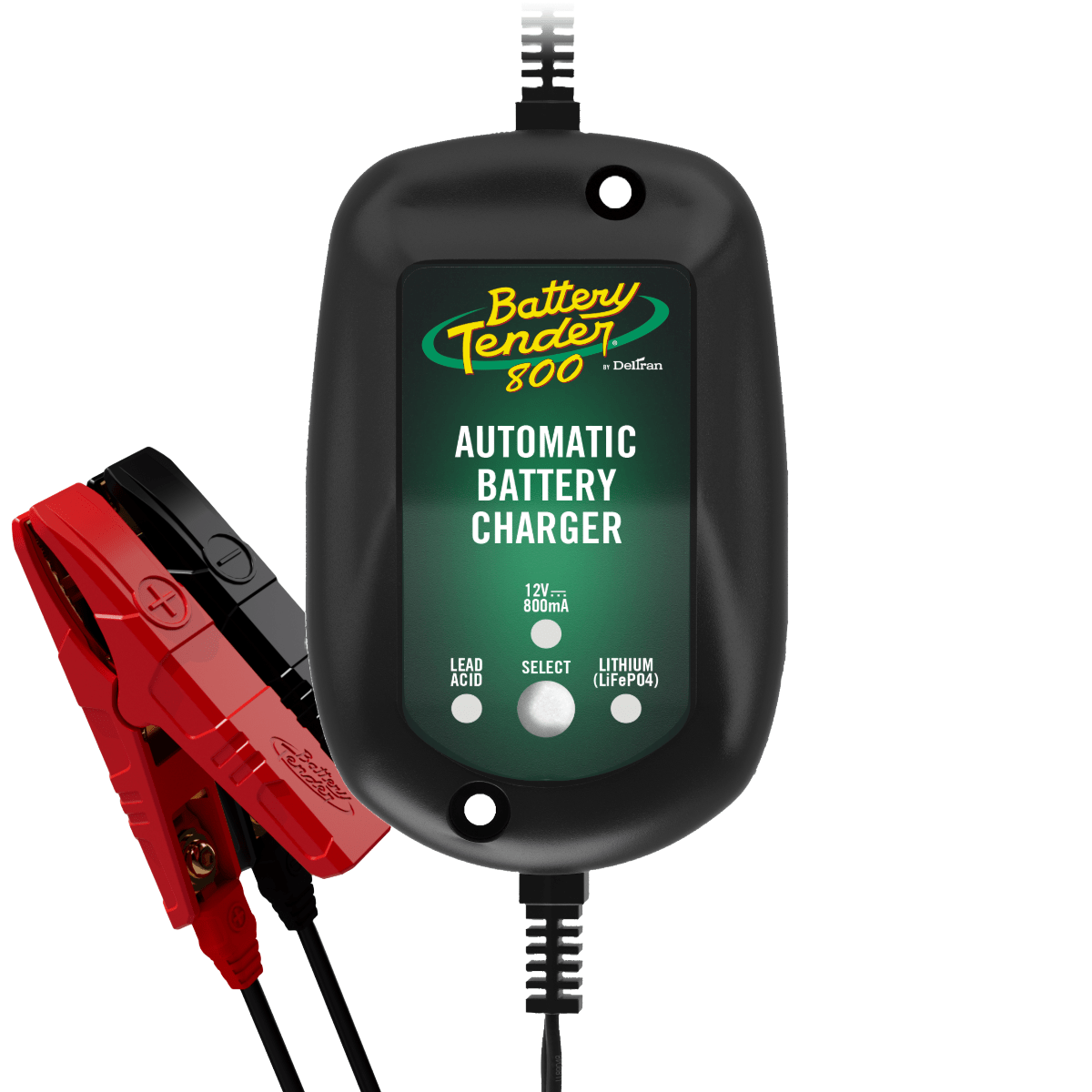
Explore this need in the finder →Battery Tender lists the Weather Resistant 022-0150 as a 12 V, 800 mA charger and maintainer, with a selectable lead-acid/AGM or LiFePO₄ mode in the exact instruction manual. But its own evidence contains a consequential conflict: the product page advertises IP67 and outdoor mounting, while the SKU-matched manual says “indoor use only” and “do not expose” the charger to rain or snow. The same page gives two different battery-size ceilings, 30 Ah in its main description and 50 Ah in its FAQ. Those conflicts change whether this model should be considered for a wet location or for a capacity-limited recharge. This is a source-based assessment, not a use test.
Verified charging configuration
The manual names part number 022-0150 and describes a 12 V selectable 800 system for six-cell lead-acid/AGM and four-cell LiFePO₄ batteries. It explains automatic qualification, bulk, absorption and float maintenance, and states the charge rate as 800 mA. The model page also identifies the unit as 12 V and lists one alligator/ring-terminal connection cable. It is a single-output, wall-powered charger, not a multi-bank device or a jump starter.
Battery Tender’s product page lists flooded, AGM, gel, sealed maintenance-free and lithium battery types; the manual is more specific, naming lead-acid/AGM and LiFePO₄. The manual’s chemistry selector must be set before the battery connection is made. Its lithium plan is limited to LiFePO₄; the document does not establish a BMS requirement either way, so do not assume support for an arbitrary lithium pack or for lithium without consulting the battery maker.
Do not assume the weather claim settles the environment
The model page labels this charger weather resistant and advertises an IP67 rating. The instruction manual for the exact 022-0150 SKU, however, explicitly says indoor use only and not to expose the charger to rain or snow. Until Battery Tender supplies instructions that reconcile those statements for the exact edition, the conservative reading is not to install or operate it outdoors or in a wet location based on the title or image. The page’s IP claim is recorded, but it is not treated as a verified use permission in this assessment.
That distinction matters for a car stored outside: a weatherproof-looking enclosure is not enough to establish that the entire charger, plug, lead joins and battery connection can be exposed. Confirm the current manual, installation arrangement, outlet protection and warranty terms with the manufacturer before choosing any outdoor setup. If the manual in the actual box still says indoor-only, follow it.
Capacity evidence is unresolved
The product-page body says the 800 mA output is optimized for 3–30 Ah batteries. Its FAQ later says 3–50 Ah and provides charge-time examples. Because the exact model page does not reconcile these ceilings, this assessment does not assign the model a verified maximum charge capacity. Its slow 0.8 A output is plainly not a fast-recovery choice, and a numeric capacity shortlist should not rely on either conflicting limit until the exact edition and rating are confirmed.
For a battery already charged and needing maintenance, the manual’s float stage is relevant, but it does not override the indoor-only warning or the battery maker’s charging directions. For recovery charging, identify the battery’s rated capacity and permitted current first; do not extrapolate from one published example.
How it differs from simple storage maintainers
Unlike the standard 021-0123 Junior and 021-0128 Plus, the 022-0150 manual documents a separate LiFePO₄ mode. It also has a mountable case according to the product page, but mounting hardware and safe installation permissions must be checked in the exact package documentation. The ordinary Junior and Plus have a clearer lead-acid-only instruction basis and no outdoor rating; their own manuals also warn against rain or snow. The 022-0150’s distinctive features therefore come with a need to resolve the source conflict rather than a simple “better in weather” conclusion.
Who should shortlist it
The 022-0150 is a possible indoor 12 V single-battery option if the buyer confirms the exact 800 mA edition, compatible chemistry mode and battery instructions. It is not a verified outdoor charger on the present record, despite the product page’s IP67 claim, and its capacity ceiling is not settled. Do not select it for a wet or exposed installation until Battery Tender confirms that the SKU-specific manual has been updated and the allowed environment is explicit.
Before buying, confirm SKU 022-0150, manual revision, the charger’s current mode and output, the manufacturer’s approved capacity range, and whether any mounting parts are actually included. Do not assume the retailer page’s photographs represent an exact package. No physical use, measurements or charging test were performed.
Manufacturer references: the Weather Resistant 022-0150 product page, the SKU 022-0150 Selectable 800 instruction manual, and the Battery Tender automotive charger collection.
Key specifications
Key details at a glance
| Output battery voltages | 12 V |
|---|---|
| Supported chemistries | Lead-acid / Lithium-ion |
| Rated DC charging current | 0.8 A |
| Independent battery outputs | 1 |
| Arrangement | Portable plug-in charger |
| Included connection | Two-in-one alligator-clip and ring-terminal cable listed on the product page; verify exact package contents. |
Use the exact model’s instructions for operating limits, supplied equipment and version differences.
Sources for this review
Sources for this assessment
Keep the next step evidence-led
Use the finder to combine voltage, battery chemistry, charging job and setup requirements; then check the exact model and its manual.