
Your needs, this model
Does it fit your priorities?
Can the exact 022-0151 maintain a 12 V AGM battery?
The SKU-matched manual identifies a selectable 12 V Lead Acid/AGM mode, a 1 A charging rate and a storage/float maintenance stage. It says indoor use only and not to expose the charger to rain or snow. Check that the battery maker permits the current and follow the manual supplied with the exact unit.
Explore this need in the finder →Does 022-0151 support 12 V LiFePO₄, and does the battery need a BMS?
The exact manual has a selectable 12 V LiFePO₄ mode, but it does not state whether a built-in BMS is required. That requirement remains unknown; verify it with both the battery maker and Battery Tender before charging.
Explore this need in the finder →Is 022-0151 suitable for outdoor storage or onboard marine charging?
Not on the manual evidence. Although the exact page lists IP68 in one field and IP65 in its FAQ and uses outdoor language, the P/N 022-0151 manual says indoor use only and no rain or snow. It also directs users to remove marine batteries and charge ashore; onboard charging calls for equipment designed for marine use.
Explore this need in the finder →This assessment is for Battery Tender’s Weather Resistant 1 AMP, 12 V charger, exact SKU 022-0151-DL-WH and manual part number 022-0151. The maker describes a mountable, weather-resistant charger with an IP rating, but the instruction manual for this exact part number says indoor use only and not to expose the charger to rain or snow. That conflict is more important than the product name: the available instructions do not establish outdoor use. This is desk research from the manufacturer’s page and manual, not a physical test.
What the 1 A rating does—and does not—tell you
The manual identifies a selectable 1 A, 12 V charging system. It describes qualification, bulk charging, absorption, and storage/float maintenance, after which the unit monitors and maintains a full battery. It is a single-battery charger, not a multi-bank unit, a jump starter, or a general-purpose 12 V power supply. The exact manual expressly says it is not intended to power a low-voltage electrical system except in a starter-motor application.
One amp is a modest charging rate for a car battery. The manual gives an approximate example: a fully discharged 15 Ah battery takes about 12 hours to reach 80% capacity. That is a manual example, not a guarantee for a particular battery, and it does not define a maximum supported capacity. The manual publishes no Ah ceiling. A buyer choosing by capacity should not convert this one time example into a capacity limit or assume this is a rapid-recovery charger.
Selectable chemistry, with a boundary to verify
The exact manual names six-cell lead-acid/AGM batteries and four-cell lithium iron phosphate (LiFePO₄) batteries. Its Select control switches between a 12 V Lead Acid/AGM mode and a 12 V LiFePO₄ mode; the selected mode must be set before connecting the battery. The manufacturer’s product page additionally lists flooded, sealed maintenance-free, AGM and gel lead-acid types. It does not claim EFB or calcium support, so this review does not extend the compatibility list to them.
The manual does not say whether a LiFePO₄ battery must have a built-in battery-management system, nor whether charging without one is acceptable. Treat that as unknown, not as permission. Check the battery maker’s voltage and current requirements and the charger’s supplied instructions before selecting a lithium profile. The manual also says the charger will not begin output until it senses at least 3 V at the output and warns against charging a frozen battery; a deeply discharged or damaged battery may need a different assessment.
Resolve the weather-resistance disagreement before installation
The current exact-model page calls the enclosure mountable and water resistant, displays IP68 in its specification field, and elsewhere describes an IP65 package and covered outdoor use. The manual that identifies part number 022-0151 gives a stricter instruction: indoor use only, and do not expose the charger to rain or snow. No source here reconciles the ratings or supersedes that manual. Do not use the marketing wording or image as evidence that this charger can be left exposed outdoors.
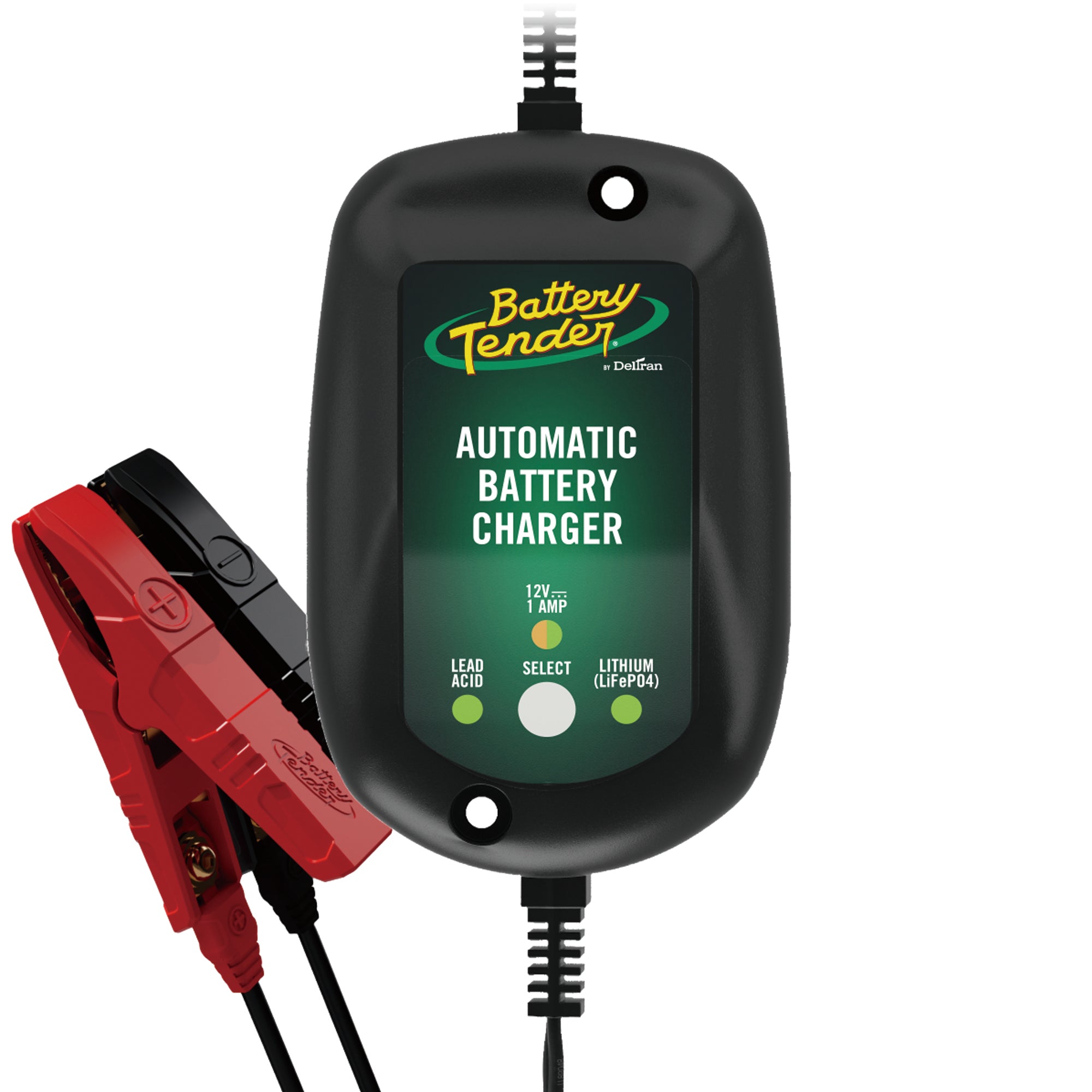
The same manual says a marine battery must be removed and charged on shore; charging it aboard requires equipment specially designed for marine use. This is a meaningful limitation despite the product page’s marine and outdoor application language. Before considering any permanent mount, confirm the current exact-SKU instructions, the actual approved location, and what connection lead or mounting hardware the particular package includes. The product image shows clamp leads, but a picture is not a package inventory.
How it differs from nearby Battery Tender models
The Weather Resistant 022-0151 is not the 022-0150 800 mA sibling: the exact 022-0151 manual specifies 1 A, while the other model’s manual specifies 800 mA. That is a real output difference, but neither manual gives a maximum supported Ah capacity for the model. The 1 A output is also the same current listed for the separate Charge N Start 1100 and 1120 chargers; those models add distinct jump-start hardware, while this charger’s manual documents no jump-start function. Match the charger’s charging current to the battery maker’s instructions rather than comparing their jump-start ratings or assuming a small current increase makes a large battery a quick charge.
For a stored car with a compatible 12 V battery in an indoor location, the documented float-maintenance stage may be relevant after charging is complete. The lead set, battery chemistry selection and AC source still need to match the instructions. It is not a verified on-board marine charger and it is not a fit for someone who specifically needs a documented outdoor installation, a known Ah ceiling, more than 1 A, or an established LiFePO₄ BMS condition.
Checks to make before choosing this model
Confirm that the offer is SKU 022-0151-DL-WH, not the 800 mA 022-0150 or a retailer bundle. Check that the included manual is revision 392-0456-R0 or a newer instruction that explicitly resolves the indoor-only warning; until then, follow the indoor/no-rain direction. Verify the charger lead and mount hardware in the exact package, the battery’s 12 V chemistry and accepted current, and any battery-maker restrictions on long-term maintenance. For LiFePO₄, ask both manufacturers about the BMS requirement. No charging-speed test, outdoor test, ownership or hands-on assessment was performed.
Manufacturer references: the Weather Resistant 022-0151 product page, the SKU 022-0151 instruction manual, P/N 392-0456-R0, and the Weather Resistant 022-0150 product page for the neighboring 800 mA model.
Key specifications
Key details at a glance
| Output battery voltages | 12 V |
|---|---|
| Supported chemistries | Lead-acid / Lithium-ion |
| Rated DC charging current | 1 A |
| Independent battery outputs | 1 |
| Arrangement | Portable plug-in charger |
| Included connection | The product image shows clamp leads; the manual discusses output clips or ring terminals. The exact package inventory and mounting hardware are not established by the reviewed product description. |
Use the exact model’s instructions for operating limits, supplied equipment and version differences.
Sources for this review
Sources for this assessment
- Battery Tender charger collection, 022-0151 card observed
- Battery Tender exact U.S. Weather Resistant 022-0151 product page
- Battery Tender Selectable 1 A, 12 V manual P/N 392-0456-R0; identifies charger P/N 022-0151
- Battery Tender official exact-model image for SKU 022-0151-DL-WH
- Battery Tender exact Weather Resistant 022-0150 sibling page, 800 mA model

Keep the next step evidence-led
Use the finder to combine voltage, battery chemistry, charging job and setup requirements; then check the exact model and its manual.