
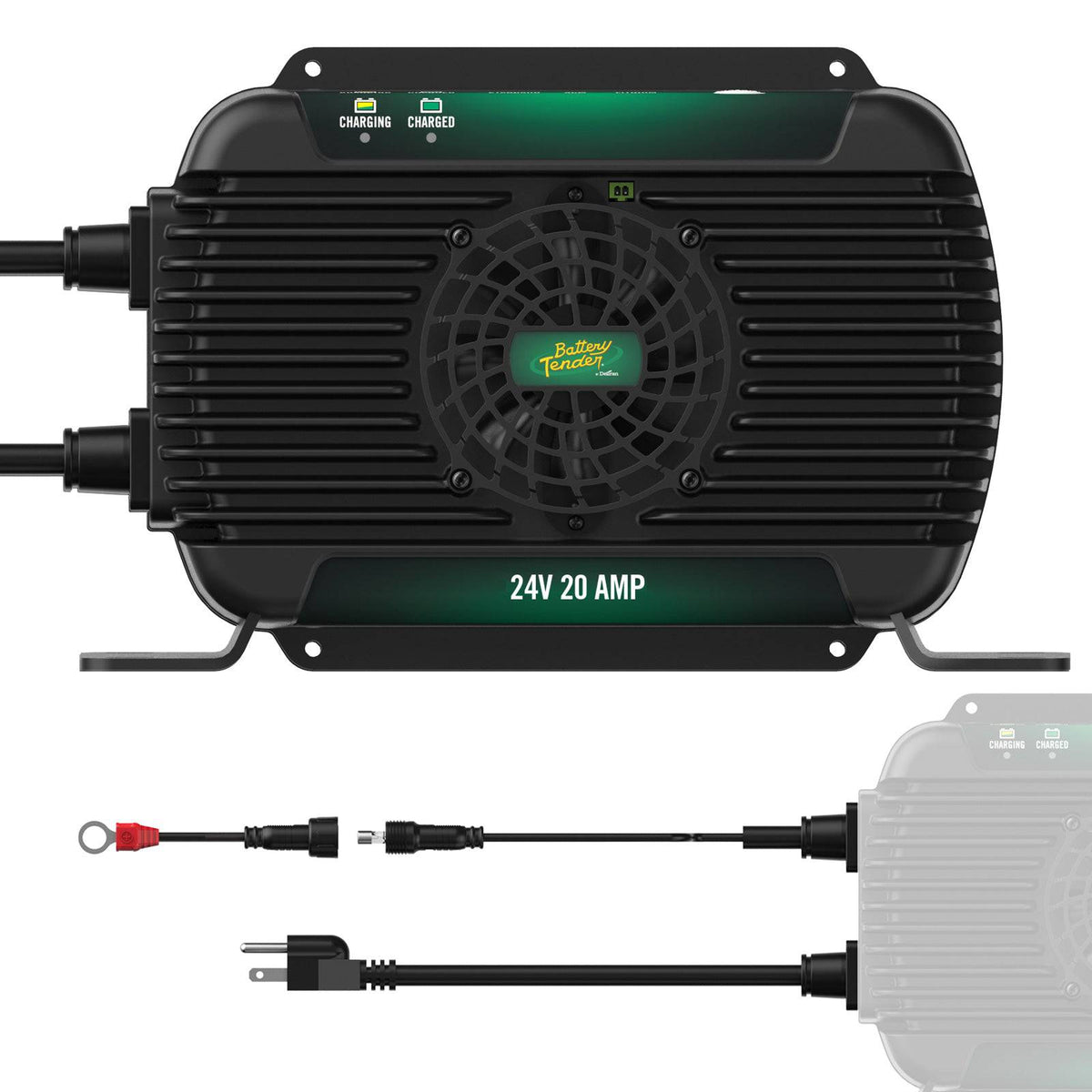
Your needs, this model
Does it fit your priorities?
Will this 24 V model charge a standard 12 V car battery?
No. SKU 022-2012 is fixed at 24 V and 20 A, and the manual identifies it as a 24 V charger. For a 12 V vehicle battery, use a confirmed 12 V model and check its specific battery profile; the similar 022-2011 PowerPlus is the 12 V sibling.
Explore this need in the finder →What does the maker say about a 300 Ah 24 V battery?
The exact 022-2012 product page states a 40–300 Ah range for its 24 V plan. The shared manual confirms 24 V at 20 A but does not restate an Ah limit, so read 300 Ah as a product-page ceiling rather than as a charging-time promise. The finder’s Ah question ends at 300, which lets it test this stated upper edge but not anything above it. Check that the battery manufacturer permits the selected current and profile.
Explore this need in the finder →Does the 24 V lithium mode prove this charger fits a battery with no BMS?
No. The maker materials identify a lithium mode but do not state whether a built-in battery management system is required. An explicit no-BMS requirement is therefore not established; confirm the battery maker’s requirement and the exact charger instructions before connection.
Explore this need in the finder →The Battery Tender PowerPlus 24V 20 A is the fixed 24 V SKU 022-2012-DL-WH. Its manufacturer page identifies large diesel trucks and commercial vehicles among its applications, and the shared P/N 392-0449-R0 manual lists this exact part number as a 24 V, 20 A on-board charger. That is a narrower use case than a typical 12 V passenger-car battery: check the vehicle’s actual battery-system voltage before considering it. This is a source-based assessment, not a hands-on test.
Twenty amps for one 24 V battery system
The model has one charging connection, not multiple independent banks. Its 20 A rating belongs to the 24 V output; it should not be read as 20 A per channel or as a combined rate across separate batteries. The maker describes automatic bulk charging, absorption and float maintenance. That is useful for a commercial vehicle or equipment battery that needs a compatible 24 V profile, but the battery maker’s allowed charge current remains the deciding limit. Battery Tender’s page states a 40–300 Ah capacity range for SKU 022-2012. The manual confirms the exact model and voltage/current but does not repeat an Ah limit, so 300 Ah is a product-page claim rather than a manually documented charge-time calculation. The finder’s capacity question also stops at 300 Ah; it can test that stated ceiling but not a larger value. The separate lower edge on the maker page is another package-specific check. Neither the rating nor a match predicts how quickly a real battery will recover or diagnoses its condition.Voltage and chemistry are separate requirements
The exact SKU is fixed at 24 V. It does not charge a standard 12 V car battery, and the similar-looking PowerPlus 022-2011 is a separate 12 V model rated at 26 A. This 24 V variant is more specific to heavy-duty vehicle systems, marine applications and industrial equipment. The exact product page also mentions cars and trucks in its broad compatibility summary, but its detailed use examples focus on large diesel trucks and commercial vehicles. The point is to verify the actual system rather than infer a 24 V battery from a vehicle class. The product page and shared manual identify Standard, AGM and lithium modes; the manual does not state whether a lithium battery must contain a built-in BMS. The review therefore does not claim a match for either an explicit BMS-required or no-BMS condition. The maker page lists gel and sealed maintenance-free types as well, but the fact record uses the narrower profiles clearly named in the manual. Confirm the battery’s exact chemistry and acceptable charge profile before use. For a 24 V vehicle choosing between reviewed output tiers, the PowerPlus is rated at 20 A. NOCO’s GENIUSPRO25 is rated at 12.5 A in its 24 V battery plan, while GENIUSPRO50 documents 25 A at 24 V. Those numbers are not a ranking: the useful comparison is whether the battery permits the current, whether a portable unit or on-board arrangement suits the installation, and what exact capacity and chemistry the manual covers.Installation claims deserve a manual check
Battery Tender describes the 022-2012 for portable use as well as permanent on-board mounting. Its page lists a 120 V AC input, mounting hardware and fused ring-terminal leads; check the exact package, cable reach and terminal plan before buying. The manual includes instructions for batteries installed in a vehicle, including polarity and connection order. Follow those instructions and the battery maker’s safety guidance rather than treating a high-current rating as permission to connect without checking the setup. The page advertises IP68 and installation in wet areas, but the shared manual explicitly says not to expose the charger to rain or snow. This assessment follows that direct manual restriction. The page also advertises UL marine ignition protection, but the inspected manual does not identify a certification declaration or number that this review can verify. Do not assume the product is approved for an exposed or fuel-vapor location based on this page alone.Who should consider it
The 022-2012 is relevant for a verified 24 V vehicle battery when 20 A, one output and the documented lead-acid or lithium mode fit the battery’s instructions. It is not a universal charger for cars, not a 12 V fallback and not a multi-bank arrangement. Before purchase, match the SKU exactly, verify battery voltage and chemistry, check the manufacturer’s capacity claim against the battery, confirm current and cable needs, and resolve the dry-use installation condition. The browser page title currently conflicts with the on-page model text, so rely on the H1, SKU and manual identity rather than the title alone.Key specifications
Key details at a glance
| Output battery voltages | 24 V |
|---|---|
| Supported chemistries | Lead-acid / Lithium-ion |
| Rated DC charging current | 20 A |
| Published charge capacity limit | 300 Ah |
| Independent battery outputs | 1 |
| Arrangement | Portable and on-board |
| Included connection | The exact page lists mounting hardware and ring-terminal leads with a 40 A fuse; verify actual package and lead reach before installation. The page describes 6.5 ft AC and 5 ft DC cords with a short accessory lead. |
Use the exact model’s instructions for operating limits, supplied equipment and version differences.
Sources for this review
Sources for this assessment
Keep the next step evidence-led
Use the finder to combine voltage, battery chemistry, charging job and setup requirements; then check the exact model and its manual.