
Your needs, this model
Does it fit your priorities?
What changed from Battery Tender SKU 022-0337 to 022-1005?
Battery Tender calls 022-1005 the replacement. Both are single-output 12 V 8 A/2 A chargers, but the newer manual supports a LiFePO4 profile and the current page claims weather resistance; the older model sources conflict on lithium and have no stated ingress rating. The manuals must be checked separately.
Explore this need in the finder →Can the 022-1005 power a 12 V accessory in supply mode?
The page lists a 6 A power-supply function, and the manual has a Power Supply selector, but the same manual says it is not intended to supply a low-voltage electrical system. Because those instructions are not reconciled, this assessment does not count the unit for an external 12 V device; seek written instructions for the exact load and SKU.
Explore this need in the finder →Is the 022-1005 approved for rain or a permanent outdoor mount?
The page advertises IP65 while the manual labels an IP67 rating, but that manual also says not to expose the charger to rain or snow. Do not infer an outdoor installation permission from the rating language; confirm the allowed placement and use in current manufacturer instructions.
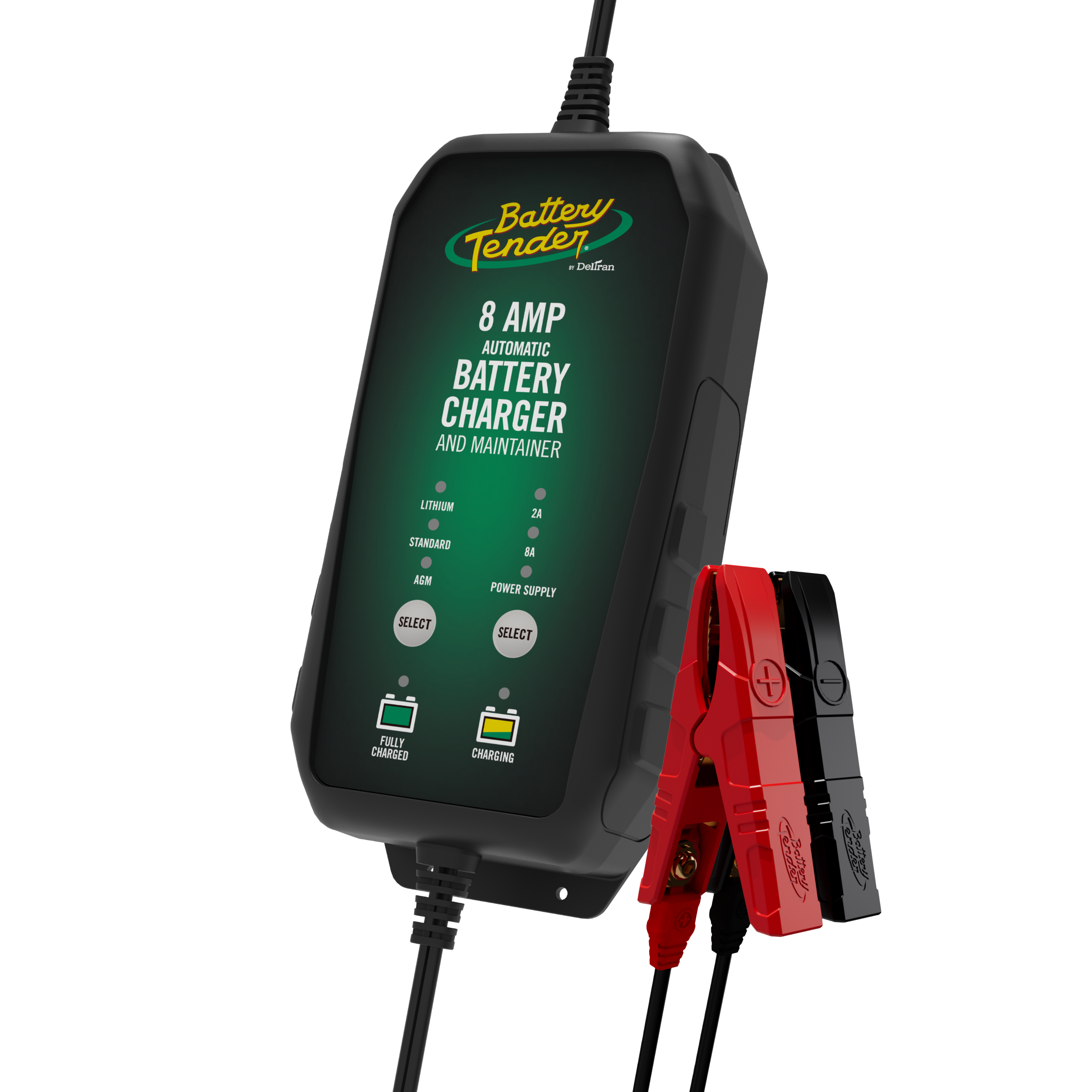
Explore this need in the finder →Battery Tender's Power Tender 8 A/2 A, SKU 022-1005-DL-WH, is the current replacement for its earlier 022-0337 charger. It remains a portable, single-output 12 V unit, but its exact manual and product page describe lithium support that the older model's documentation does not resolve. The current 022-1005 page also promotes weather resistance and a separate power-supply feature, yet each needs to be read alongside its manual rather than treated as an unrestricted capability.
Rate selection and battery charging
The manual body identifies P/N 022-1005 and lets the user select 2 A or 8 A. At 8 A, the charger provides the higher bulk rate; at 2 A it offers a lower-rate option. The manual describes automatic qualification, bulk charging, absorption and float maintenance after charging. That sequence can support a charge-then-maintain routine on one 12 V battery, not two independent batteries. The rates are alternatives, not a combined 10 A output, and neither is a time guarantee. The manual's approximate 60 Ah timing example reaches 80 percent; battery condition, starting state, temperature and the final absorption stage can change elapsed time.
The exact page says it is suited to 12 V batteries from 20 Ah to 150 Ah. That range is a manufacturer page statement, not a precise maximum repeated in the manual. Compare the battery's labeled capacity and recommended charge current with the exact SKU before use. For a smaller battery whose maker calls for low current, the selectable 2 A rate may still be too high; “selectable” does not mean every rate is appropriate for every battery.
Supported chemistry and an unknown BMS condition
The current product page and manual identify standard lead-acid, AGM and LiFePO4 selections. The manual describes a four-cell LiFePO4 configuration and recovery behavior for low-voltage batteries, but does not state the BMS requirement. A lithium label alone is not enough to establish fit: confirm the pack's chemistry, nominal 12 V rating, BMS status and allowed current with its manufacturer. The manual also describes standard lead-acid/AGM recovery thresholds. A recovery mode is not proof that an otherwise damaged battery will recover.
Battery Tender distinguishes this model from the earlier 022-0337 by adding lithium multi-chemistry support and other claimed upgrades. The older SKU is still a separate reference because its manual cover mentions lithium while its safety section says lead-acid only and its product FAQ directs lithium owners elsewhere. Do not borrow either model's chemistry claims or package contents from the other.
Weather and the 6 A supply feature are not settled
The 022-1005 product page advertises IP65 weather resistance. The linked PDF, whose filename says 022-0209 but whose first page and body identify P/N 022-1005 and manual revision 392-0454-R0, prints IP67 on a later page. Its safety instruction also says not to expose the charger to rain or snow. These statements do not provide a clear permission for outdoor mounting or water exposure, so this assessment leaves the ingress rating unresolved and follows the conservative instruction not to expose it to rain or snow. If a planned installation relies on a weather rating, request current written placement guidance for the exact SKU.
The product page lists a 6 A supply function and the manual includes a Power Supply selection, but that same manual says the charger is not intended to supply a low-voltage electrical system. That conflict prevents a responsible claim that it can power an arbitrary 12 V accessory. The finder therefore does not match it to the 12 V DC-device supply option. Ask the manufacturer about the exact device, load, connection method and mode before using this feature; do not connect a load based on the mode label alone.
Connections and practical checks
The product page describes a 120 V AC input, about 12.5 feet of total reach and a combination ring-terminal/alligator lead with a 15 A fuse. The manual says set the chemistry and charge rate before connection, keep the charging area ventilated, avoid contact with moving vehicle parts, and never charge a frozen battery. It also says marine batteries must be removed and charged ashore unless the charger is designed for on-board marine use. The illustrated and listed package contents should be checked on the exact seller listing before purchase; this assessment cannot confirm a seller's current box.
For one 12 V lead-acid, AGM or LiFePO4 battery where the battery maker permits the rate, 022-1005 combines a higher charging choice with automatic maintenance. Its constraints are a single output, an unstated lithium BMS requirement, a page-reported 20–150 Ah range, and unresolved environmental and supply-mode contradictions. Verify the exact model number and manual before buying. This research-based review is not a report of hands-on testing, ownership or real-world performance.
Key specifications
Key details at a glance
| Output battery voltages | 12 V |
|---|---|
| Supported chemistries | Lead-acid / Lithium-ion |
| Rated DC charging current | 8 A |
| Published charge capacity limit | 150 Ah |
| Independent battery outputs | 1 |
| Arrangement | Portable plug-in charger |
| Included connection | The product page lists a ring-terminal and alligator-clip combination lead with a 15 A fuse; verify package contents for the exact retail SKU. |
Use the exact model’s instructions for operating limits, supplied equipment and version differences.
Sources for this review
Sources for this assessment
Keep the next step evidence-led
Use the finder to combine voltage, battery chemistry, charging job and setup requirements; then check the exact model and its manual.