
Your needs, this model
Does it fit your priorities?
Does the Power Tender 5 A support 6 V AGM charging?
The exact P/N 022-0186G manual provides a 6 V AGM/flooded selection and states a 5 A charge rate. Set the voltage and chemistry before attaching the battery, and use that current only when the battery maker permits it.
Explore this need in the finder →Can this 5 A charger use a 12 V LiFePO₄ profile?
The manual documents a 12 V LiFePO₄ selection, distinct from its 6 V AGM/flooded mode. The lithium BMS condition is not stated, so confirm the pack's protection and allowed current with its maker; do not infer a 6 V lithium capability.
Explore this need in the finder →What capacity range can I safely match to model 022-0186G?
The current product page gives two different Ah ranges, and the manual's cover lists 60 Ah lead-acid and 13 Ah LiFePO₄ designs without identifying those figures as upper limits. The manual's charging example is not a capacity ceiling. No verified maximum is recorded here; ask Battery Tender for a clarified specification and check the battery maker's rate.
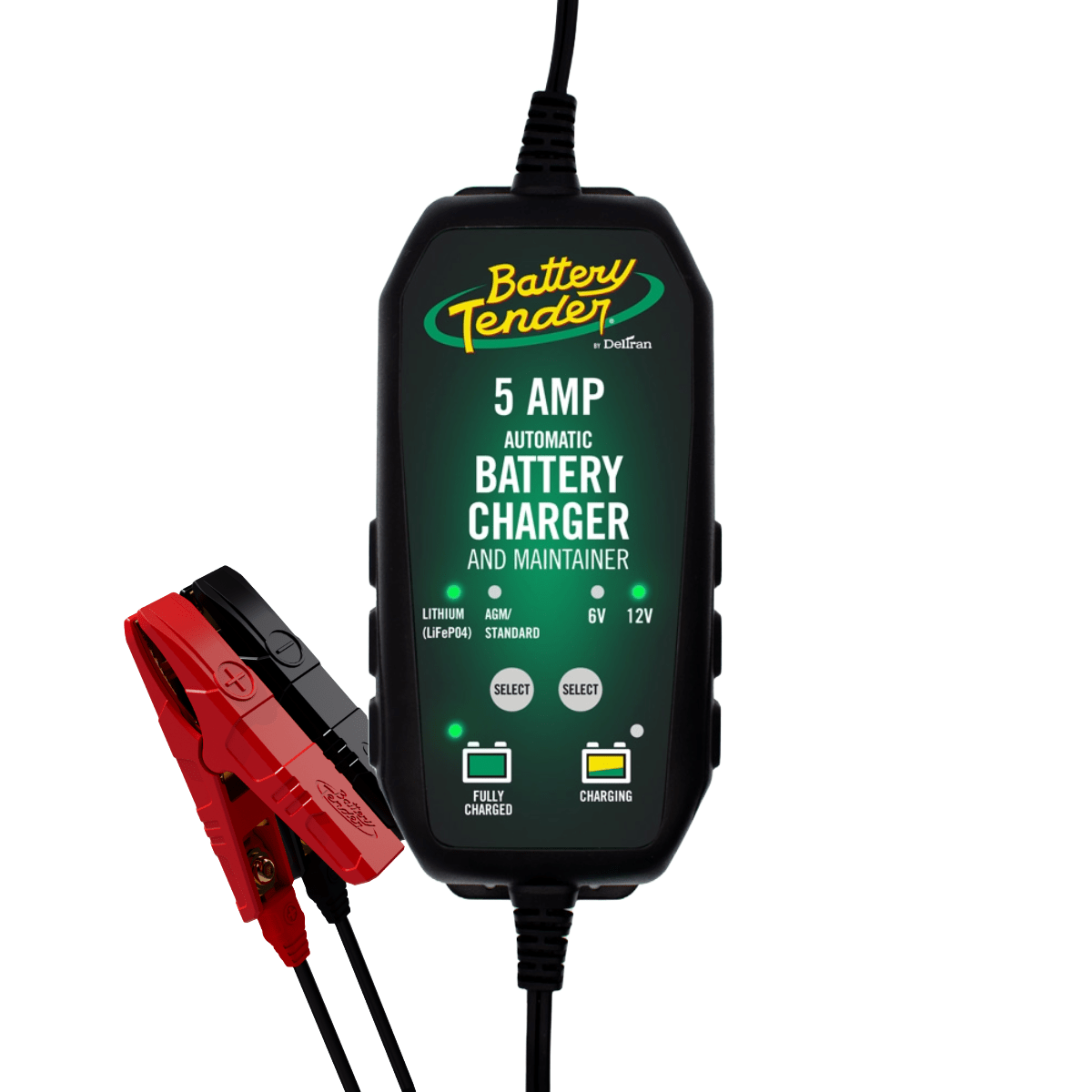
Explore this need in the finder →The Battery Tender Power Tender 5 A 12V/6V, retail SKU 022-0186G-DL-WH, is the highest-output member of the small single-output Power Tender group reviewed here. Its exact manual identifies P/N 022-0186G and states a 5 A charge rate. It documents selectable 6 V/12 V flooded/AGM modes and a separate 12 V LiFePO₄ setting. A higher rated output can be useful only when the battery maker permits it; it is not a promise of a specific charging time or a license to ignore battery condition. This assessment is based on primary documents, not hands-on testing.
What this exact configuration does
The product page describes a portable charger and maintainer and lists a 120 V AC input, a 5 A output and a two-in-one alligator-clip/ring-terminal lead. The manual describes qualification, bulk, absorption and storage/float stages, and says the charger's output depends on the battery. It provides a time example for a 15 Ah battery to reach 80%; that example should not be converted into a promised turnaround for another battery, whose state of charge, chemistry, temperature, health and vehicle draw may differ.
There is one output, so this is not the 5-bank Power Tender. A single charger cannot independently charge multiple batteries at once just because its page lists several vehicle applications. The selector offers a 6 V or 12 V setting, and the chemistry selection is lead-acid/AGM or 12 V LiFePO₄. The manual does not describe LiFePO₄ at 6 V. It also does not specify a BMS requirement, so lithium owners should verify the pack's protection and allowed charging rate with the battery maker.
Capacity claims need a manufacturer answer
The exact product page says 20–150 Ah in one section and 30–250 Ah later in its FAQ. The manual cover identifies 60 Ah lead-acid/AGM and 13 Ah LiFePO₄ designs, but does not label those examples as upper limits. Its 15 Ah charge-time illustration also is not a maximum-capacity statement. Those figures do not reconcile into one defensible numerical charging range. This assessment therefore stores the different reported claims, leaves maximum charge capacity unknown, and does not match the unit to an entered Ah requirement. Ask Battery Tender for a current rating tied to P/N 022-0186G before choosing it for a capacity-sensitive charging task.
Voltage, chemistry and setup safety
Set both selectors according to the battery before attaching the leads. The manual explains that voltage and battery type cannot be changed while the battery is connected; disconnect AC and battery before resetting. The page's application copy describes lithium at both 6 V and 12 V, but the exact manual specifies a 12 V-only LiFePO₄ profile alongside 6 V flooded/AGM. Because those statements conflict, this assessment follows the manual and does not count 6 V lithium without an exact-model clarification. No gel, EFB, calcium or maintenance-free subtype match is recorded from the manual even though the product page has broader lead-acid compatibility copy.
The product page lists an IP65 rating, but the exact manual says not to expose the charger to rain or snow. The conflict means this assessment cannot establish outdoor suitability from the rating or product label. Keep the charger dry unless the manufacturer provides a revised instruction for this exact configuration. The manual further warns against charging frozen batteries, calls for ventilation, and tells users to follow the battery and vehicle maker's procedures. It says a marine battery must be charged ashore unless using equipment specially designed for on-board marine charging.
Choosing between the 3 A, 4 A and 5 A units
The current rating is the clearest verified distinction across the reviewed single-output Power Tenders: 3 A for P/N 022-0202, 4 A for P/N 022-0209 and 5 A for P/N 022-0186G. The mode structure is similar: selectable 6 V/12 V flooded/AGM, plus a 12 V LiFePO₄ profile. None becomes a multi-bank charger, and the single-output rating is not divided among simultaneous battery channels. The 5 A unit has a higher rated current than the 4 A and 3 A variants; actual current changes as a charge progresses, so a simple percentage comparison cannot predict elapsed time.
The product page's capacity and weather claims are also not enough to call this the best fit for a large or outdoor battery. If either capacity ceiling or wet-location use is essential, resolve the exact manual conflict first. For a smaller known 12 V lead-acid battery, the Battery Tender Plus 021-0128 has its own published capacity ceiling and 1.25 A output; it is a different, lower-current choice rather than a direct substitute for the 5 A model. Use the Plus's own facts and manual, not this Power Tender's claims, when comparing.
Who should shortlist it
Consider P/N 022-0186G when one portable output is enough, the exact battery fits a documented voltage/chemistry mode, and its manufacturer approves a 5 A charging rate. Do not choose it on an assumed 250 Ah maximum, an unverified outdoor claim, a 6 V lithium need, or a multi-battery requirement. Before buying, confirm the full retail SKU, manual revision, selector positions, included connectors and a clarified capacity rating if needed. No use, ownership, measurement or performance test is claimed in this review.
Manufacturer references: the Power Tender 5 A product page, the model 022-0186G instruction manual, and the Battery Tender charger collection.
Key specifications
Key details at a glance
| Output battery voltages | 6 / 12 V |
|---|---|
| Supported chemistries | Lead-acid / Lithium-ion |
| Rated DC charging current | 5 A |
| Independent battery outputs | 1 |
| Arrangement | Portable plug-in charger |
| Included connection | Product page lists a two-in-one alligator-clip and ring-terminal lead; confirm exact package contents. |
Use the exact model’s instructions for operating limits, supplied equipment and version differences.
Sources for this review
Sources for this assessment
Keep the next step evidence-led
Use the finder to combine voltage, battery chemistry, charging job and setup requirements; then check the exact model and its manual.