
Your needs, this model
Does it fit your priorities?
Can the Power Tender 5-Bank charge five batteries independently?
The current 021-0133 version has five separate outputs, each rated up to 4 A. The channel count lets it connect five batteries separately; it does not combine five outputs into one higher-current battery connection. The maker lists 14–100 Ah per channel, so check each battery individually and confirm its allowed rate.
Explore this need in the finder →Does the 5-Bank support both 6 V AGM and 6 V LiFePO₄?
The exact 392-0386-R0 manual documents 6 V lead-acid, including AGM, but its LiFePO₄ instructions are for 12 V only. Do not treat broad product-page lithium wording as 6 V lithium support; verify the battery chemistry and voltage selector before connection.
Explore this need in the finder →Can this wall-mountable charger be left outdoors?
No outdoor use is established: the exact manual says not to expose the charger to rain or snow. Plan a dry, ventilated 120 V AC location and follow the manual's spacing, connection order, battery-temperature and supervision instructions; wall mounting alone does not make it an onboard or weatherproof installation.
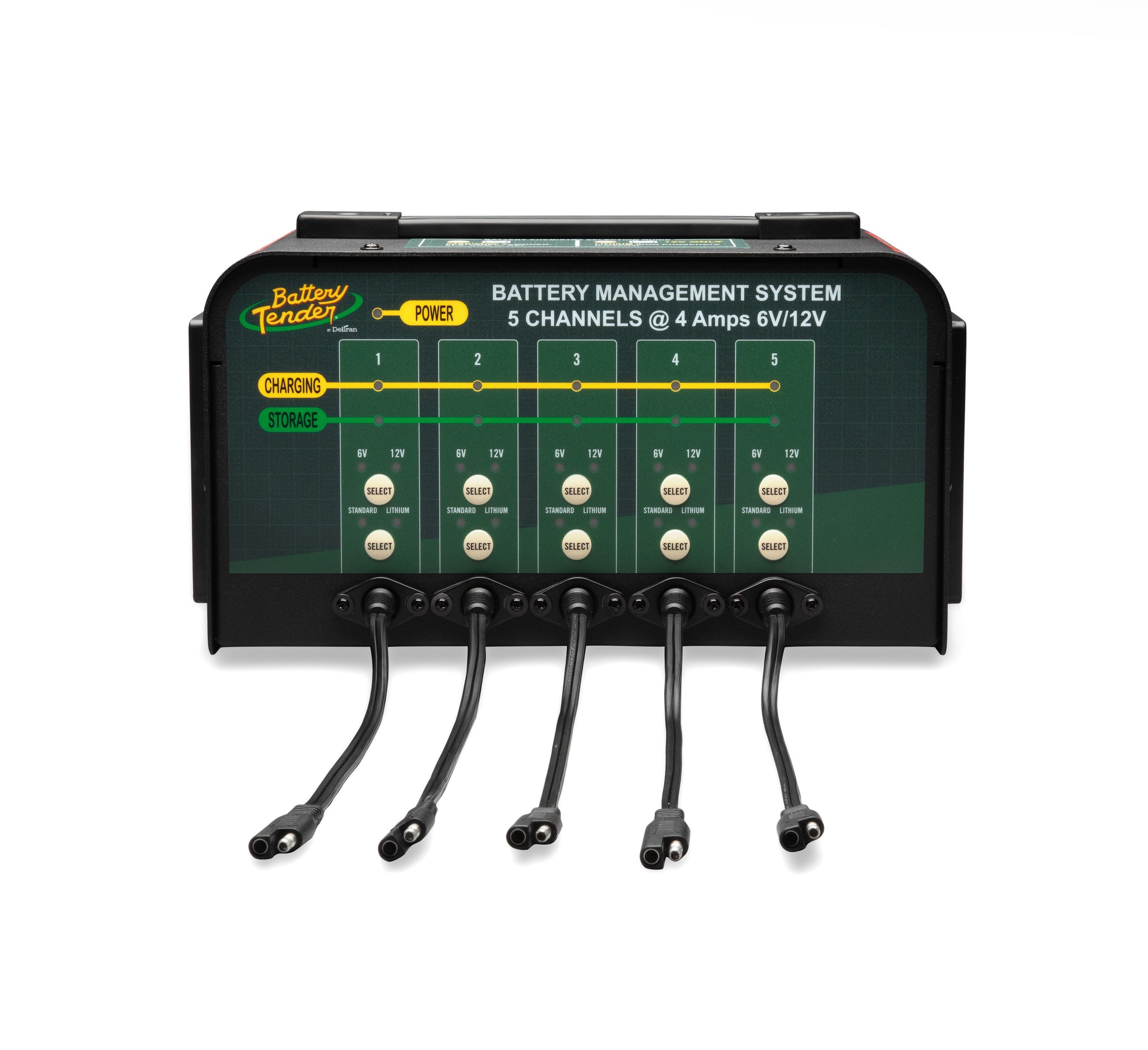
Explore this need in the finder →The Battery Tender Power Tender 5-Bank 4 A, retail SKU 021-0133-DL-WH, is best understood as a small shop's multi-vehicle charging station rather than a bigger version of a pocket-sized maintainer. Its current product page describes five separate charging circuits, and the linked manual revision 392-0386-R0 identifies both the five-bank P/N 021-0133 and the related ten-bank P/N 021-0134. Each channel is rated up to 4 A and configured for its own battery. This assessment is based on those manufacturer documents, not hands-on use or testing.
Five independent outputs, not a shared 4 A pool
Five outputs are useful when a garage, collector, or small service operation needs to keep several batteries on a maintenance cycle at once. The product page lists five 7.5-foot quick-disconnect output leads and the manual says each charging station works independently. The 4 A figure applies to each channel, not to the five outputs combined into one battery lead. It is a maximum rating: the manual notes that current changes with the battery and charge stage, so a battery does not receive a fixed 4 A through the whole cycle.
That distinction also keeps bank count separate from capacity. One channel serves one battery; five channels do not make a single 500 Ah charger. The product page publishes a 14–100 Ah compatible range per channel. The manual does not state that range, though it gives a 12 V, 40 Ah example that takes about eight hours to reach 80 percent at 4 A. Treat that as the maker's example, not a charge-time promise or a different capacity limit. Battery condition, state of charge, temperature, loads and the permitted charge rate all matter. If a battery is below the page's 14 Ah lower edge, confirm its suitability directly instead of assuming the finder has tested that floor.
Modes are selected per channel—with a lithium boundary
The meaningful mixed-fleet feature is not merely five leads; every channel has separate voltage and chemistry selectors. The exact manual documents 6 V and 12 V flooded/AGM/gel lead-acid modes and a LiFePO₄ mode for 12 V batteries only. The current page's broad lithium language can read as though 6 V lithium is supported as well, but the manual explicitly narrows lithium to 12 V. This review follows the manual and does not count a 6 V lithium plan. The current page also lists sealed maintenance-free lead-acid compatibility; it does not document EFB or calcium as dedicated subtypes.
Battery Tender does not state a lithium BMS requirement in this manual. Reverse-polarity protection and references to a BMS do not resolve that question, so a lithium owner should confirm both the battery's protection and the manufacturer's approved charge profile. The selectors also demand attention: when a channel is connected, its mode indicators flash for roughly ten seconds before the cycle starts; once charging begins, the manual says the setting cannot be changed until that battery is disconnected. Check the battery label first and set the channel deliberately.
A fixed garage charger, not an onboard or weatherproof unit
The exact page lists 120 V AC input, five alligator-clip quick-disconnect leads and a wall-mountable case measuring 13.5 by 7 by 7.5 inches at 10.58 pounds. It is an external shop charger; the finder classifies it with off-board plug-in units, not with onboard chargers installed in a vehicle. In practice, its size and the need for several cable runs suit a dedicated dry work area better than carrying one charger around to different parking spots. Check the reach from the mounting location and leave airflow space at both ends—the manual describes a fan that needs an unobstructed path.
The manual says not to expose the unit to rain or snow, not to charge a frozen battery, and not to put the charger directly above a battery. It calls for ventilation and correct polarity. It also says a boat battery must be removed and charged ashore unless equipment specifically designed for onboard marine charging is used. The 5-bank product page advertises a 25-hour safety-timer feature, while the manual describes a safety-timer fault without specifying an elapsed time; do not use that page statement as a manual-backed clock or as a reason to ignore battery condition.
When five banks are enough
Against the Power Tender 10-Bank, the 5-Bank has the same documented per-channel rating and the same voltage/chemistry boundaries, but half the number of independent stations and a smaller published case. If five batteries or fewer are normally connected, the extra channels of the 10-bank version may not earn their space. If a workbench routinely serves six to ten vehicles, the 10-Bank is the distinct configuration to investigate; the 5-Bank cannot cover a sixth battery just because the included leads are detachable. For one vehicle, a single-output charger may be simpler and less costly to install, while an onboard charger is a different choice when permanent vehicle wiring is the priority.
The 4 A rating can suit a battery whose maker permits that rate, but does not prove compatibility with every battery size, chemistry or fault condition. The very-low-voltage protections also mean this is not a universal recovery tool: the manual says it will not start below its sense threshold, and it warns that an unusually low resting lead-acid voltage may indicate a damaged battery. Get the battery tested when the manual's fault guidance applies.
What to verify before choosing it
Match the full 021-0133-DL-WH retail SKU and manual P/N 021-0133 to the current five-channel 4 A version. Confirm the exact battery voltage, chemistry, capacity range and maker-approved rate for each channel, as well as the included connectors and cable reach in the seller's package. If a BMS requirement, a smaller-than-14-Ah battery, outdoor placement, or an exact safety-timer duration is essential, the current documents do not settle that point. This is an evidence-based assessment, not a report of ownership, measurements or charging trials.
Manufacturer references: the Power Tender 5-Bank product page and its 5- and 10-bank instruction manual, revision 392-0386-R0.
Key specifications
Key details at a glance
| Output battery voltages | 6 / 12 V |
|---|---|
| Supported chemistries | Lead-acid / Lithium-ion |
| Rated DC charging current | 4 A |
| Published charge capacity limit | 100 Ah |
| Independent battery outputs | 5 |
| Arrangement | Portable plug-in charger |
Use the exact model’s instructions for operating limits, supplied equipment and version differences.
Sources for this review
Sources for this assessment
Keep the next step evidence-led
Use the finder to combine voltage, battery chemistry, charging job and setup requirements; then check the exact model and its manual.