
Your needs, this model
Does it fit your priorities?
Can model 022-0258 charge a 24 V LiFePO4 battery?
Yes, the exact P/N 022-0258 manual identifies 24 V eight-cell LiFePO4 as supported, with a 2.5 A output. It does not state the battery's BMS requirement, so check that detail and the allowed rate with the pack maker before connecting.
Explore this need in the finder →How does the 5/2.5 A output change between 12 V and 24 V?
The manual ties 5 A to 12 V and 2.5 A to 24 V. It says set voltage and chemistry before connecting, and the selector cannot be changed while the battery is connected. It is one output, not two simultaneous voltages.
Explore this need in the finder →Does an IP67 claim mean this charger can be left in rain?
Do not infer that from the page. The exact manual says not to expose the charger to rain or snow; this assessment follows that instruction and treats the page's IP67 claim as an unresolved conflict, not outdoor-use approval.
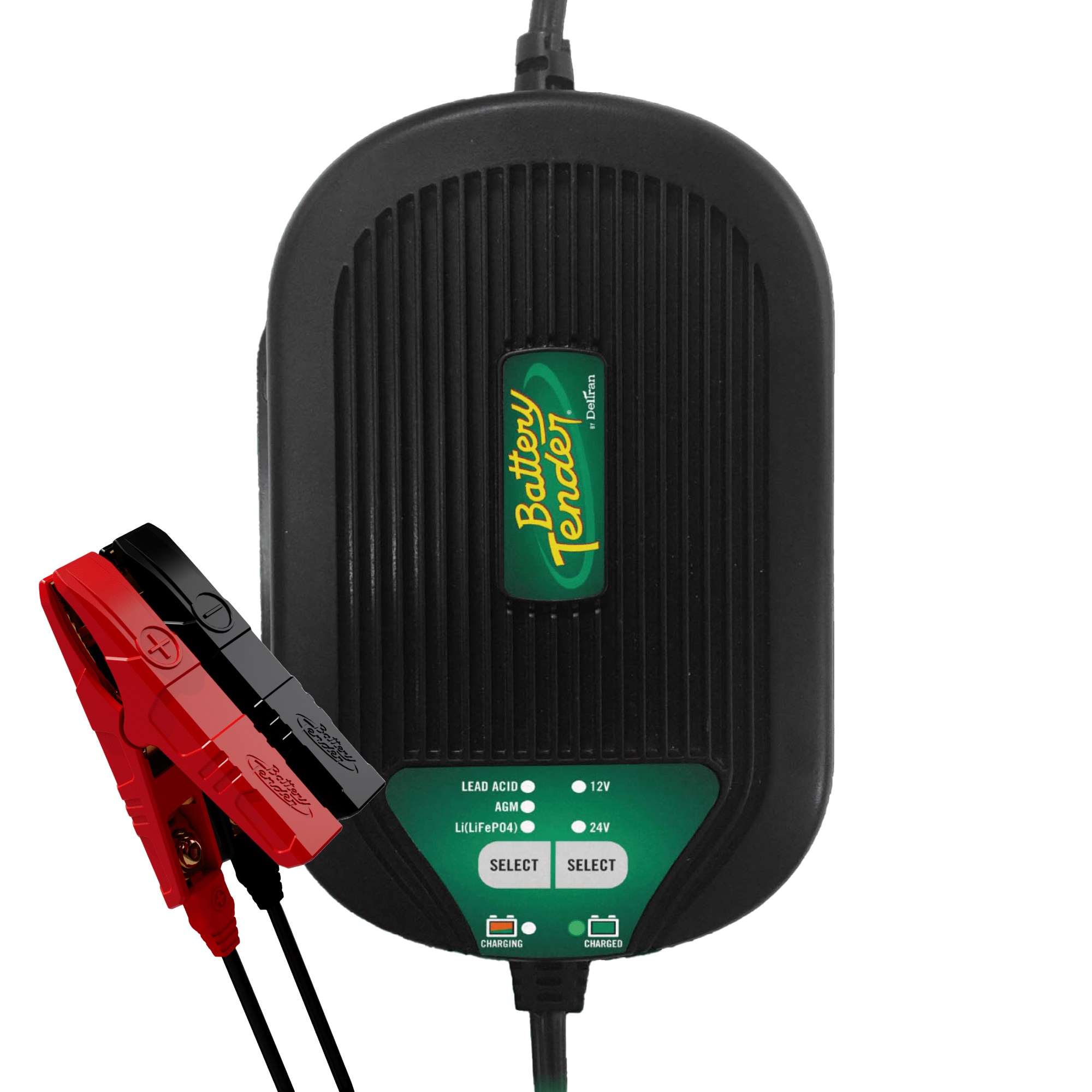
Explore this need in the finder →The Battery Tender Power Tender 5/2.5 A, SKU 022-0258-DL-WH, is a single-output charger for a choice of 12 V or 24 V batteries. The exact manual identifies P/N 022-0258 and ties 5 A to the 12 V setting and 2.5 A to 24 V. That distinction matters more than the product name's compact “5/2.5” shorthand: this is not a 5 A 24 V charger, nor does it charge both voltages at once.
Two voltage plans, one output
The voltage selector and battery-chemistry selector must be set before connection. The manual says the selections cannot be changed after the charger is connected to a battery. Its plan is straightforward when the battery label and instructions are clear: select 12 V for a 12 V battery, or 24 V for a 24 V battery, then choose the manual's standard lead-acid, AGM or LiFePO4 profile. If the battery's nominal voltage or construction is uncertain, stop and confirm it rather than trying the settings. The single DC output serves one connected battery system, so a household with several independent batteries would need an additional charger or a true multi-output model.
At 12 V, the manual specifies 5 A; at 24 V, 2.5 A. For a 24 V battery the halved current is a meaningful limitation if the task is rapid recovery. The manual's example says a fully discharged 40 Ah 12 V battery takes about 6½ hours to reach 80 percent at 5 A. That illustration is not a promise for another capacity, depth of discharge, battery condition or final absorption stage; real charging time varies. The product page publishes a compatible 20–150 Ah range at either voltage, but the manual does not repeat a maximum. Treat that as a manufacturer page claim and check it against the battery maker's allowed current and the charger instructions.
Mode compatibility is not interchangeable
Battery Tender's manual lists four-cell LiFePO4 batteries at 12 V and eight-cell LiFePO4 at 24 V, along with lead-acid/AGM configurations for each voltage. That is more specific than a general “lithium compatible” label. It does not state a BMS requirement, so lithium owners should verify the pack's protection and charging limits with its maker. The exact product page separately lists flooded, AGM, gel-cell and sealed maintenance-free lead-acid batteries at both supported voltages, while the manual uses the broader standard lead-acid and AGM selector labels rather than naming those subtypes individually. This assessment records the maker page's subtype list but does not imply separate gel electronics or a different manual-selected profile; confirm that the battery maker permits the charger mode and rate.
The manual describes automatic qualification, bulk charging, absorption and float maintenance, and permits extended connection while operating as instructed. This is useful when the same battery needs initial charging and later maintenance, but maintenance does not diagnose a failed cell or restore capacity lost to battery damage. The charger also will not supply a general low-voltage electrical system, according to the manual. It is not a substitute for a regulated bench supply.
Weather and installation claims need care
The current product page promotes a fully potted housing and IP67 water resistance, but the exact manual says not to expose the charger to rain or snow. Those claims are not reconciled by the supplied operating instructions. The conservative reading is not to treat the page's ingress wording as permission for exposed outdoor mounting, immersion or use in a wet engine compartment. Ask Battery Tender for current written placement guidance if the planned installation depends on that claim.
The page lists a 120 V AC input, one two-in-one alligator-clip/ring-terminal lead, a 4.5-foot DC output cable and a 1.5-foot accessory lead. Check the exact package before purchase and ensure the AC outlet, cable route and battery location suit the setup. The manual calls for ventilation around charging, correct polarity, keeping the charger away from battery gases and charging marine batteries ashore unless the equipment is designed for on-board marine use. It also says never to charge a frozen battery.
Where this model fits
This model is a plausible choice when one 12 V or 24 V battery is confirmed, the battery maker permits its corresponding 5 A or 2.5 A rate, and a portable AC unit is more useful than permanent installation. For six- or twelve-volt household batteries, compare the separate Power Tender 5 A 6V/12V 022-0186G instead; for a 12 V-only dual-rate option, the 8 A/2 A 022-0337 and newer 022-1005 are different models with different chemistry and weather claims. Those comparisons should not be collapsed into a family-level specification.
The main tradeoffs are the single battery output, the lower 24 V current, an unstated lithium BMS condition, and the gap between the page's IP67 wording and manual's rain/snow warning. Before selecting it, match the exact 022-0258 SKU, voltage, chemistry, battery capacity range and placement rules. The source-based assessment identifies what the manufacturer documents; it is not a hands-on test or a guarantee that any individual battery is healthy or compatible.
Key specifications
Key details at a glance
| Output battery voltages | 12 / 24 V |
|---|---|
| Supported chemistries | Lead-acid / Lithium-ion |
| Rated DC charging current | 5 A |
| Published charge capacity limit | 150 Ah |
| Independent battery outputs | 1 |
| Arrangement | Portable plug-in charger |
| Included connection | The current page lists a two-in-one alligator-clip and ring-terminal cable; verify package contents for the exact retail SKU. |
Use the exact model’s instructions for operating limits, supplied equipment and version differences.
Sources for this review
Sources for this assessment
Keep the next step evidence-led
Use the finder to combine voltage, battery chemistry, charging job and setup requirements; then check the exact model and its manual.