
Your needs, this model
Does it fit your priorities?
Can the Power Tender 3 A charge a 6 V AGM battery?
Yes, the exact 022-0202 instruction manual describes a selectable 6 V AGM/flooded mode at 3 A. Set the correct voltage and chemistry before connecting the battery; use only if the battery maker approves the rate and follow the manual's ventilation and connection instructions.
Explore this need in the finder →Does the Power Tender 3 A support a 12 V LiFePO₄ battery?
Its 022-0202 manual names a selectable 12 V LiFePO₄ profile, but not a 6 V lithium profile, and it does not state whether a BMS is required. Confirm the battery's voltage, BMS and approved charge rate with its manufacturer before connecting it.
Explore this need in the finder →Can I leave the Power Tender 3 A connected to maintain a charged battery?
The manual describes an automatic storage/float-maintenance stage after charging and permits long connection periods, while advising periodic checks of the charger and battery. Use the mode that matches the battery, keep the unit out of rain and snow, and follow both manufacturers' safety instructions.
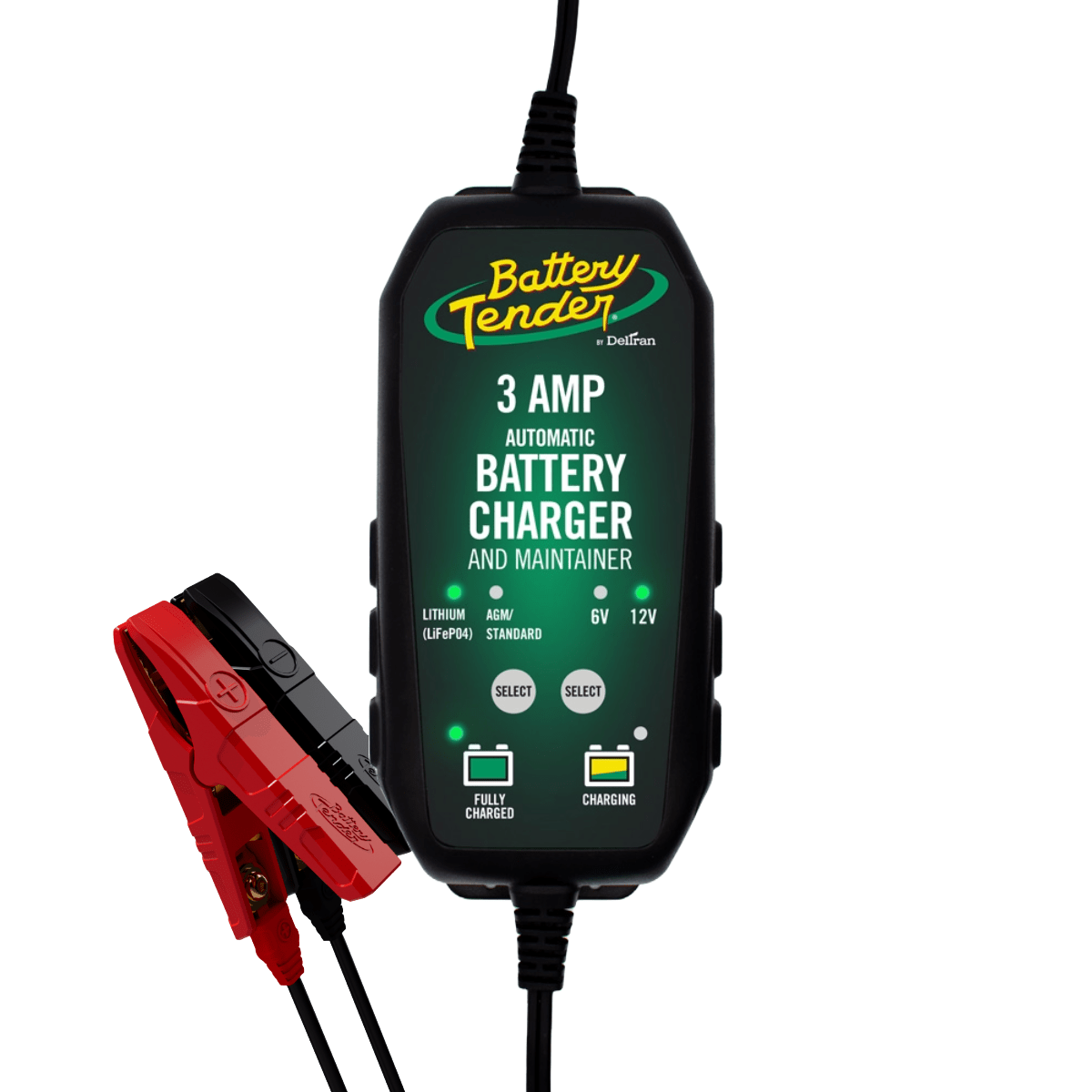
Explore this need in the finder →The Battery Tender Power Tender 3 A (retail SKU 022-0202-COS; instruction-manual P/N 022-0202) combines a selectable 6 V/12 V output with a separate lead-acid/LiFePO₄ selection. Its manual documents 3 A charging and a later storage/float phase. This makes it a more configurable option than a fixed-voltage maintainer, but not an all-purpose charger: the voltage and chemistry must match the battery, and the manual limits lithium to 12 V. This is a source-based assessment of the listed configuration, not a use test.
What the exact manual documents
The product page identifies the Power Tender 3 A as a 6 V/12 V unit and lists SKU 022-0202-COS. Its linked North American manual identifies model P/N 022-0202 and describes four automatic stages: qualification, bulk, absorption and storage/float maintenance. The manual gives a 3 A rate and says output depends on battery condition. That rated current is useful for screening, but it does not promise a fixed recovery time: the charger changes stages, the battery condition matters, and the battery maker's allowed rate still controls.
One output serves one battery at a time. The product page lists a combination alligator-clip/ring-terminal lead; check the package and connector arrangement offered by the seller rather than treating the illustration as a guarantee of every included item. The page also lists a 120 V AC input. This is a portable wall-powered unit, not an installed on-board charger or a jump starter.
Voltage and chemistry are linked choices
The most important detail is not simply that the face has two voltage indicators. The manual's voltage selector provides 6 V AGM/flooded and 12 V AGM/flooded profiles, while its chemistry control also offers a 12 V LiFePO₄ profile. This conflicts with the current product page's broader application copy, which also describes 6 V lithium; the exact manual says LiFePO₄ is 12 V only, so this assessment does not treat 6 V lithium as an established mode. Request exact-model clarification before considering that combination. Choose the battery voltage and chemistry before connecting the battery; once AC power and the battery are connected, the manual says the selection cannot be changed without disconnecting and resetting the charger. Check the vehicle or battery label rather than guessing from the equipment's age or size.
The manual names flooded/AGM lead-acid and LiFePO₄, not every lead-acid subtype shown in broad product-page compatibility copy. This review therefore does not match it to gel, EFB, calcium or maintenance-free subtype requests. The LiFePO₄ BMS condition is not established in the manual either. Verify a lithium pack's BMS and charging instructions with the battery maker before use.
Do not use the page's capacity claims as a limit
The current product page gives 14–100 Ah in its main specifications and a different 20–150 Ah range in its FAQ. The exact manual provides a 15 Ah charge-time example but does not state a maximum compatible capacity. An example battery is not an upper limit, and neither inconsistent page range is enough to establish a dependable boundary. The fact record therefore leaves maximum charge capacity unknown; a numeric finder result should not use this model as a confirmed fit for a particular Ah rating. Ask the manufacturer for a reconciled, SKU-specific range and check the battery's own charging guidance.
Environment and safe setup
The product page advertises IP65, but the manual says not to expose the charger to rain or snow. Because those statements do not establish a consistent permission for exposed use, this assessment does not call it weatherproof or recommend an outdoor installation. Keep it dry unless Battery Tender supplies current instructions for the exact unit that reconcile the conflict. The manual also says never to charge a frozen battery, to ventilate the battery area, to verify polarity, and to follow the vehicle and battery maker's procedures. It specifically says a boat battery must be removed and charged ashore unless equipment designed for on-board marine charging is used.
Where it sits beside the 4 A and 5 A models
The 3 A Power Tender is the lowest-current model in the related 3/4/5 A single-output group. The 4 A model 022-0209 and 5 A model 022-0186G retain selectable 6 V/12 V profiles, while their manuals document their own output ratings and model numbers. A higher nameplate current can matter when the battery maker allows it, but it does not by itself guarantee a proportional reduction in charging time or make an unknown capacity compatible. The 3 A version may be preferable when a 3 A rate is sufficient; buyers needing more output should compare the exact manual and battery guidance for the 4 A and 5 A models rather than extrapolating from one family member.
For a 12 V lead-acid battery with a verified size range, the existing Battery Tender Plus 021-0128 has a published 14–80 Ah range in its own product evidence and a lower 1.25 A output; it is a different current/capacity tradeoff. Here, the Power Tender's capacity remains unresolved, so it should not displace a model with a clear ceiling when that number is essential.
Who should shortlist it
Consider the 022-0202 configuration only when one portable output is enough, the battery is 6 V or 12 V, the manual documents its exact chemistry, a 3 A rate is acceptable, and a dry charging location is available. Before buying, confirm the SKU, manual revision, cord and terminal style, correct selector settings, battery condition and maker-approved rate. If the required battery capacity, outdoor use, on-board charging or BMS condition is essential, resolve that question with the manufacturer first. No hands-on use, measurements or charging tests were performed for this assessment.
Manufacturer references: the Power Tender 3 A product page, the model 022-0202 instruction manual, and the Battery Tender charger collection.
Key specifications
Key details at a glance
| Output battery voltages | 6 / 12 V |
|---|---|
| Supported chemistries | Lead-acid / Lithium-ion |
| Rated DC charging current | 3 A |
| Independent battery outputs | 1 |
| Arrangement | Portable plug-in charger |
| Included connection | Product page lists a two-in-one alligator-clip and ring-terminal lead; confirm exact package contents. |
Use the exact model’s instructions for operating limits, supplied equipment and version differences.
Sources for this review
Sources for this assessment
Keep the next step evidence-led
Use the finder to combine voltage, battery chemistry, charging job and setup requirements; then check the exact model and its manual.