
Your needs, this model
Does it fit your priorities?
Is the higher battery-charging setting 8 A or 10 A?
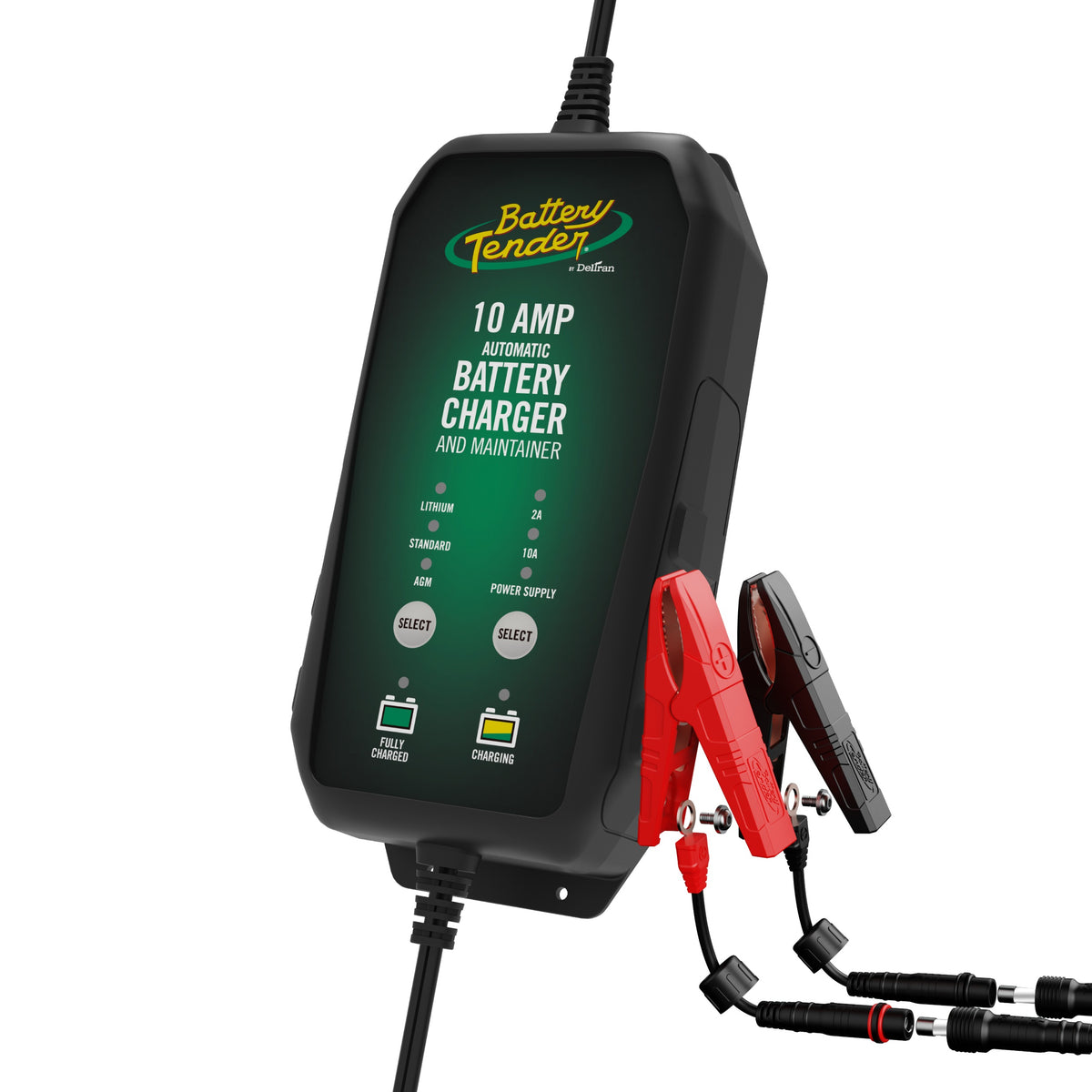
The exact SKU 022-1006 manual P/N 392-0455-R0 and product-panel image identify selectable 2 A and 10 A battery-charge settings. A separate product-page specification field says 8 A/2 A, so this review preserves that disagreement rather than treating every page field as consistent. The article and matcher rely on the exact manual’s 10 A setting; confirm the marking and model number of the actual package.
Explore this need in the finder →Does the manual document 12 V accessory supply from the Power Supply button?
No general-purpose 12 V device output is established. The manual shows a separate Power Supply selection but gives no output voltage/current and says the charger is not intended to supply a low-voltage electrical system; the page’s 8 A supply description does not resolve that gap. Do not select this unit to power an accessory unless the maker confirms the exact use.
Explore this need in the finder →Can it charge a 201 Ah battery under the page-stated range?
The exact 022-1006 page gives 40–200 Ah at 12 V; 201 Ah is beyond that stated upper edge. The manual confirms 2 A/10 A but does not repeat the capacity range. In the finder, the 200 Ah upper claim is tested, while the stated 40 Ah lower edge must still be checked manually.
Explore this need in the finder →Battery Tender Power Tender SKU 022-1006-DL-WH is a portable 12 V single-output charger and maintainer. The exact manual P/N 392-0455-R0 names the 022-1006 and documents 2 A and 10 A charging selections for Standard/lead-acid, AGM and four-cell LiFePO4 batteries. Battery Tender describes it as the current replacement for earlier SKU 022-0229, but the two are distinct products: the earlier model has a different manual and feature set. This is an assessment of the current exact-model materials, not a hands-on review.
Use the exact manual to interpret the current setting
The 022-1006’s title, product-panel image and exact manual identify a 10 A high charge setting plus a separate 2 A setting. The current product page is not internally consistent: its narrative says 10 A, while a technical field says 8 A/2 A. I rely on the exact SKU manual’s 2/10 A instructions and preserve the page discrepancy rather than quietly treating every listing field as equal evidence. Before purchase, check that the package label is 022-1006-DL-WH and that the control panel and included leads agree with the current manual. Battery Tender’s exact-model page gives a 40–200 Ah range. The manual confirms the model and current selections but does not state an Ah limit. The 200 Ah figure is therefore a manufacturer page ceiling, not a calculation or promise of charge time; the page-stated 40 Ah lower edge also matters. The site finder compares a requested capacity with documented upper limits but does not apply this model’s lower page boundary, so a result must still be checked against the exact battery’s size and the current maker guidance. A 201 Ah battery falls outside the stated page range.Three charging profiles, with an important unknown
The manual identifies Standard/lead-acid, AGM and four-cell LiFePO4 charging. It does not state whether a built-in BMS is required for the lithium mode. A LiFePO4 label alone is not proof of fit: confirm the battery maker’s charging instructions and BMS requirement before selecting the mode. The product page lists broader lead-acid types, but this review uses the narrower manual profiles. The manual also describes a separate selection called Power Supply. The page’s box description mentions an 8 A supply function, but the manual does not state a supply voltage or current and says the charger is not intended to power a low-voltage electrical system. That is not enough evidence to recommend it as a general 12 V accessory supply. Keep this function separate from battery charging and ask Battery Tender for written clarification before relying on it for vehicle electronics or an accessory.Maintenance and setup
The manual describes an automatic charging sequence and a storage/float maintenance stage that can keep a fully charged battery maintained. That does not mean it repairs a failed battery or overrides a car maker’s battery-management procedure. Its 120 V AC supply and clip/ring-terminal lead arrangement make it a portable workbench or vehicle-side charger; confirm which terminals and fused cable are included in the exact package. Disconnect AC before attaching or removing DC leads, follow the manual’s polarity steps, and do not charge a frozen battery. There is another meaningful source conflict. The product page advertises IP67 water resistance and full-immersion use, while manual P/N 392-0455-R0 says not to expose the charger to rain or snow. Follow the manual; this assessment does not recommend leaving it in weather. Page copy also mentions power-supply capability, but without a clear output specification in the manual. Neither claim should be interpreted more broadly than the exact instructions support.Where it fits in the lineup
Compared with the earlier 022-0229, the current 022-1006 has an exact manual bridge to its newer SKU and documents LiFePO4 alongside Standard and AGM. The older manual is separate and must not be used to fill gaps in the current model’s BMS or accessory-supply instructions. Compared with the larger 022-0234, the 022-1006 is a lower-current 2/10 A selection rather than a 15/8/2 A charger; compare battery size, permitted charging current, installation and the exact mode rather than choosing by the product-family name. The 022-1006 is most useful when a single 12 V battery is inside the maker page’s stated range and its instructions allow the selected 2 A or 10 A profile. It is a poor fit for 6 V or 24 V batteries, a capacity above the page’s 200 Ah limit, a battery with an unresolved lithium BMS condition, or a plan that depends on an undocumented 12 V device-supply output or rain exposure. Check the SKU, manual, battery label, fuse and included cable package before purchase.Key specifications
Key details at a glance
| Output battery voltages | 12 V |
|---|---|
| Supported chemistries | Lead-acid / Lithium-ion |
| Rated DC charging current | 10 A |
| Published charge capacity limit | 200 Ah |
| Independent battery outputs | 1 |
| Arrangement | Portable plug-in charger |
| Included connection | The product page lists ring-terminal and alligator-clip leads with a 15 A fuse; verify the exact package and cable connections before buying. The manual cautions to disconnect AC before connecting or removing DC leads. |
Use the exact model’s instructions for operating limits, supplied equipment and version differences.
Sources for this review
Sources for this assessment
Keep the next step evidence-led
Use the finder to combine voltage, battery chemistry, charging job and setup requirements; then check the exact model and its manual.