
Your needs, this model
Does it fit your priorities?
Can the Power Tender 10-Bank deliver 40 A to one car battery?
No. Its ten independent channels are each rated up to 4 A, and the aggregate ten-channel rating is spread among separate battery connections. A one-battery job gets the selected output from one channel, not all ten; follow the battery maker's permitted voltage and current.
Explore this need in the finder →What does the 10-Bank add beyond a five-bank charger?
The 10-Bank has ten separately controlled battery output channels, while the 5-Bank has five; each channel remains rated up to 4 A. A minimum of six or ten connections distinguishes the 10-Bank, while a five-bank request can be met by either. Check the page-stated 14–100 Ah range for each connected battery.
Explore this need in the finder →Does its lithium selector establish BMS compatibility?
The exact manual covers a 12 V LiFePO₄ mode but does not state whether the battery must have a BMS or whether operation without one is supported. It does not document 6 V lithium despite broader page language; confirm the pack and charger instructions directly before selecting the lithium mode.
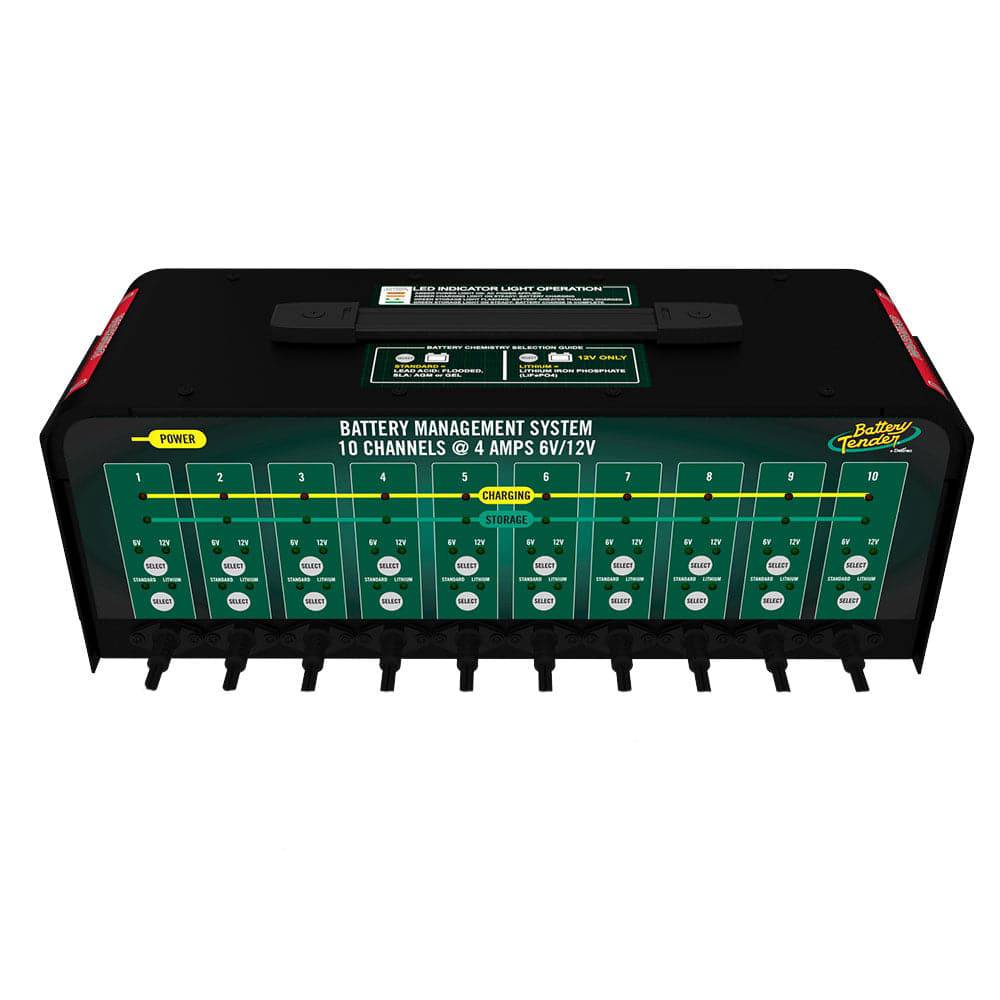
Explore this need in the finder →The Battery Tender Power Tender 10-Bank 4 A, retail SKU 021-0134-DL-WH, addresses a different scale of job from a one-car battery maintainer: it offers ten separate charging outputs from one off-board 120 V AC unit. The current model page identifies ten independent channels, and its linked manual, revision 392-0386-R0, lists P/N 021-0134 together with the five-bank P/N 021-0133. The manual states a maximum 4 A rate per channel. This review compares documented configuration and limitations; no hands-on charging test is claimed.
Ten channels change the installation, not the per-battery rating
For a shop, dealership or large collection, ten outputs can reduce the need to connect and disconnect one portable charger between vehicles. Each channel has its own voltage and chemistry selection and the manual says each station charges and maintains its own battery independently. The product page describes the 4 A rating per bank and 40 A total across ten outputs. That is not 40 A available to one battery: any one channel is rated up to 4 A, and actual output varies as the battery moves through charge stages.
The exact page gives a 14–100 Ah compatible range per bank. The shared manual does not independently define that range; it offers a timing example for a 12 V, 40 Ah battery reaching 80 percent at 4 A, which should not be generalized to another battery or treated as a ceiling. The authored matcher uses the page's 100 Ah maximum for one battery on one channel. The page's lower 14 Ah edge is still worth checking for small batteries because a numeric answer in the finder tests the maximum, not every lower boundary printed on a product page.
Output count also does not combine battery capacities. Ten channels make room for ten individual batteries, each within its own documented mode and capacity guidance. They do not create one large battery port. Nor does the rated current stay at 4 A for every stage: the manual notes that channel current depends on battery condition and that the unit transitions through qualification, bulk, absorption and storage/float maintenance.
Per-channel selectors support mixed fleets—with limits
The manufacturer describes separate 6 V/12 V and standard/lithium selection for each bank. The exact manual is the critical detail: it documents 6 V and 12 V flooded/AGM/gel lead-acid, but LiFePO₄ is 12 V only. Broad product-page copy can imply that lithium covers both voltages; the manual does not support that interpretation, so this assessment excludes a 6 V LiFePO₄ plan. The product page also lists sealed maintenance-free lead-acid. EFB and calcium are not established as supported subtypes in the reviewed manual.
The BMS requirement for its LiFePO₄ mode is not stated. Do not infer it from the charger's reverse-polarity protection or from page wording about protecting a battery BMS. Confirm the battery manufacturer's requirements before using the lithium mode. Each channel has controls that must be set for the battery: the manual gives about ten seconds after connection for the active modes to be changed before the cycle starts, and the selection cannot be altered once charging is underway without disconnecting that bank.
Plan for a fixed, ventilated shop location
This is an external charger, not a unit wired into a vehicle. The product page describes a wall-mountable chassis, 19 by 7 by 7.5 inches and 13 pounds, ten 7.5-foot output leads, and a 120 V AC input. It also lists a 5-foot-8-inch AC cord. Those numbers make it easier to plan a central charging wall, but they do not prove that every parking stall can be reached: measure each route and check the exact output cable and connector package. The page's included leads are a starting point, not a substitute for safe cable routing.
The manual says not to expose the charger to rain or snow, to avoid placing it directly above a battery, and to keep air passages open for its fan. It warns not to charge a frozen battery and requires attention to polarity and battery-maker instructions. If a marine battery is involved, the manual says to remove it and charge ashore unless the charger is specifically designed for onboard marine use. Its fault guidance describes a safety-timer condition without a fixed duration; do not assume a particular cut-off time from other product-page copy or substitute a timer for supervision.
Choose the 10-Bank only when its extra outputs matter
The related 5-Bank 021-0133 shares the current manual revision, 4 A per channel, selection method and documented battery modes, but provides five rather than ten independent stations. That makes it a more contained footprint for a small garage or shop with no more than five regularly connected batteries. The 10-Bank is the distinct candidate when a sixth through tenth battery needs a separate output; it is not a higher-current single-battery alternative. A single-output 3 A, 4 A or 5 A charger may make more sense for one vehicle, and onboard chargers serve another installation job entirely.
This higher-capacity bank count brings practical tradeoffs: the case needs a dedicated position, all ten leads need routing, and each battery still needs a valid voltage/chemistry selection. Its maximum per-channel current does not make it automatically suitable for every automotive battery. Check that the battery maker allows up to 4 A, particularly if the battery is small or has special charging instructions. Below the manual's sensing thresholds—2 V for standard/AGM lead-acid and 4 V for LiFePO₄—the charger does not start, so it is not documented as a recovery choice for a deeply depleted battery.
Buying checks for this exact model
Verify retail SKU 021-0134-DL-WH, manual P/N 021-0134 and the 392-0386-R0 manual revision, especially if comparing a used unit or older listing. Confirm that ten outputs are genuinely needed, that the 120 V AC installation and ventilation are suitable, and that every battery fits its own 14–100 Ah page range and approved chemistry/voltage mode. If a lithium BMS condition, 6 V lithium, a smaller-than-14-Ah battery or outdoor use is essential, the current documents leave a meaningful question open. This document-based review reports no ownership, measurements or charge-time trial.
Manufacturer references: the Power Tender 10-Bank product page and its 5- and 10-bank instruction manual, revision 392-0386-R0.
Key specifications
Key details at a glance
| Output battery voltages | 6 / 12 V |
|---|---|
| Supported chemistries | Lead-acid / Lithium-ion |
| Rated DC charging current | 4 A |
| Published charge capacity limit | 100 Ah |
| Independent battery outputs | 10 |
| Arrangement | Portable plug-in charger |
Use the exact model’s instructions for operating limits, supplied equipment and version differences.
Sources for this review
Sources for this assessment
Keep the next step evidence-led
Use the finder to combine voltage, battery chemistry, charging job and setup requirements; then check the exact model and its manual.