
Your needs, this model
Does it fit your priorities?
Does the exact Charge N Start 4120 have a 12 V AGM charging plan at its stated current?
The exact U.S. page identifies SKU 030-7020-WH and lists 12 V AGM support. The shared P/N 390-1364-R0 manual names this exact part number, and its specification table rates the charger output at 4 A. The page states a 14–100 Ah range; the manual does not repeat that range, and the finder only applies the upper edge. Check the battery maker's recommended charging rate and confirm the exact manual included with the retail unit.
Explore this need in the finder →What changes between this model and the other Charge N Start chargers?
The charger output is 4 A on this SKU. The manual's product-specification table rates the 1100 and 1120 at 1 A but 4120 at 4 A; it lists the 1100 jump pack at 1,000 peak A and the 1120/4120 at 1,200 peak A. Peak jump-start current describes a separate function and does not change the charger's 12 V charging current. The source pages and review compare these independent ratings rather than infer charging performance from jump-start numbers.
Explore this need in the finder →Can the charger be left in rain or used to charge a marine battery in place?
No. The exact product page lists IP65, but the shared manual P/N 390-1364-R0 tells users not to expose the charger to rain or snow. It also says a marine battery must be removed and charged on shore; onboard marine charging requires specially designed equipment. Use the actual supplied instructions rather than treating the separate jump-start or ingress claims as marine-use permission.
Explore this need in the finder →The Charge N Start with the 4 A charger section
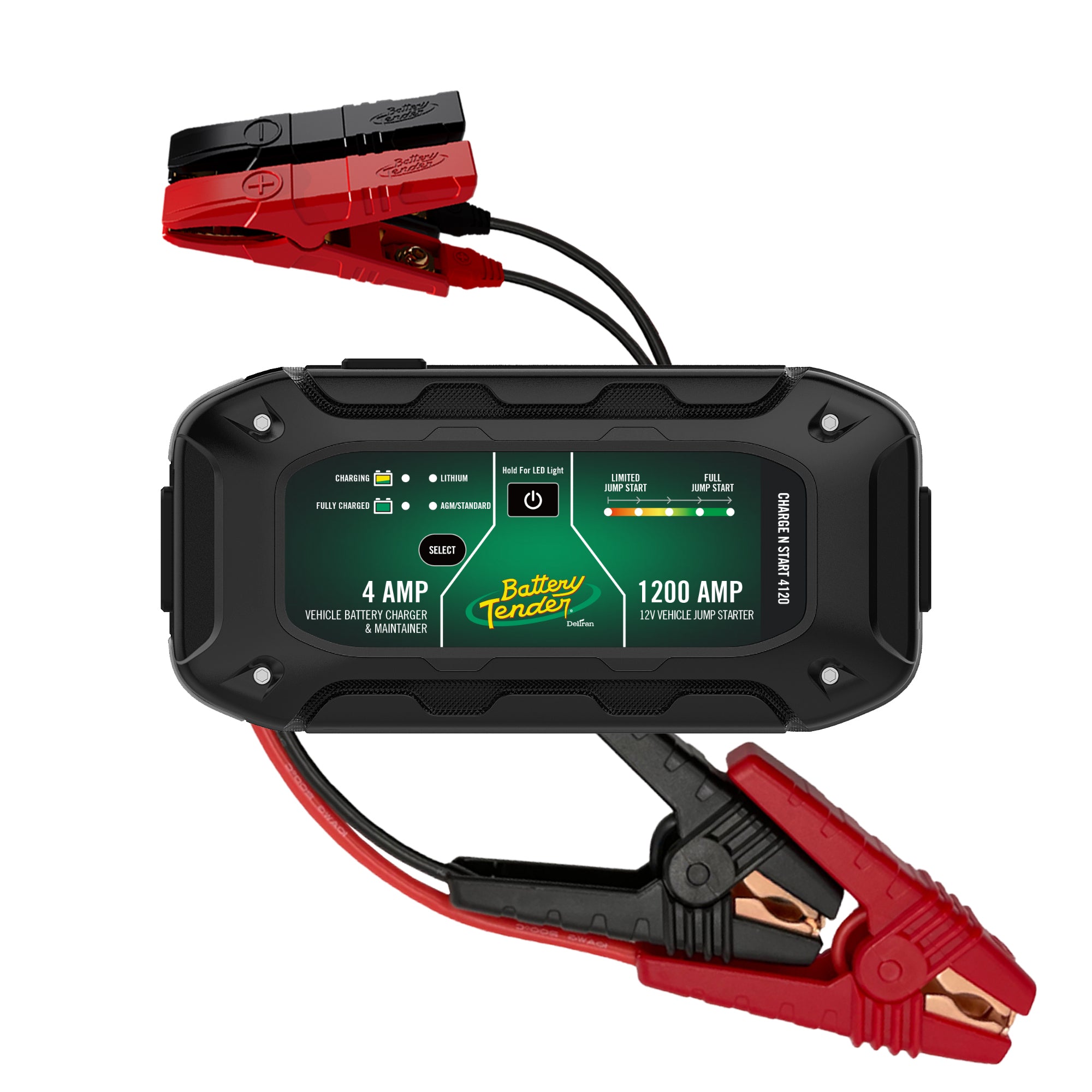
Battery Tender’s Charge N Start 4120 is a portable two-function unit: a 12 V mains-powered battery charger/maintainer and a separate lithium jump starter. Its charger side qualifies it here; the 1,200 A jump-start label does not describe the charger’s output. The exact SKU is 030-7020-WH. The product page and the shared model-family manual agree that the charger delivers 12 V DC at 4.0 A, while the 1100 and 1120 siblings are each rated at 1.0 A.
Four amps is a higher charger rating than the other Charge N Start models, but it is not a guaranteed recovery time. Actual charging depends on the battery’s condition, permitted current, state of charge and the charger’s automatic stages. Battery Tender’s exact page characterizes 4 A as faster than the 1 A alternatives, but this review does not treat that page statement as an independently measured result. Check the battery maker’s rate guidance before selecting the higher-rated model.
Voltage, chemistry and capacity boundaries
The 4120 documents a single 12 V external battery plan. Its chemistry selector covers 12 V AGM/Standard and LiFePO₄ in the shared manual; the exact page also lists flooded, AGM, gel and sealed maintenance-free lead-acid. The product is not documented for 6 V or 24 V batteries, and no EFB or calcium support appears in the reviewed materials. The manual describes a four-stage sequence that ends in storage/float maintenance, plus a separate internal-pack charging cycle.
Battery Tender’s exact SKU page states a 14–100 Ah charging range. The shared manual does not repeat the range, so the capacity ceiling comes from the product page rather than the manual. The finder uses the stated 100 Ah upper edge for a numeric charging request, but it cannot enforce the 14 Ah lower edge. A result at a small entered value therefore is not a verified fit below 14 Ah. For maintenance-only needs, leave the Ah filter blank and check the battery maker’s directions independently.
The 4 A output is available to one battery, not divided across several banks. If a multi-battery installation is needed, compare a model with documented independent output channels rather than interpreting jump-pack capacity or total product ratings as additional charger banks. The 4120 also has no documented fixed onboard installation plan; the manufacturer shows a portable unit and corded connection arrangement.
Its jump starter is similar to the 1120, not the charging side
The manual’s model table lists the 4120’s jump-starter portion at 1,200 peak A, with a 10,400 mAh internal pack and engine specifications up to 6.0 L gas or 4.0 L diesel. The 1120 carries the same listed peak jump current and engine limits but has an 8,000 mAh internal pack and 1 A charger. The 1100 is the 1,000 A jump version with an 8,000 mAh internal pack, a 1 A charger, and the manual’s lower 5.0 L gas/3.0 L diesel engine figures.
These figures describe separate functions. The charger clamps and jump-start clamps are dedicated and are not interchangeable; the emergency jump output operates from its own port rather than the external battery’s 4 A charge lead. The manual’s jump instructions call for checking the pack’s charge level and vehicle guidance, confirming correct polarity and removing the clips promptly after the engine starts. They are not a guarantee of starting a specific vehicle.
What arrives, how it is used and what the manual rules out
The shared manual lists a hard case, smart jump-start clips, a combo alligator/ring charging lead, a six-foot AC cable and six-foot DC extension cable. Its product-specification diagram identifies 4 A charging for P/N 030-7020. Battery Tender advertises more than 14 feet total reach and lists separate charger and jump cable lengths. Check the exact retail box, connectors and route to the battery rather than assuming the headline reach guarantees a safe connection in every vehicle.
The page lists IP65, but the instruction manual says not to expose the charger to rain or snow. This assessment does not treat the IP listing as permission to charge outdoors. The manual also directs the user to remove a marine battery and charge it on shore; an installed on-board marine charger must be specifically designed for that use. The exact page’s broader boat references do not establish an on-board configuration for this model.
For charger use, follow the manual’s 12 V selection sequence, work in a ventilated area, keep the charger away from battery gases and acid, and disconnect AC before attaching or removing DC leads. The manual warns against charging frozen batteries and tells users to consult the battery maker’s charging rate and precautions. The jump-starter’s stored energy and starting clamps add handling steps beyond a plain maintainer, not a reason to skip them.
Who should compare the 030-7020-WH
The 4120 is a candidate when the job is one portable 12 V battery, a 4 A charger rating is appropriate, and the exact page’s 14–100 Ah range covers the battery being recharged. It shares the 1120’s listed 1,200 A jump rating but raises charging current from 1 A to 4 A. That distinction is its central charger-side difference. A battery whose maker limits charging current to 1 A or less is not a reason to choose this unit simply because it has a higher rating; check the permitted profile first.
As with the rest of the series, the exact manual does not confirm the page’s Ah range or a lithium BMS condition, and the manual’s rain/snow and marine-battery instructions constrain how the product should be used. Confirm the model number, included leads and supplied manual before ordering. This assessment is based on manufacturer documents only; no charge-time test, vehicle trial or hands-on experience is claimed.
Manufacturer sources: the exact Charge N Start 4120 product page and shared manual P/N 390-1364-R0.
Key specifications
Key details at a glance
| Output battery voltages | 12 V |
|---|---|
| Supported chemistries | Lead-acid / Lithium-ion |
| Rated DC charging current | 4 A |
| Published charge capacity limit | 100 Ah |
| Independent battery outputs | 1 |
| Arrangement | Portable plug-in charger |
| Included connection | The shared manual's box list identifies smart jump-start alligator clips, a combo alligator/ring charging lead, a 6 ft AC cord, a 6 ft DC extension cable, a hard carry case and manual. Exact product pages specify separate clamp sets and more than 14 ft total reach; verify the retail SKU package and connectors. |
Use the exact model’s instructions for operating limits, supplied equipment and version differences.
Sources for this review
Sources for this assessment
Keep the next step evidence-led
Use the finder to combine voltage, battery chemistry, charging job and setup requirements; then check the exact model and its manual.