
Your needs, this model
Does it fit your priorities?
Does the exact Charge N Start 1120 have a 12 V AGM charging plan at its stated current?
The exact U.S. page identifies SKU 030-7012-WH and lists 12 V AGM support. The shared P/N 390-1364-R0 manual names this exact part number, and its specification table rates the charger output at 1 A. The page states a 14–80 Ah range; the manual does not repeat that range, and the finder only applies the upper edge. Check the battery maker's recommended charging rate and confirm the exact manual included with the retail unit.
Explore this need in the finder →What changes between this model and the other Charge N Start chargers?
The charger output is 1 A on this SKU. The manual's product-specification table rates the 1100 and 1120 at 1 A but 4120 at 4 A; it lists the 1100 jump pack at 1,000 peak A and the 1120/4120 at 1,200 peak A. Peak jump-start current describes a separate function and does not change the charger's 12 V charging current. The source pages and review compare these independent ratings rather than infer charging performance from jump-start numbers.
Explore this need in the finder →Can the charger be left in rain or used to charge a marine battery in place?
No. The exact product page lists IP65, but the shared manual P/N 390-1364-R0 tells users not to expose the charger to rain or snow. It also says a marine battery must be removed and charged on shore; onboard marine charging requires specially designed equipment. Use the actual supplied instructions rather than treating the separate jump-start or ingress claims as marine-use permission.
Explore this need in the finder →The 1120’s charger matches the 1100; its jump pack does not
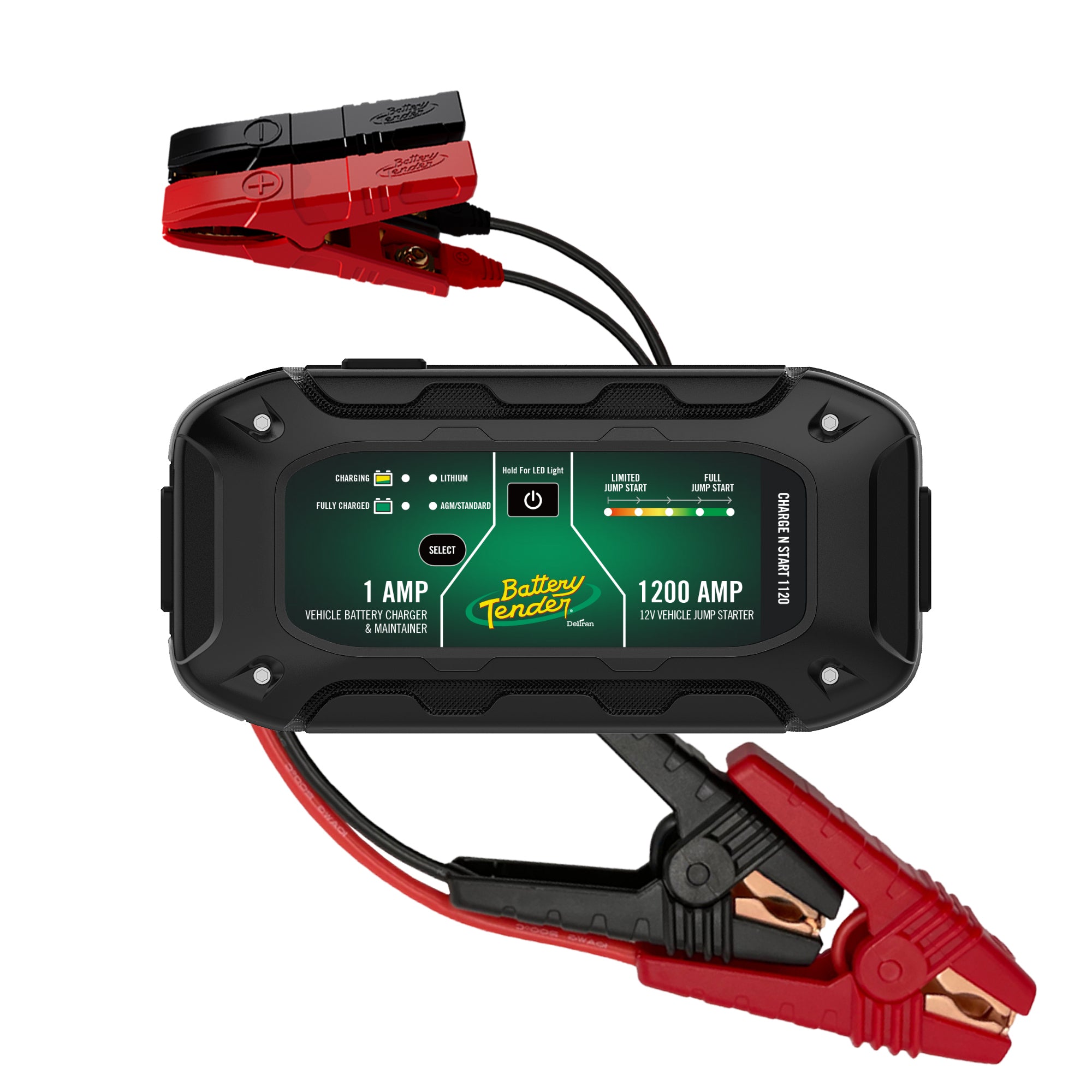
Battery Tender’s Charge N Start 1120 (SKU 030-7012-WH) pairs a portable AC-powered charger/maintainer with a separate lithium jump-starter function. That combined design qualifies for this battery-charger catalogue because its mains input runs a 12 V charging circuit, not because it can crank an engine. On the charging side, the 1120 is rated at 1 A—the same output as the 1100. The “1200” in its model name refers to the jump-starter rating, not 1,200 A battery charging.
That difference matters when choosing among the three Charge N Start models. The 1100 is also a 1 A charger, but its manual-table jump rating is 1,000 peak A; the 1120’s is 1,200 peak A. The 4120 shares the 1120’s 1,200 peak A jump rating while stepping up to a 4 A charger. For a shopper comparing charge jobs, the 1120 should therefore be treated as a low-current 12 V charger with a higher jump-pack rating than the 1100—not as a faster charger.
One 12 V output, with separate lead-acid and LiFePO₄ profiles
The exact 030-7012 page and the shared manual agree on 12 V DC charger output at 1.0 A. The manual’s selector covers AGM/Standard and LiFePO₄ 12 V modes; the product page lists flooded, AGM, gel and sealed maintenance-free lead-acid along with LiFePO₄. It does not document 6 V, 24 V, EFB or calcium profiles. A chemistry choice is not interchangeable with a voltage choice, so check both the battery label and its instructions rather than generalizing from the product family.
On the external battery, the manual describes initialization, bulk charging, absorption and storage/float maintenance. Battery Tender states that the unit cycles between the external battery and its internal jump pack after the external battery reaches float. The routine maintenance side can be useful in seasonal storage, but this is still a single-output charger: there is one external battery path, not multiple independently charged banks. The separate smart jump clamps are not the charger connectors.
The exact product page states a charging capacity range of 14–80 Ah. The family manual does not publish a matching Ah range, so the capacity figure remains a product-page claim, not a manual-confirmed limit. The finder can apply the 80 Ah upper edge to a charging request but cannot enforce the 14 Ah lower edge. If the capacity is below that page range, verify with the maker before using this model; if the job is maintenance of an already charged battery, do not enter an Ah value as though the quiz had verified maintenance-size suitability.
What its 1,200 A jump specification tells you
The manual’s printed specification table separates the charge and jump sections. For the 1120 it lists an 8,000 mAh internal battery, 1,200 peak A, and stated engine limits up to 6.0 L gas or 4.0 L diesel. The exact page says the same peak figure. These are the maker’s specifications for emergency starting, not measured performance or a substitute for checking a vehicle’s manual. The jump pack works from its own port and its own clamp set; it is independent of the AC charger output.
Relative to the 1100, the documented charger output stays at 1 A while the peak jump-start rating rises from 1,000 to 1,200 A. Relative to the 4120, the jump-start rating stays at 1,200 A while the charger output rises from 1 A to 4 A. A larger jump number is not a reason to expect quicker battery charging. If the charge rate is the buying constraint, compare that specification directly with the battery maker’s guidance and consider whether 1 A is appropriate for the battery’s size and state.
Connection and environment checks
The manual’s retail-box list covers smart jump-start alligator clips, a combo alligator/ring charging lead, six-foot AC and DC extension cables, a hard case and manual. Battery Tender’s exact page advertises more than 14 feet total reach and shows separate charge and jump leads. Package revisions and retail bundles can differ, so verify the exact SKU and supplied connector arrangement before relying on a lead already installed on a motorcycle, car or other vehicle. Follow the supplied manual’s instructions for selecting chemistry, AC connection, polarity, battery ventilation and routing cables away from moving engine parts.
Although the product page lists IP65, the shared charging manual says not to expose the charger to rain or snow. That is the conservative operating direction used here. The manual also says marine batteries must be removed and charged on shore; an on-board marine installation requires specialized equipment. References to boats or powersports in product marketing do not turn this portable charger into an on-board model.
When the 1120 makes sense in a charger shortlist
Compare the 030-7012-WH when you want a one-battery, portable 12 V 1 A charger/maintainer inside the page-stated 14–80 Ah range and separately value an integrated 1,200 A jump pack. If charger current is the priority, it does not offer more output than the 1100; the 4 A 4120 is the sibling with the higher charger rating and the same listed 1,200 A jump rating. If a simple maintainer is the whole job, the additional jump-start hardware is an added function rather than evidence of better charging.
A separate powersports bundle page pairs the 1120 with a two-foot ring-terminal jump-starter cable for easier access to a hard-to-reach battery. The cable changes jump-start access, not the charger’s 1 A output. The bundle page does not show a separate SKU, so verify the exact package before ordering.
Confirm the exact SKU and manual in the box, the battery maker’s approved current and chemistry, the 14–80 Ah page range, and a dry operating location. The manual does not state a LiFePO₄ BMS requirement or a separate onboard plan. This is a desk assessment of product documents, not a hands-on test: no owner experience, charge-time measurement or engine-start result is claimed.
Manufacturer sources: the exact Charge N Start 1120 product page, the Charge N Start 1120 powersports bundle page and shared manual P/N 390-1364-R0.
Key specifications
Key details at a glance
| Output battery voltages | 12 V |
|---|---|
| Supported chemistries | Lead-acid / Lithium-ion |
| Rated DC charging current | 1 A |
| Published charge capacity limit | 80 Ah |
| Independent battery outputs | 1 |
| Arrangement | Portable plug-in charger |
| Included connection | The shared manual's box list identifies smart jump-start alligator clips, a combo alligator/ring charging lead, a 6 ft AC cord, a 6 ft DC extension cable, a hard carry case and manual. Exact product pages specify separate clamp sets and more than 14 ft total reach; verify the retail SKU package and connectors. |
Use the exact model’s instructions for operating limits, supplied equipment and version differences.
Sources for this review
Sources for this assessment
- Battery Tender exact U.S. product page: Charge N Start 1120 (SKU 030-7012-WH)
- Battery Tender Charge N Start shared manual P/N 390-1364-R0 (P/Ns 030-7010/7012/7020)
- Battery Tender refreshed exact U.S. product page: Charge N Start 1120 (SKU 030-7012-WH)
- Battery Tender Motorcycle and Powersports Charge N Start 1120 bundle product page
Keep the next step evidence-led
Use the finder to combine voltage, battery chemistry, charging job and setup requirements; then check the exact model and its manual.