
Your needs, this model
Does it fit your priorities?
Does the exact Charge N Start 1100 have a 12 V AGM charging plan at its stated current?
The exact U.S. page identifies SKU 030-7010-WH and lists 12 V AGM support. The shared P/N 390-1364-R0 manual names this exact part number, and its specification table rates the charger output at 1 A. The page states a 14–80 Ah range; the manual does not repeat that range, and the finder only applies the upper edge. Check the battery maker's recommended charging rate and confirm the exact manual included with the retail unit.
Explore this need in the finder →What changes between this model and the other Charge N Start chargers?
The charger output is 1 A on this SKU. The manual's product-specification table rates the 1100 and 1120 at 1 A but 4120 at 4 A; it lists the 1100 jump pack at 1,000 peak A and the 1120/4120 at 1,200 peak A. Peak jump-start current describes a separate function and does not change the charger's 12 V charging current. The source pages and review compare these independent ratings rather than infer charging performance from jump-start numbers.
Explore this need in the finder →Can the charger be left in rain or used to charge a marine battery in place?
No. The exact product page lists IP65, but the shared manual P/N 390-1364-R0 tells users not to expose the charger to rain or snow. It also says a marine battery must be removed and charged on shore; onboard marine charging requires specially designed equipment. Use the actual supplied instructions rather than treating the separate jump-start or ingress claims as marine-use permission.
Explore this need in the finder →A charger with a second, separate job
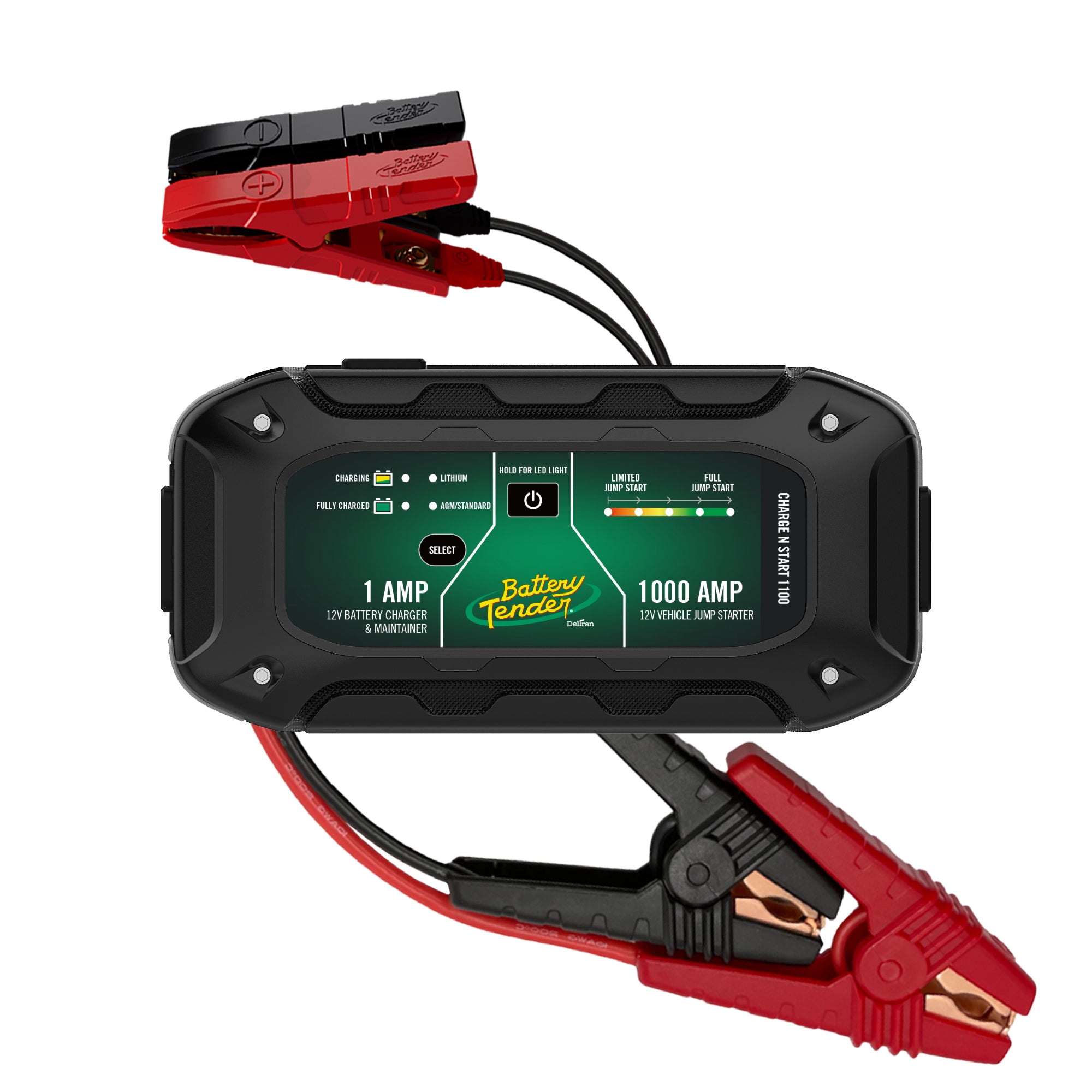
The Charge N Start 1100 is not just a portable jump pack with a token charging feature. Battery Tender’s exact 030-7010-WH product page describes a wall-powered 12 V battery charger and maintainer, while the shared instruction manual is explicitly for a vehicle jump starter and automatic battery charger/maintainer. Its mains-connected charging function is real category fit here. The emergency starting side remains a different function and is not a substitute for the charger’s 1 A rating.
There are two dedicated lead sets: a charger lead and a smart jump-start clamp set. Battery Tender says not to interchange them. The product’s built-in lithium pack can be topped up when connected to AC, but when a vehicle battery is connected, the charger first manages that external battery and then cycles back to the internal pack. This arrangement can reduce the number of separate devices a garage needs, but it also means the compact-looking product combines two electrical jobs that need to be understood separately.
The 1100 is a 1 A charger, not a 1000 A charger
The important charge-side number is 1 A at 12 V. The exact product page and the manual’s model-by-model specification table agree on 12 V DC at 1.0 A for P/N 030-7010. The much larger 1,000 A number printed on its face describes the jump-start function. It is not the charger’s current, and it should not be used to compare charge time or charging suitability.
For its external battery, the manual describes four stages: initialization, bulk, absorption, then storage/float maintenance. A chemistry selector chooses 12 V AGM/Standard or 12 V LiFePO₄. The exact product page names flooded, AGM, gel and sealed maintenance-free lead-acid types, and it separately lists LiFePO₄. Those are useful maker-stated profiles, not a promise that every battery in those groups accepts the same current. Confirm the battery’s nominal voltage, chemistry and allowed charge rate with its own instructions before connecting it.
The page states a 14–80 Ah charging range. The model-family manual does not repeat an amp-hour limit, so the range is supported by the current product page rather than corroborated by a second technical document. The finder applies the stated 80 Ah upper end when a capacity is entered; it cannot screen out a battery below the page’s 14 Ah minimum. That lower edge still needs a manual check. For maintenance of a battery that is already charged, leave the capacity question blank: the matcher’s capacity question is framed for recharging, not a maintenance-size claim.
What the larger jump-start number does—and does not—mean
The manual’s table identifies the 1100’s jump-starter portion as 1,000 peak A, with an 8,000 mAh internal battery and stated engine limits of up to 5.0 L gas or 3.0 L diesel. Those are maker specifications for a brief starting function, not independent test results. The manual says to check the vehicle maker’s directions, verify the pack has at least 50% charge, connect its smart clips to the separate engine-start port, and remove them promptly once the engine starts.
The nearby Charge N Start 1120 is rated at the same 1 A for charging but 1,200 peak A for starting; its manual-table engine limits are higher. The Charge N Start 4120 keeps the 1120’s 1,200 peak A but raises its charger rating to 4 A. Those distinctions matter if comparing the combined product, but the 1100 remains a 1 A charger whichever jump-start number appears in its name or artwork. Someone who only needs battery charging may prefer a simpler charger; someone who values an integrated separate jump function should still check the charger rate first.
Leads, placement and the manual’s safety limits
The shared manual’s box list names the unit, smart jump-start alligator clips, a combo alligator/ring charging lead, six-foot AC and DC extension cables, a hard case and the instruction manual. The exact 1100 page also lists those pieces and advertises more than 14 feet of total reach. Still, confirm the exact retail package and connector style before planning a permanent lead, ring-terminal installation or a route around a vehicle. The manual requires AC to be disconnected before charging clips are attached or removed and gives specific vehicle-polarity and chassis-ground instructions.
There is a material environmental caveat: the product page lists IP65, but the charging manual says not to expose the charger to rain or snow. This assessment follows the direct safety instruction and does not treat the page rating as outdoor-use permission. The manual also says that a marine battery must be removed and charged on shore; on-board marine charging needs equipment specifically designed for that job. General product-page references to boats do not establish an installed marine arrangement for this portable charger.
Who should compare the 030-7010-WH
This model merits comparison when the job is a single portable 12 V battery, the battery maker allows a 1 A charging profile, and the page-stated 14–80 Ah range is a fit. Its unusual advantage is not higher charger output; it is the combination of a modest-output maintainer with a separately connected jump pack. The tradeoff is that the jump component does not make 1 A recovery faster, and the manual does not provide a capacity range of its own.
A separate powersports bundle page pairs the 1100 with a two-foot ring-terminal jump-starter cable for easier access to a hard-to-reach battery. The cable changes the jump-start connection setup, not the charger’s 1 A output. The bundle page does not show a separate SKU, so verify the exact package before ordering.
Use the exact 030-7010-WH label and current supplied manual when checking a retail offer. Do not infer 6 V or 24 V support, an on-board installation plan, a lithium BMS requirement or rain/snow permission from the Charge N Start family name. This desk-research assessment summarizes manufacturer material only. No hands-on testing, ownership, charge-time measurement or vehicle-specific result is claimed.
Manufacturer sources: the exact Charge N Start 1100 product page, the Charge N Start 1100 powersports bundle page and shared manual P/N 390-1364-R0.
Key specifications
Key details at a glance
| Output battery voltages | 12 V |
|---|---|
| Supported chemistries | Lead-acid / Lithium-ion |
| Rated DC charging current | 1 A |
| Published charge capacity limit | 80 Ah |
| Independent battery outputs | 1 |
| Arrangement | Portable plug-in charger |
| Included connection | The shared manual's box list identifies smart jump-start alligator clips, a combo alligator/ring charging lead, a 6 ft AC cord, a 6 ft DC extension cable, a hard carry case and manual. Exact product pages specify separate clamp sets and more than 14 ft total reach; verify the retail SKU package and connectors. |
Use the exact model’s instructions for operating limits, supplied equipment and version differences.
Sources for this review
Sources for this assessment
- Battery Tender exact U.S. product page: Charge N Start 1100 (SKU 030-7010-WH)
- Battery Tender Charge N Start shared manual P/N 390-1364-R0 (P/Ns 030-7010/7012/7020)
- Battery Tender refreshed exact U.S. product page: Charge N Start 1100 (SKU 030-7010-WH)
- Battery Tender Motorcycle and Powersports Charge N Start 1100 bundle product page
Keep the next step evidence-led
Use the finder to combine voltage, battery chemistry, charging job and setup requirements; then check the exact model and its manual.