
Your needs, this model
Does it fit your priorities?
What charging rates does the earlier 022-0229 offer?
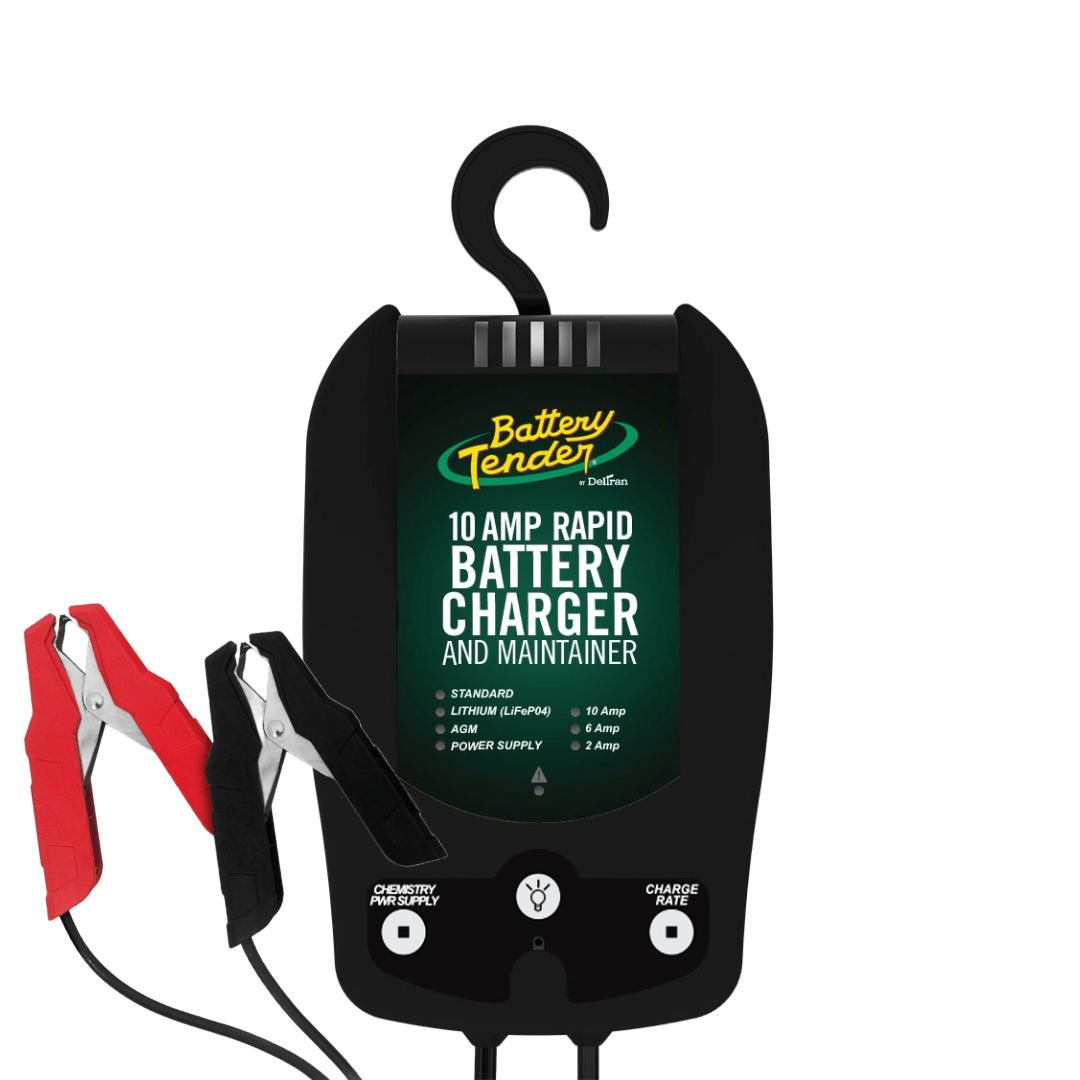
The exact P/N manual provides 12 V charge selections of 2 A, 6 A and 10 A, followed by automatic charge and maintenance behavior. The numeric finder treats 10 A as the highest available rating, not a recommendation for every battery. Use the battery maker's permitted rate and note that the manufacturer lists 022-1006 as the successor.
Explore this need in the finder →Can 022-0229 power a device while a vehicle battery is removed?
Yes, for the narrow task the exact manual documents: it supplies 12.8 V DC at up to 10 A as a memory saver while changing a battery. The same manual says it is not intended as a general low-voltage supply, so this should not be read as approval to run arbitrary accessories or equipment. The dedicated supply mode is separate from battery charging.
Explore this need in the finder →Does the 022-0229 LiFePO4 mode specify a BMS requirement?
The exact manual identifies a four-cell LiFePO4 mode, but it does not establish whether the battery must include a built-in BMS. Therefore an open BMS answer can consider it, while either explicit BMS answer excludes it from a documented match. Its 022-1006 successor is a different model and its specs should not be copied onto 022-0229.
Explore this need in the finder →What the legacy 022-0229 actually is
The 022-0229 is an earlier Battery Tender charger for one 12 V battery. Its product page gives the SKU and explicitly says that it has been replaced by the PowerTender 10 A Multi-Chemistry 022-1006. The exact manual 392-0423-RC independently names P/N 022-0229-DL-WH. This is not merely a color or bundle label for the newer product: the manufacturer describes the successor as adding IP67 protection and upgraded lithium compatibility. Do not transfer those successor claims onto an older 022-0229 offer.
For charging, the manual lists 2 A, 6 A and 10 A selections. It describes automatic operation through charge and maintenance stages, but choosing a higher setting does not establish that a battery can safely accept it. The unit's top 10 A rating is the relevant upper hardware capability in the numeric current finder; the 6 A and 2 A choices may be more appropriate for a smaller or more rate-sensitive battery when its maker's instructions call for them. The current question is a minimum output rating, not a personalized rate prescription.
Chemistry and the separate supply mode
The SKU-matched manual describes six-cell lead-acid/AGM and four-cell LiFePO4 batteries. Its charge workflow includes a chemistry selector, and the product page lists flooded, AGM, gel, sealed maintenance-free and lithium compatibility. That supports an exact LiFePO4 plan; it does not settle the pack's battery-management requirement. The matcher therefore does not treat this product as meeting either an explicit BMS-required or BMS-not-required request. Confirm the battery maker's voltage, charging profile and BMS instructions before using a legacy unit.
The 022-0229 also has an entirely separate DC supply function. Its exact manual states 12.8 V at up to 10 A and says the function is for memory retention while changing a battery. It also cautions that the charger is not intended to power a low-voltage electrical system. Those statements are narrower than a general-purpose bench supply: the assessment includes it only as a vehicle-memory-saver scenario and does not recommend it for running arbitrary accessories. Select that mode before connecting, follow the manual's sequence and do not combine it with a battery-charging plan. The current finder choice says “Power a 12 V DC device”; read that as a documented vehicle-memory use here, not universal device compatibility.
Capacity and operating limits
The product page calls 20–150 Ah the optimal battery range. The exact manual does not state an absolute amp-hour ceiling or a minimum, so the 150 Ah value is used only as a page-stated screening maximum. It is not a timing guarantee. Battery state, load, chemistry, temperature and the selected 2/6/10 A mode all affect a real charge, and a weak or damaged battery may not reach full charge at all. A numeric match above 150 Ah is excluded because the page's cited range stops there; lower sizes should be checked against the battery and charger instructions rather than treated as proven by the broad range statement.
Battery Tender's exact instructions say not to expose the charger to rain or snow. The 022-1006's page-level IP67 claim belongs to that different model and cannot be used to qualify the 022-0229 for a wet location. The earlier unit is a portable 120 V AC charger with hardwired alligator clips, so also verify the seller's exact suffix, lead condition, included manual and return terms. A used or older item can carry uncertainty about storage, damage and accessories that a manufacturer specification page does not answer.
Who should compare it—and who should not
This model is a useful reference when an existing 022-0229 is already in a garage, when a shopper must identify a legacy listing, or when the separate memory-saver mode matters. Its three selected charge rates and single 12 V output are straightforward to distinguish from the LCD-equipped 15/8/2 022-0234 and the distinct current 022-1006 successor. The 022-0234 adds a different interface and winter-mode claim; the 022-0229 manual instead gives fixed 2, 6 and 10 A selections and an explicit 12.8 V memory-saver output. Neither output should be confused with jump-start capability.
It is not a sensible default for a new purchase if a current successor, confirmed wet-use rating or explicit lithium/BMS compatibility is essential. The manufacturer marks the 022-0229 as replaced, and the old manual's dry-use warning remains. A result with earlier models excluded will omit this configuration; a result including earlier models can show it alongside current alternatives. That switch does not confirm seller inventory, condition or exact-package contents. The assessment is based on the exact product page and model manual, not a teardown, measured charge, ownership or use report.
Assessment basis
The source set is Battery Tender's exact 022-0229 product page, the SKU-matched 392-0423-RC manual and its collection identity. Where the product page's replacement marketing, battery claims and the manual do not align perfectly, this assessment states the narrower evidence rather than borrowing specifications from the 022-1006 successor.
Key specifications
Key details at a glance
| Output battery voltages | 12 V |
|---|---|
| Supported chemistries | Lead-acid / Lithium-ion |
| Rated DC charging current | 10 A |
| Published charge capacity limit | 150 Ah |
| Independent battery outputs | 1 |
| Arrangement | Portable plug-in charger |
| Included connection | The exact product page lists hardwired alligator clips and an instruction manual; verify the actual offer and connector condition. |
Use the exact model’s instructions for operating limits, supplied equipment and version differences.
Sources for this review
Sources for this assessment
Keep the next step evidence-led
Use the finder to combine voltage, battery chemistry, charging job and setup requirements; then check the exact model and its manual.